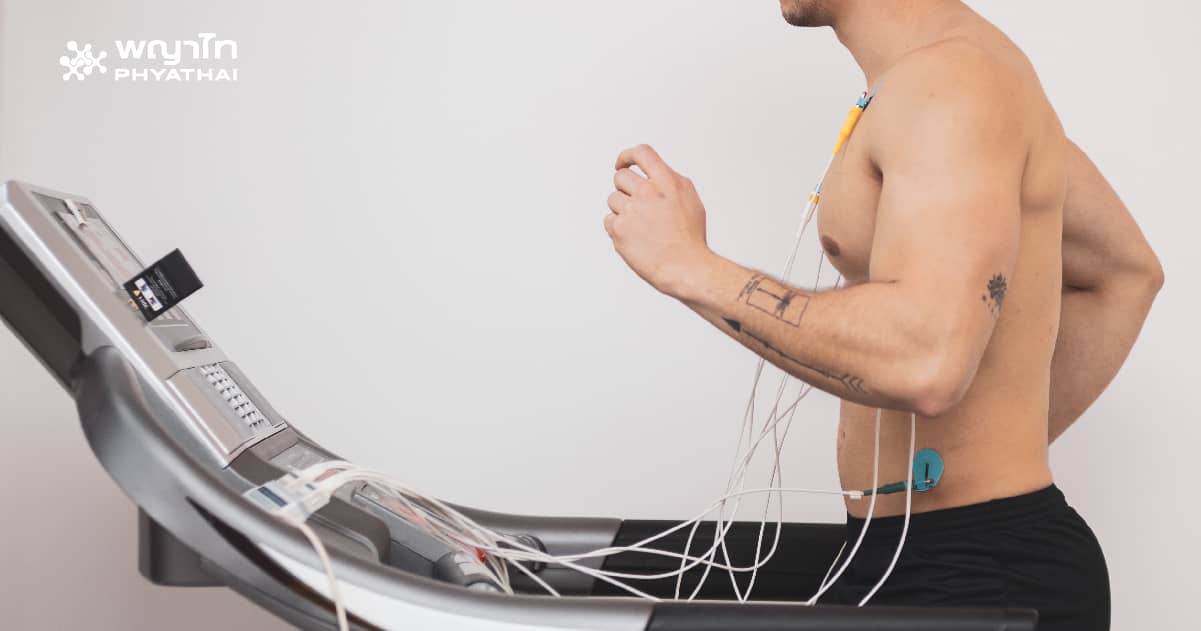
What is an Exercise Stress Test (EST)?
The Exercise Stress Test (EST) is a test that records the heart’s electrical activity while under physical stress by stimulating the heart to beat faster, similar to exercising by walking on a treadmill or cycling on a stationary bike. The test provides an electrocardiogram (ECG) graph that can be analyzed to diagnose coronary artery disease, myocardial ischemia, and various other heart-related conditions.
Who should undergo an Exercise Stress Test (EST)?
Those who should undergo an Exercise Stress Test (EST) are individuals with the following behaviors and risk factors:
- Age 40 years or older
- Experiencing chest pain or shortness of breath
- Having abnormal heart rhythms
- Having risk factors or existing vascular disease in organs other than the heart
- Having chronic conditions such as diabetes, high cholesterol, or hypertension
- Having previously received treatment for coronary artery disease
- Having a family history of heart disease or stroke
- Frequently consuming foods that are sweet, fatty, or salty
- Heavy smokers or regularly exposed to secondhand smoke
- Insufficient rest, poor sleep quality, and frequent fatigue
However, the Exercise Stress Test (EST) is not suitable for individuals with bone and joint diseases, patients with enlarged hearts, or elderly people who are unable to exercise.
Procedure for the Exercise Stress Test (EST)
The technician will attach electrodes to 6 points on the chest and 4 points on the arms and legs, totaling 10 points, and wrap a blood pressure cuff around one arm. Then, the patient will start walking slowly on a treadmill, while the doctor gradually increases the speed and incline of the treadmill. The walking phase typically lasts about 6-12 minutes, followed by a recovery stage of about 5-10 minutes, making the total test time approximately 20-30 minutes. Blood pressure will be measured periodically during the test.
During the test, if the patient experiences myocardial ischemia, changes will appear on the ECG, and some may feel chest pain or tightness. The test is supervised by a specialist doctor, ensuring safety. For patients unable to walk on a treadmill, such as the elderly, stationary cycling is usually used as an alternative.
Preparation before undergoing the Exercise Stress Test (EST)
- Avoid food and drink for at least 3 hours before the test; the meal before the test should avoid high-fat foods
- Avoid tea, coffee, and caffeinated beverages for at least 12 hours before the test
- Avoid smoking for 3-4 hours before the test
- Wear clothing and shoes suitable for exercise, either bring your own or use those provided by the hospital
- Patients taking regular medications should inform the doctor in advance, as some medications may need to be withheld, such as beta-blockers used to treat hypertension, certain arrhythmias, glaucoma, anxiety, migraine, and hyperthyroidism
- Asthma patients should bring their inhalers
- Diabetic patients should inform their diabetes doctor to adjust medications appropriately for the test day
Interpretation and evaluation of the Exercise Stress Test (EST)
The doctor will evaluate the test results from the ECG graph, which can diagnose risks and various diseases such as:
- Coronary artery disease, with good risk assessment in asymptomatic patients who have moderate or higher risk levels
- Assessment in patients with existing coronary artery disease to determine the need for further testing or treatment such as angioplasty
- Evaluation of the effectiveness and response to medication in patients with coronary artery disease
- Assessment and diagnosis of certain types of arrhythmias
- Evaluation of the heart’s maximum exercise capacity to plan or prescribe appropriate exercise intensity and type
- Assessment of maximum exercise capacity in patients recovering from acute myocardial infarction to monitor treatment outcomes and prevent overexertion