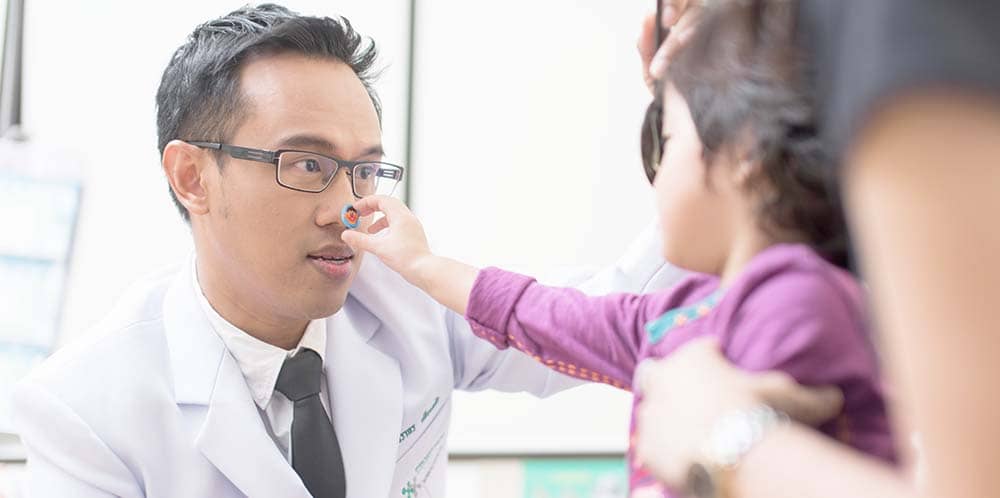
Normal Vision in Children
In young children, normal vision is farsightedness because children have smaller eyeballs and less focusing power of the cornea and lens compared to adults. This results in images forming behind the retina, or farsightedness. Farsightedness may increase until about 8 years old, after which it will decrease until reaching a normal state.
Abnormal Vision in Children
Farsightedness
As mentioned above, children have farsightedness, which differs from age-related farsightedness in adults that occurs after 40 years old. If a child’s farsightedness exceeds the normal range, it causes blurred images, especially when looking at close objects. In some cases, severe farsightedness can lead to strabismus. In some children, one eye may be more farsighted than the other, increasing the risk of amblyopia in the more farsighted eye.
Nearsightedness and Pseudomyopia
In Thai and Asian children, the incidence of nearsightedness has increased rapidly. Studies show that nearsightedness is less common in children who spend more time outdoors or outside the classroom compared to those who stay indoors more often. It is believed that prolonged near work is a contributing factor to the development of nearsightedness.
Nearsightedness in children should be carefully evaluated as it may be pseudomyopia. Children tend to focus intensely, which can cause vision measurements to show more nearsightedness than actually present, known as pseudomyopia.
Nearsightedness in children is considered a full abnormality. Children with nearsightedness often present with difficulty seeing distant objects, needing to move closer to see clearly, or squinting when trying to focus on distant objects.
Astigmatism
Astigmatism mostly results from unequal focusing power in different meridians of the cornea. Naturally, the human cornea is not perfectly round like a ball but is shaped more like a rugby ball, with different curvatures in each meridian. This causes images not to focus on a single point, resulting in blurred vision at both near and far distances.
Children with significant astigmatism that causes problems often compensate by tilting or turning their heads to find the clearest focus angle.
The three types of abnormal vision mentioned above can lead to amblyopia if one eye’s vision is worse than the other or if both eyes have very poor vision.
Vision Measurement in Children
Because children naturally tend to focus intensely, vision measurements may show more nearsightedness or less farsightedness than actually present. Therefore, it is necessary to temporarily relax or stop the child’s focusing, especially in children under 12 years old. The standard method is to use eye drops to reduce focusing, then measure vision to determine the child’s true vision. These drops are different from the pupil-dilating drops used in adults.
After the vision test, the ophthalmologist will prescribe glasses as appropriate and schedule follow-up appointments because children’s vision can change continuously. Generally, eye drops for vision measurement are used once a year until about 11 to 12 years old, when vision can be measured similarly to adults because focusing power decreases to near adult levels. At this stage, vision measurements before and after using drops usually do not differ, which is why drops are not needed for this group of children.
Preparation for Vision Testing in Children
- The child should be healthy without fever, and there should be no exams or activities requiring intense visual focus the next day because the drops will cause blurred near vision for about one day.
- Prepare sunglasses or a hat because the pupils will be slightly dilated after the test, which may cause light sensitivity for about one day.
- Apply eye drops for vision measurement every 5 to 10 minutes, 2 to 3 times in both eyes, then wait about 30 minutes before testing. The child may be fussy during the drops because they can cause stinging.
- After the vision test, the ophthalmologist will examine the retina since the pupils are sufficiently dilated for this examination.
- After the test, avoid outdoor activities, rest indoors, and avoid exposure to bright lights.
Dr. Warakorn Thiamthat
Ophthalmologist, Eye Center
Phyathai 2 Hospital
