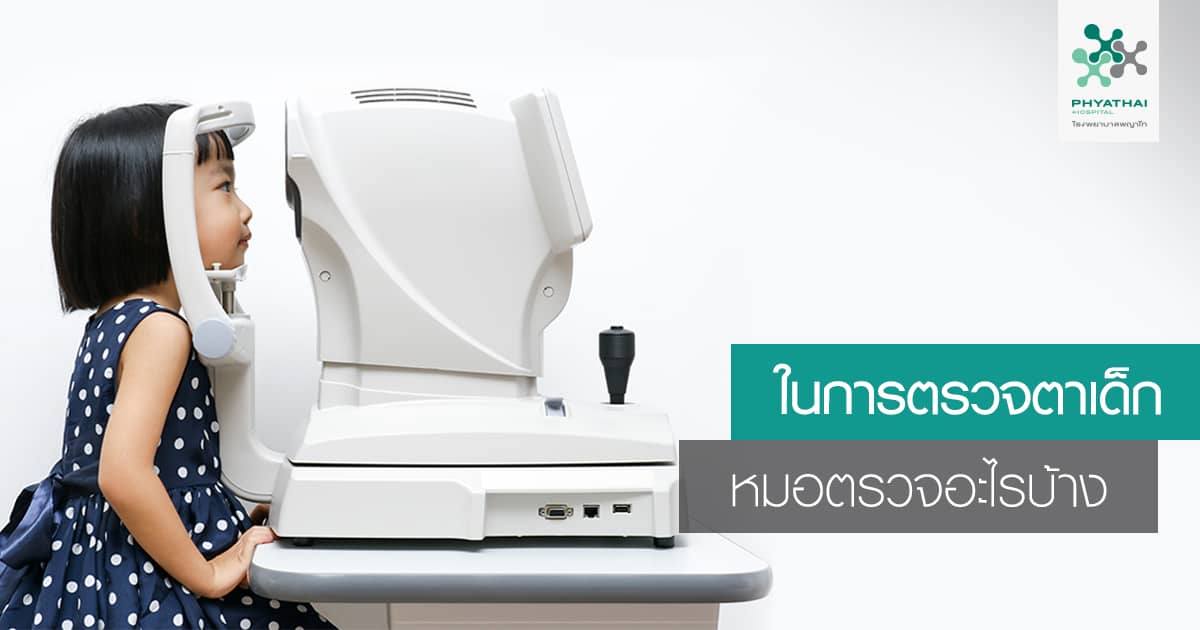
Because the eye health of your beloved child is something that parents must prioritize just as much as other organs, and during an eye examination… questions may arise about what the ophthalmologist will assess and how to prepare the child before the examination. This article has the answers…
What the ophthalmologist will assess includes…
- Vision or visual behavior
- Assessment of visual acuity, which can be evaluated using various techniques depending on the child’s cognitive function and cooperation, to assess for amblyopia or lazy eye
- Assessment of binocularity or the use of both eyes together, and stereopsis (3D vision)
- Color vision, which is done in cases at risk such as a family history of color blindness, especially in boys, to prepare the family for planning the child’s continued education
- Assessment of eye movement (extraocular movement) to detect strabismus (crossed or wandering eyes)
- Examination of the front part of the eye, including the cornea, anterior chamber, and lens using a slit lamp biomicroscope
- Assessment of refractive status and accommodative status, and retinal examination, which requires dilating eye drops for accurate evaluation, especially in children under 10 or 12 years old (cycloplegic refraction)
- Measurement of intraocular pressure in cooperative children and those at risk of pediatric glaucoma, such as children with myopia before school age, family history of glaucoma, or those with asymmetrical corneal sizes, especially if one side is larger than normal
- Assessment of visual field in children at risk of glaucoma, as screening and monitoring for children with increased intracranial pressure
- Retinal photography in cooperative children, at least to serve as a baseline for the patient
Steps of eye examination in children
The examination process, including pupil dilation, takes approximately 40-50 minutes. The effect of the dilating drops lasts about 6-12 hours depending on the medication and purpose. If the drops are used for measuring refractive error, the effect lasts about 12 hours (theoretically up to 72 hours). The child will have blurred near vision and will need reading glasses to help. There may be a stinging sensation when the drops are applied. The drops are applied 3 times every 5 minutes. The medication used specifically for measuring children’s refractive error is called 1% cyclogyl (1% cyclopentolate).
How should parents prepare the child?
It is recommended to bring sunglasses, a hat, or an umbrella to reduce light sensitivity after dilation. Results are available immediately for those who need glasses, and a prescription will be given so the patient can get glasses at their regular store. For those diagnosed with other conditions, the doctor will assess and inform the parents individually.
