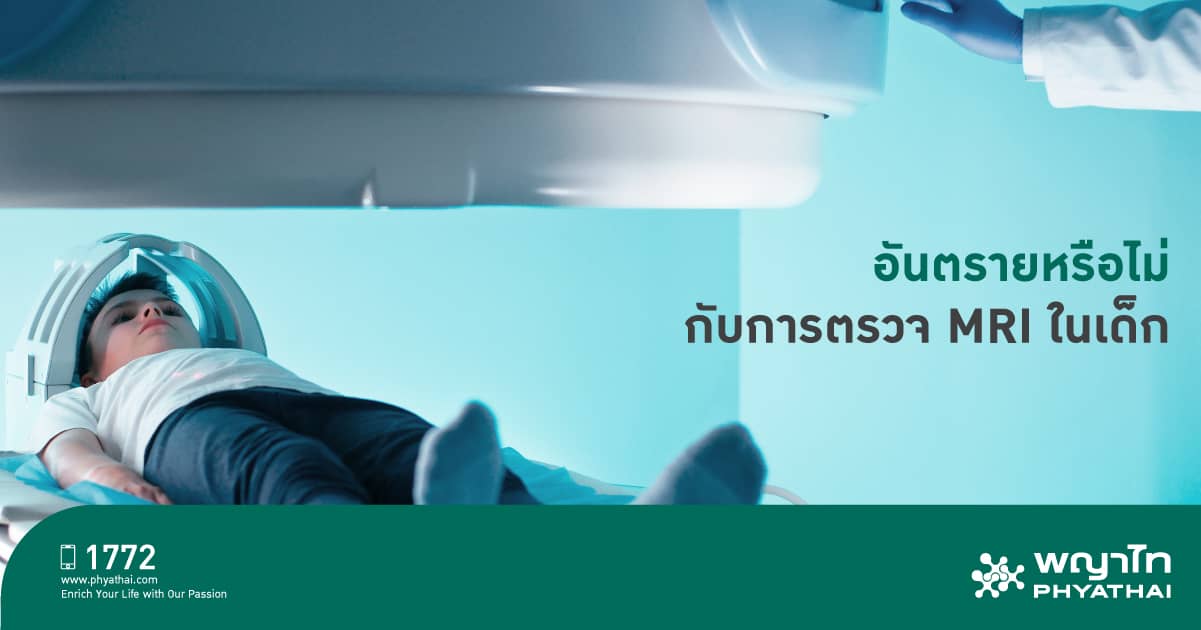
Is it really okay for a small child to undergo an MRI scan? This is often a concern for parents who fear it might be harmful to their little one. In reality, MRI scans in children are not as scary as they seem and are very important for planning treatment to keep the child safe from serious diseases that may be invisible or unclear.
What is an MRI scan?
MRI, or Magnetic Resonance Imaging, is a body scanning machine that creates realistic images using magnetic wave energy, processed by a computer. Many people mistakenly think it involves radiation risks, but in fact, it does not use radiation and has no side effects. However, MRI scans in children require special caution more than in adults, which parents should understand to make decisions about their child’s scan with greater peace of mind. The following are important points about MRI scans in children that parents should know.
How necessary is it to have an MRI scan?
An MRI scan allows doctors to see exactly which part of the body is abnormal and how it is abnormal. For example, a brain MRI clearly shows which part or area of the brain is abnormal, enabling doctors to plan accurate and targeted treatment, leading to effective results. Therefore, MRI scans are important as they directly affect treatment outcomes.
How is an MRI scan different from an EEG (electroencephalogram)?
To clearly explain the difference between an MRI and an EEG, we can compare it to repairing a television. An EEG is like using a screwdriver to find the short circuit and see where the electrical leakage is. An MRI, on the other hand, shows a clear image of the short circuit, how it looks, and how severe it is. If we skip the EEG and go straight to MRI, it’s like dismantling the TV without knowing the exact cause, which might cause damage to other parts. In brain examinations, MRI helps determine whether surgery to open the skull is needed, and if so, where and how. EEG alone cannot provide this detailed information; it only indicates whether there is an abnormality or not.
Why is MRI scanning in children more difficult than in adults?
The differences or difficulties of MRI scanning in children compared to adults can be summarized into three main points:
- Children often do not cooperate because the MRI tunnel is dark and narrow, which is scary for them. The MRI procedure takes about 45 minutes on average, making it very difficult for children to stay still voluntarily. Therefore, almost all pediatric MRI cases require general anesthesia.
- General anesthesia in children carries risks because the tunnel is dark and narrow, making it hard to clearly see if the child is asleep, lacking oxygen, or at risk of choking on saliva. Therefore, at Phyathai 3 Hospital, expert anesthesiologists closely monitor children inside the MRI tunnel to minimize the risk of complications during the scan.
- Reading MRI results in children is more difficult than in adults, especially brain MRIs, because a child’s brain is much smaller. This requires high expertise and meticulous attention, as even a slight misinterpretation can lead to incorrect treatment and harm. Therefore, Phyathai 3 Hospital assigns only specialized medical professors to read pediatric MRI results to ensure the most effective and safest treatment planning.
MRI scans are performed only when deemed necessary by a doctor to clearly diagnose the cause of a disease and plan effective treatment. Overall, if the scan is done in a standard hospital under the care of pediatric specialists, parents can be reassured that it is safe and the risks are minimized. If asked whether it is possible to avoid an MRI, the answer is that if the doctor recommends it, it should be done because it leads to the best treatment outcomes for our little ones.
Pediatric Neurologist
Child and Adolescent Health Center
Phyathai 3 Hospital
