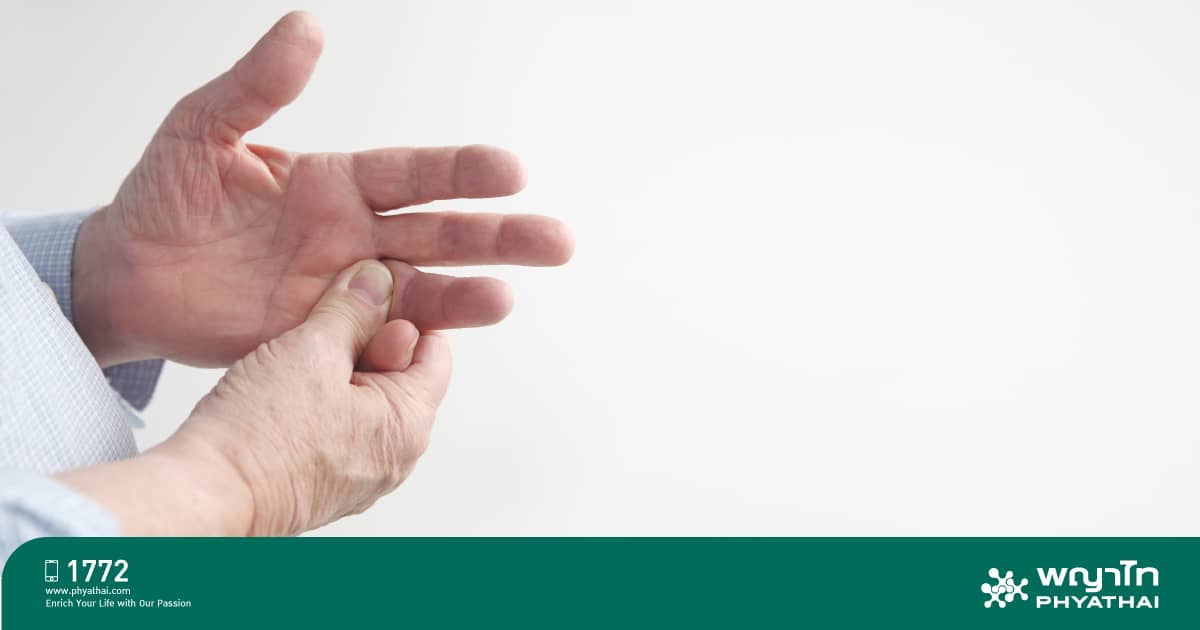
Finger joint pain, pain at the base of the finger, is one of the symptoms of “tendinitis,” caused by tendons or tissues that support movement between bones and joints being overused repeatedly at the same spot, leading to injury. If tendinitis persists for several weeks or months, this chronic tendinitis may lead to degeneration within the tendons and muscles, resulting in finger joint stiffness or “trigger finger,” one of the musculoskeletal problems that can be cured with surgery.
Compare to recognize! What stage of trigger finger is this symptom…
Stage 1: Pain at the base of the finger on the palm side. A hard lump may be felt at the base of the finger. When making a fist and opening the hand, the lump will move back and forth.
Stage 2: When using the hand to grasp objects, a catching sensation in the finger joint is felt.
Stage 3: Unable to bend the finger or make a fist so that the fingertip touches the palm, or when making a fist, unable to straighten the finger.
Stage 4: Joint stiffness occurs due to chronic tendinitis lasting several weeks or months, possibly causing scar tissue formation around the joint.
What are the risk factors for trigger finger?
- Occupational groups include cooks, farmers, industrial workers, hairdressers, or writers.
- Age It can be found in people aged 30 and above but is more common between 40-60 years old due to repetitive use causing continuous inflammation.
- Gender Studies show that women are six times more likely to have trigger finger than men.
- Underlying diseases commonly found in people with a history of diabetes or rheumatoid arthritis patients.
- Behaviors include prolonged computer typing or mouse use, frequent smartphone use especially holding the phone with one hand, or driving continuously for long periods and often gripping the steering wheel too tightly.
Did you know? You can treat trigger finger yourself from the early symptoms with these methods
- Soak in warm water to relax the tendons and muscles. It is recommended to soak from the lower arm down to the hand.
- Massage to relax tendons and muscles using oil or pain relief ointment, massaging from the lower arm muscles down to the fingertips.
- Stretch tendons and muscles by extending the arm straight forward, opening the palm at a right angle to the wrist, then using the other hand to gently press on each fingertip.
- Stretch the tendon sheath (at the base of the finger on the palm side) by holding the finger joint near the base, lifting it up, and gently pushing it toward the back of the hand.
- Stretch the muscles between the fingers by using a small rubber band looped between the fingers, then spreading the fingers apart in a V shape.
Leaving chronic trigger finger untreated for a long time, anti-inflammatory injections… are another treatment option
For those who let finger joint pain worsen until catching occurs due to increased inflammation, physical therapy alone may not be sufficient. You should consult a doctor for medication treatment such as anti-inflammatory drugs. However, if the doctor monitors symptoms for more than 6 weeks and finds no improvement, anti-inflammatory injections may be the next step. But since repeated injections (more than 3 times) can cause tendon degeneration and rupture, if the first injection does not yield good results, the doctor may consider surgery, similar to patients with stage 3 and stage 4 trigger finger.
Trigger finger surgery solves joint stiffness… with only a 2-millimeter small wound
When the doctor says the treatment for severe trigger finger is surgery, most patients may worry. But actually, with modern medical innovations, trigger finger surgery is not as scary as it seems. Although traditional open surgery leaves a small scar about 1-1.5 centimeters, the new surgical method called “trigger finger percutaneous release” reduces the wound size to only 2 millimeters. The advantage of this method is that the surgical blade is very small, causing minimal disturbance to surrounding tissues, no stitches are needed, and the wound can dry and stop bleeding within 1 day. This allows hand use 1-2 days after surgery and multiple fingers or both hands can be operated on simultaneously.
Phyathai Call Center 1772