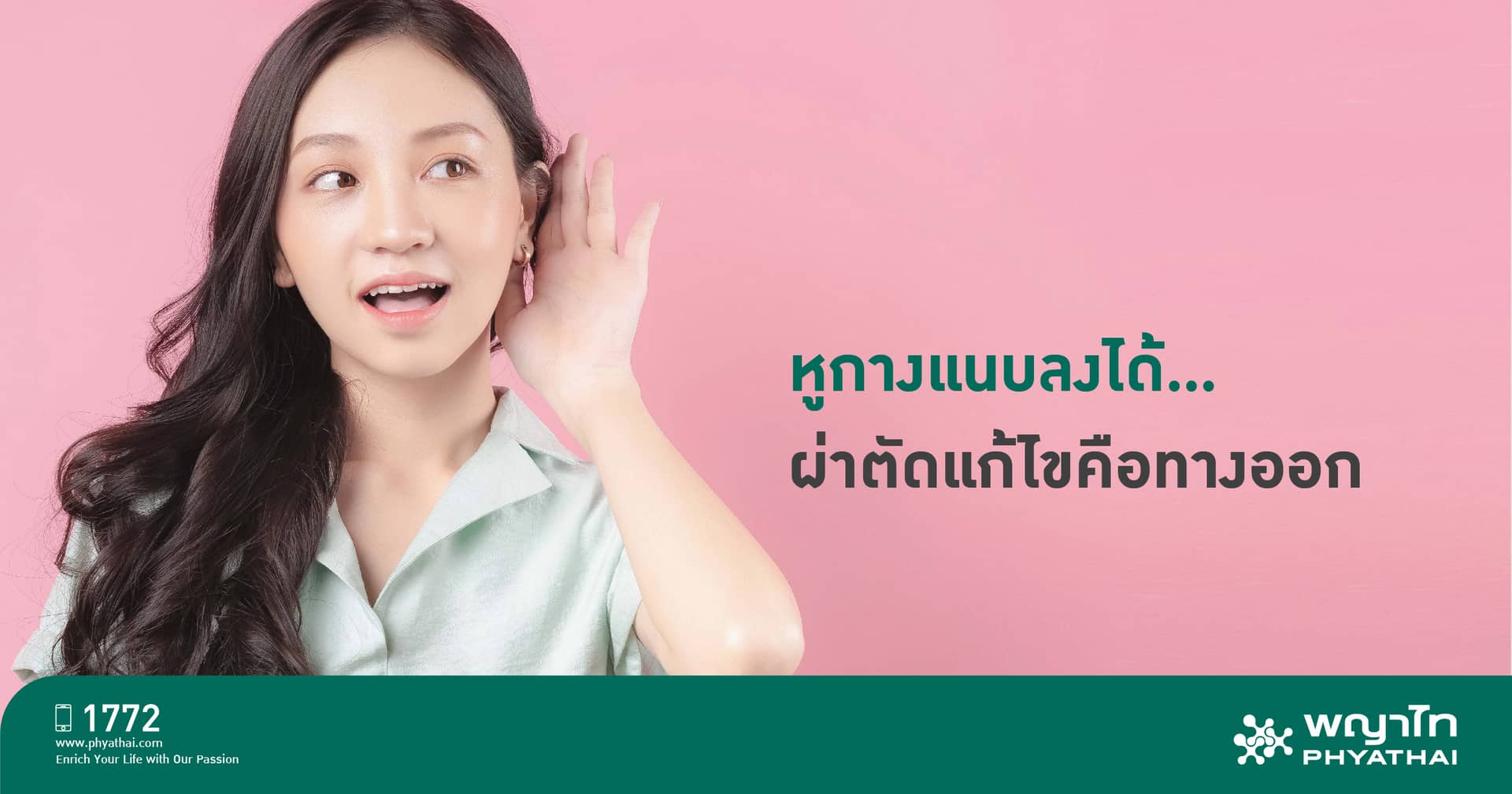
Generally, our ears are attached close to the back, at the angle approximately 25-35 degrees. In some cases, where ears protrude and are at the greater angle with the head than normal or the ears are not in beautiful shape, ears do not attach to the back as they should be. Some cases, the edges of the ears do not fold back, mostly it results from the ear cartilage not folded normally. Possibly, it become like that since childhood because of genetic.
Otoplasty surgery can start from the age of 12, however, most people start when they are adults.
Normally, otoplasty can start from the childhood at the aged 12 years old and above. At this age, children’s ears are fully grown as same size as adult’s ears.
Correcting deform ears are easy and effective with surgery which is considered as the only solution. Because those cartilages have become deformed, so it is difficult to adjust with other methods. It must be softened and reshaped. The surgery involves making an incision along the back of the ear to adjust or cut and sew the cartilage of the ear back into shape as needed.
The technique of surgery on the left and right ears may not be the same because each ear is more or less different than the other one. For ear shape correction surgery, patients do not have to worry about the scars that will be occurred as it will only be a thin line hidden behind the ear. Other people will not be able to see it from the front side.
Preparation before Otoplasty surgery
Before surgery is conducted, patients have to prepare as follows:
- Stop taking Vitamins and all types of supplements for at least one week.
- Stop smoking and drinking alcoholic beverages for at least one day.
- Anticoagulant drugs should be discontinued.
- Patients can eat normally before surgery because only anesthesia drug will be injected at the site of the surgery.
- On the surgery day, the patients should wear clothes that are easy to remove and put back on.
- On the surgery day, a relative or caregiver should come with the patient.
Procedure for Otoplasty surgery
There are few and easy steps for Otoplasty surgery, details as follows:
- The doctor will inject anesthesia at the area to be operated on.
- Open a wound behind the ear, then, cut a small amount of the skin from the back, and decorate the ear cartilage to make the patient’s ear more flexible, making it easier to fold.
- Use sutures to sew the ear down towards the back according to the treatment plan that has been determined.
- The wound is then stitched to fit the shape.
- The surgery from start to finish takes approximately 1 hours.
- Put the plaster around the ears for 2 days.
- The patient needs recovery time approximately 2 weeks, then, come back to have a stiches removed as the appointment by the doctor.
The Problems which may be occurred after the Otoplasty surgery
- There is a little blood seeping from the surgical wound, however, it will be gradually improve and heal on its own.
- There is a possibility of ear rebound.
- In case of bilateral ear surgery, when the ears are closed after the surgery, the two ears may not be the same. Therefore, it cannot guarantee that both ears will close equally or 100% the same, if one side does not bounce, they will look similar. However, most doctors will perform surgery to make both ears as close as possible.
- In case of ears that bounce back, it usually takes a long time to bounce back or the ears may bounce out only slightly. If the patient still satisfied with the appearance, there is no need for surgery to correct it. However, if it feels like it bounces back too much and becomes not beautiful, surgery can be performed to correct it again. However, in most cases, the first three months must be left to allow the wound to heal completely. Because if it is corrected immediately, there may be a problem of stitches not sticking well and there is a chance that it will bounce back as before.
Patient Self-Care after the surgery:
- Avoid getting the wound to be wet at least for two days.
- Patients may feel pain after the first two nights which the wound is closed, but they will feel better after the wound is opened. So, they can take medicine as prescribed by the doctor.
- After surgery, let patients to sleep with their head elevate to help to reduce the pain.
- Two days after surgery, the wound can be opened and can touch with water. Anyway, patients have to dry the wound and apply the medication to the wound, in the morning and the evening.
- After 2 weeks, come and have the stiches removed as scheduled by the doctor.
- After stiches removal, patient has to wear “face support” or “headband”. It should be worn since the wound was opened. It should be worn over the ears for about 3 months to prevent the ears from bouncing back. The face support or the headband can be worn as the patients’ convenience, during the day or the night. The timing is about 2-3 hours per day or as the patients’ convenience, to do without the pain. After 3 months, if the ear does not bounce back, it usually will not bounce back.
- After the surgery, avoid exercise that may impact the head for at least 1 week.
- Avoid drinking the alcoholic beverages and smoking for at least 1 week or until the wound is completely healed. If there is any abnormal bleeding, you should see the doctor immediately.
Remarks: Since the ears can bounce back, there is no guarantee of the result surgery.
Dr.Thaweesak Larpjitkusol
Plastic Surgeon,
Beauty Center, Phyathai 2 Hospital
