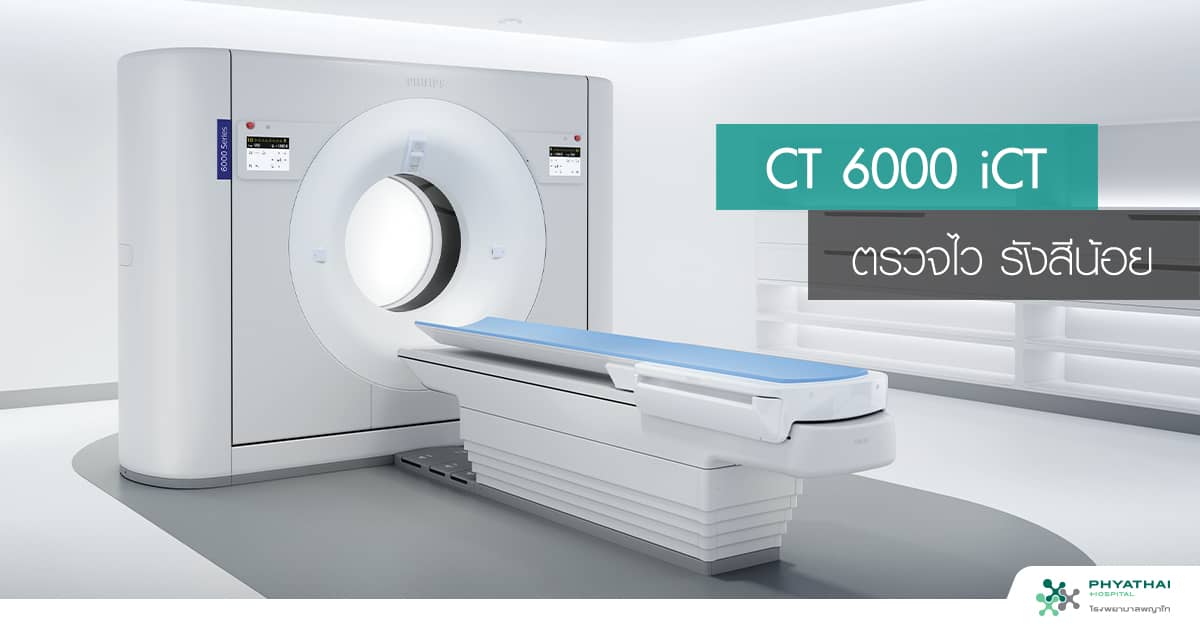
Many people already know that disease screening nowadays has increasingly allowed technology to play a greater role, enabling us to detect diseases more quickly. This also leads to more effective treatments. One of the technologies we will discuss today is the “CT SCAN”, a large tunnel that helps pinpoint hidden abnormalities in the body.
CT SCAN and MRI: Which One Suits You Best?
Actually, both CT SCAN and MRI are methods to detect lesions that cannot be seen with the naked eye. Both require the injection of contrast dye into the patient’s body to enhance image clarity, but the types of dyes used differ. So how do you know which test to choose for the best effectiveness? It depends on the symptoms presented. CT and MRI each have their advantages and disadvantages for examining different organs. For example, for bone fractures, CT is often used to assess and plan treatment. However, if the fracture is very small and cannot be seen on CT, MRI can help detect the fracture and abnormalities in the bone marrow. Nevertheless, doctors will always consider and select the most appropriate and safest tool for examination.
Better, Clearer, More Accurate with 256-Slice CT
Recently, Phyathai 3 Hospital has introduced the new CT SCAN model, CT 6000 iCT, to serve patients. This upgrade enhances CT scan safety for patients by doubling the image capture area and reducing the time per scan to just 0.27 seconds, which is twice as fast as older CT models. This reduces the examination time and the radiation exposure to patients, while improving image clarity by 36%. To put it simply, a CT scan with the old model exposes patients to radiation equivalent to about 100 chest X-rays, whereas the CT 6000 iCT exposes patients to radiation equivalent to only 3 chest X-rays.
3D Scan Results Help Precisely Plan Treatment
This new CT SCAN model displays results in 3D, helping doctors simulate treatment plans more easily before actual treatment and helping patients better understand the treatment process. Additionally, it has a processing system that reduces noise signals from metal inside the patient’s body, minimizing errors in the scan. CT SCAN relies on X-ray beams to create images, but X-rays cannot penetrate metal, so scans of organs or bones near metal implants often have less clarity and a higher chance of error. This new technology helps reduce those limitations.
New CT SCAN Model for Diagnosing Various Diseases
- Detecting brain and nervous system abnormalities: The scan takes no more than 3 seconds, reducing impact on patients with claustrophobia.
- Lung cancer screening: Mostly considered for high-risk groups such as those aged 55-74 with a history of smoking or close contact with smokers. The new model reduces radiation exposure by 39%.
- Heart and vascular abnormalities: Assesses coronary artery disease risk. It can scan coronary arteries in just 4-5 seconds, compared to the previous 11-12 seconds breath-hold scan, and the HeadToToe scan takes only about 21 seconds. The increased imaging speed also allows scanning patients with higher than normal heart rates.
- Bone examination: With 3D scan results, it is easier to assess whether surgery is needed or if a cast is sufficient for bone healing.
- Tumor detection in various systems: For disease detection, treatment evaluation, and follow-up.
Radiologist, Diagnostic Radiology Specialist
Phyathai 3 Hospital
