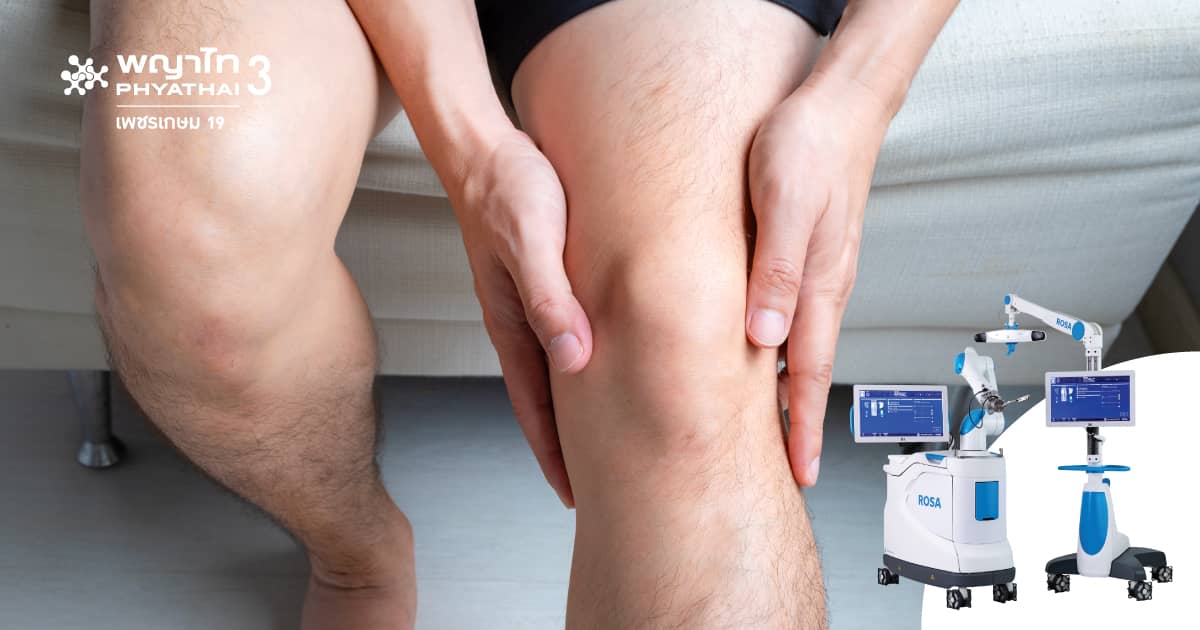
In an era where technology is advancing and playing a role in almost every moment of life, innovations in many industries have made us more comfortable, such as coffee-making robots and food-serving robots. The medical field is no exception. Not only do we have medication dispensing robots as we used to know, but today we also have “surgical robots” that help doctors perform knee joint replacement surgeries more effectively.
What is osteoarthritis of the knee?
First, let’s understand that osteoarthritis of the knee is a condition caused by the deterioration of the cartilage surface of the joint, leading to thinning and erosion of the cartilage. What was once a smooth surface becomes rough, pitted, and uneven, resulting in pain when standing, walking, bending, or straightening the knee.
Osteoarthritis of the knee has many causes, including aging, excessive body weight, heavy or improper use of the knee joint such as regularly lifting heavy objects, squatting, or kneeling frequently. It also occurs in people who have had injuries to the bones around the knee or the ligaments, which cause uneven joint surfaces or unstable knees. Chronic inflammatory joint conditions like gout or rheumatoid arthritis that are poorly controlled can also contribute, as well as genetic factors.
What type of knee pain indicates osteoarthritis?
Symptoms usually begin between the ages of 40-50. Typical pain indicating osteoarthritis mostly occurs when standing, walking, climbing stairs, or difficulty rising after sitting, especially on the floor or low chairs. In more severe cases, the knee may become deformed, swollen, inflamed, or painful even with slight movement.
Is it true that party drinkers have a higher risk of osteoarthritis?
True, because regular alcohol consumption increases the risk of avascular necrosis (bone death), which can lead to osteoarthritis more easily.
How many methods are there for screening osteoarthritis of the knee?
Screening usually starts with the doctor taking a history and performing a physical examination. If symptoms suggest osteoarthritis, an X-ray is ordered to confirm the diagnosis and determine the stage of the disease. Additionally, there is now a technology for screening using Urine CTX-II, which can detect abnormalities of osteoarthritis at the early stage when cartilage destruction begins, before progressing to full osteoarthritis.
What are the treatment options for osteoarthritis of the knee?
The best treatment for osteoarthritis is divided into two main parts:
• Patient-related: Starting with reducing controllable risk factors such as maintaining a healthy weight, avoiding heavy or improper use of the knee like lifting heavy objects or excessive exercise, especially nowadays when people exercise more but improper exercise can harm the knee. Avoid frequent squatting or kneeling. For those with inflammatory joint diseases like gout or rheumatoid arthritis, controlling inflammation well is essential to prevent cartilage damage.
• Doctor-related: Initial treatment includes pain relievers, anti-inflammatory drugs, and joint supplements. If symptoms do not improve, intra-articular injections may be considered. Currently, there are joint lubricating injections (Hyaluronic acid) to increase lubrication and reduce impact, as well as PRP (platelet-rich plasma) injections to help regenerate cartilage. These injections are typically used in mild to moderate osteoarthritis. For severe cases or when medication and injections fail to relieve symptoms and daily life is affected, knee joint replacement surgery is considered to improve quality of life.
What symptoms indicate the need for knee replacement surgery?
• Persistent knee pain requiring regular pain medication, which can harm the kidneys and stomach
• Knee instability and frequent buckling, increasing the risk of falls and fractures
• Deformed or bowed knees causing balance issues and limited movement
• Poor quality of life due to osteoarthritis, making daily activities difficult
What types of knee replacement surgery are there?
Knee replacement surgery is an excellent treatment method that relieves pain and restores quality of life. Currently, it is divided into two types:
1. Total knee replacement
This surgery replaces all parts of the knee joint and is suitable for knees with extensive damage. It not only relieves pain caused by osteoarthritis but also corrects deformities.
2. Unicompartmental knee arthroplasty
For patients with damage limited to certain areas of the knee, partial knee replacement can be performed, preserving the healthy parts of the joint. This surgery involves smaller incisions, less tissue damage, and faster recovery compared to total knee replacement.
Robotic knee surgery: a tool to increase surgical accuracy
Robotic-assisted joint replacement surgery is the latest technology that uses robots as tools to help surgeons plan and perform surgery more precisely and efficiently. Robotic knee replacement surgery does not mean the robot performs the surgery instead of the surgeon. The surgeon still plans and controls the surgery, with the robot serving as a tool to enhance surgical performance.
Advantages of robotic knee surgery
– Increased accuracy, reducing surgical errors
– Less postoperative pain due to reduced tissue dissection
– Reduced blood loss during surgery and faster recovery
– Effective correction of complex knee deformities caused by osteoarthritis
How to care for yourself after knee replacement surgery?
Knee replacement surgery is highly successful and ranks among the most satisfactory orthopedic surgeries. After surgery, pain significantly decreases, allowing patients to return to normal daily activities, climb stairs, and exercise better. However, proper care of the knee implant is important to ensure its longevity. Recommendations include:
• Maintain a healthy weight
• Exercise appropriately, avoiding high-impact activities such as running and jumping
• Avoid accidents as much as possible
With proper care, 90% of patients can use their new knee for more than 15-20 years, or for elderly patients, for the rest of their lives.


