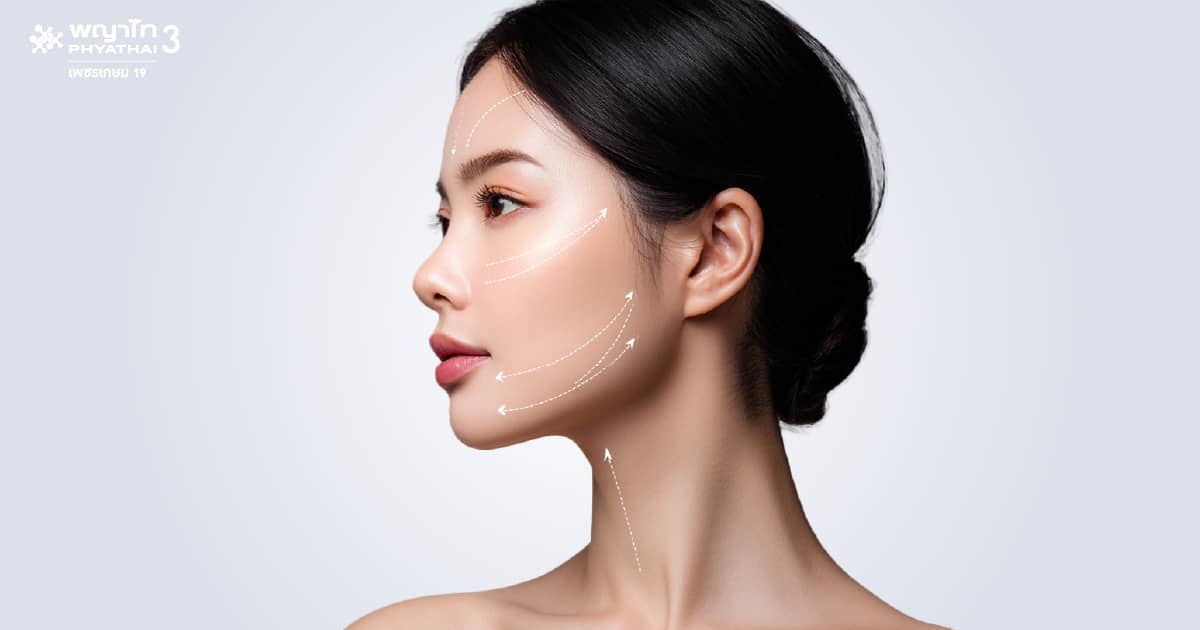
Facelift surgery, or Full Facelift, is one of the options to address facial sagging that has been proven to be the most effective currently. It can restore youthfulness, solve problems of sagging skin, drooping cheeks, less defined facial contours, deep grooves around the cheeks, sagging jowls and neck, or facial structure changes due to aging, making the face firm and smooth again. For those planning to undergo facelift surgery, this article compiles important information to help patients understand what a Full Facelift is, who it is suitable for, the process involved, and how to prepare before making a decision.
What is Facelift Surgery? Understanding Full Facelift
Facelift surgery (Facelift or Rhytidectomy) is a facial surgery aimed at correcting sagging of the skin, muscles, and underlying tissues in the face and neck area, restoring firmness and a youthful appearance that looks 10-15 years younger than the actual age.
This involves adjusting both the skin layer and the underlying tissue layer to lift and tighten, not just pulling the skin tight but repositioning the facial structure appropriately to look fresher, younger, and still natural. This differs from non-surgical lifting methods that provide temporary results but require patients to accept surgery, scars, and recovery time afterward.
What Problems Can a Full Facelift Solve?
- Drooping cheeks or sagging face
- Undefined facial contours
- Deep grooves around the cheeks and nasolabial folds
- Sagging jowls and neck
- Face looks tired or older than actual age
How Many Areas Can Be Treated with Facelift Surgery?
Facelift surgery can be performed in several areas including the forehead, brow lift, mid-face, cheeks, jawline, jowls, and neck. It is not necessary to lift all areas at once. The doctor will assess which areas are the main cause of sagging and plan the specific areas to be treated.
Who is Suitable for Facelift Surgery?
Many people think facelift surgery is only for older individuals. In fact, age is not the only determining factor. Suitable candidates must be evaluated based on their skin condition and actual problems.
Generally, those suitable for facelift surgery include:
- Individuals with obvious sagging such as drooping cheeks, undefined jawline, or sagging neck
- Those with deep nasolabial folds that cannot be corrected by non-surgical treatments or lifting devices
- People with sagging due to genetics or significant weight loss, even if they are not very old
- Those ready to undergo surgery and follow the recovery period as advised by the doctor
Most start considering surgery around 40–50 years old, but some younger individuals may also be suitable depending on skin condition and facial structure.
Who Should Not Undergo Facelift Surgery
- Individuals with severe or poorly controlled chronic diseases
- Those with significant weight fluctuations (as weight changes after surgery affect facial shape)
- People with unrealistic expectations about the results
- Those taking certain blood-thinning medications (must consult a doctor before stopping medication)
Facelift Surgery VS Lifting Devices: Which to Choose?
Currently, there are various non-surgical facial lifting technologies available such as HIFU / Ultherapy / Thermage, each using different principles, providing different results, and suitable for different groups.
- HIFU / Ultherapy (Focused Ultrasound) delivers high-frequency sound waves deep into the SMAS layer to stimulate new collagen production. It is the closest technology to surgery among non-surgical methods but has limitations in cases of severe sagging.
- Thermage (High-frequency Radiofrequency) uses heat from radiofrequency waves to stimulate collagen and tighten the upper skin layer. It is suitable for improving skin texture and mild to moderate tightening.
Comparison Table
Lifting Devices VS Facelift Surgery
| Comparison Topic | Lifting Devices | Facelift Surgery |
| Suitable Sagging Level | Mild to moderate | Moderate to severe |
| Result Characteristics | Gradual improvement (Focus on natural stimulation) |
Clearer and more lasting results (Structural correction) |
| Recovery Time | Minimal or no recovery needed | 1-2 weeks or more |
| Suitable For | Those not ready for surgery or wanting continuous skin care | Those ready for surgery and wanting targeted structural correction |
In summary, if sagging is mild, lifting devices like HIFU / Ultherapy / Thermage can be effective. But if sagging is severe and devices have limited effect, facelift surgery is a more precise option.
Which Facelift Technique to Choose? How Many Types Are There?
Facelift surgery is not a single technique. The doctor will select the method suitable for each individual based on the sagging area, degree of sagging, and skin quality.
- Skin-only Facelift is suitable for cases with mild sagging, lifting only the skin layer for tightening. It involves smaller incisions and shorter recovery but may not provide as deep results as other techniques.
- SMAS Facelift lifts the muscle tissue layer under the skin (SMAS), providing more natural and longer-lasting results than skin-only lifting.
- Deep Plane / Sub-SMAS Facelift is a deep-layer facelift suitable for cases with significant mid-face sagging, nasolabial folds, or sagging neck, as it lifts the actual structure, not just the skin, resulting in a naturally lifted appearance.
- Endoscopic Facelift (camera-assisted facelift) is suitable for brow lifts or forehead area correction, with smaller incisions in some areas.
Risks and Side Effects to Know Before Facelift Surgery
Facelift surgery requires precision. Those considering it should be aware of both benefits and limitations before deciding.
Possible Side Effects
- Swelling, bruising, and tightness after surgery, especially in the first 1-2 weeks
- Temporary numbness around the surgical area
- Scars that gradually fade over time
- Hematoma or infection (risks reduced with proper care)
- Temporary nerve weakness
- Asymmetrical results in some cases
These risks can be minimized by thorough pre-surgical evaluation, choosing the appropriate technique, performing surgery in a standard medical facility, and proper post-operative care.
How to Prepare Before Facelift Surgery?
Good preparation helps reduce risks and increase chances of good recovery. Recommended steps include:
- Provide complete medical history including chronic diseases, medications, allergies, past surgeries, and facial procedures
- Avoid medications and supplements that increase bleeding risk as advised by the doctor
- Stop smoking and alcohol before surgery as per the doctor’s instructions
- Get enough rest and plan recovery days in advance
- Arrange for someone to assist during the first 1-2 weeks after surgery
How Long is the Recovery After Facelift Surgery?
Approximate recovery time:
- First 1-2 weeks may experience the most swelling, bruising, and tightness. It is advisable to take leave or rest during this period.
- First 1-2 months swelling gradually decreases and results become clearer.
Is Hospital Stay Required for Facelift Surgery?
In some cases, the doctor may recommend an overnight hospital stay for observation, especially for general anesthesia or long surgeries, depending on the patient’s health and case complexity.
Post-Operative Care After Facelift Surgery
What to Do
- Keep the head elevated to reduce swelling
- Apply compresses and care for wounds as per doctor’s instructions
- Take all prescribed medications
- Attend all follow-up appointments
What to Avoid
- Bending the head down or strenuous activity in the early period
- Excessive facial movements
- Touching the wounds unnecessarily
Signs to Contact the Hospital Immediately
If experiencing severe pain, increased redness and swelling, fever, bleeding, or wound discharge, contact the doctor immediately.
How to Choose a Trustworthy Facelift Surgeon
Choosing the surgeon is the most important step in the entire process. Consider the following factors:
- Choose a plastic surgeon certified by the Royal College of Surgeons of Thailand or holding a board certification in plastic and reconstructive surgery
- The surgeon should have direct experience in Facelift procedures
- Provides honest information, clearly explaining benefits, limitations, and risks
- Perform surgery in a standard hospital with proper licenses, anesthesiology team, and operating rooms
Why Choose Facelift Surgery at Phyathai 3 Hospital Aesthetic Center
At Phyathai 3 Hospital Aesthetic Center, we prioritize beauty combined with safety, especially for facelift surgery which requires high precision at every step—from preoperative preparation, anesthesia, bleeding control, to postoperative care. Performing surgery in a standard hospital reduces risks and safely manages unexpected situations.
Importantly, the doctor will evaluate and plan only the necessary areas to be corrected, not lifting every point unnecessarily. The goal is a fresher, younger-looking result that still looks like yourself, under safe conditions.
Frequently Asked Questions About Facelift Surgery (FAQ)
Q: Does Facelift Surgery Hurt?
A: You will not feel pain during surgery as it is performed under general anesthesia. After surgery, you may experience tightness, mild pain, and discomfort at a tolerable level, which can be controlled with pain medication prescribed by the doctor.
Q: Can People with Chronic Diseases Undergo Surgery?
A: People with chronic diseases such as diabetes, hypertension, or heart disease may be able to undergo surgery but must be evaluated first. Diabetes can affect wound healing, high blood pressure may increase bleeding risk, and heart disease requires preoperative assessment. The doctor may coordinate with specialists as needed.
Q: Will the Scars be Visible?
A: When performed by an experienced surgeon, incisions are hidden in inconspicuous areas such as around the ears, within the hairline, and under the chin. Scars gradually fade and become almost invisible within 6-12 months.
Full Facelift Surgery Restores Youthful Radiance
Facelift surgery is a precise option for those with significant sagging who want structural correction, providing clearer and longer-lasting results than lifting devices in severe cases. However, patients must accept surgery, scars, and recovery time. The best decision starts with accurate information, direct consultation with a doctor, and thorough self-assessment of health and expectations.
If interested in consulting about facelift surgery, you can schedule an initial evaluation at the Aesthetic Surgery Center, Phyathai 3 Hospital. The medical team will plan the necessary correction areas and provide complete information before you decide.
Dr. Dulyanat Aranyapal
Specialist Surgeonin Plastic and Reconstructive Surgery
