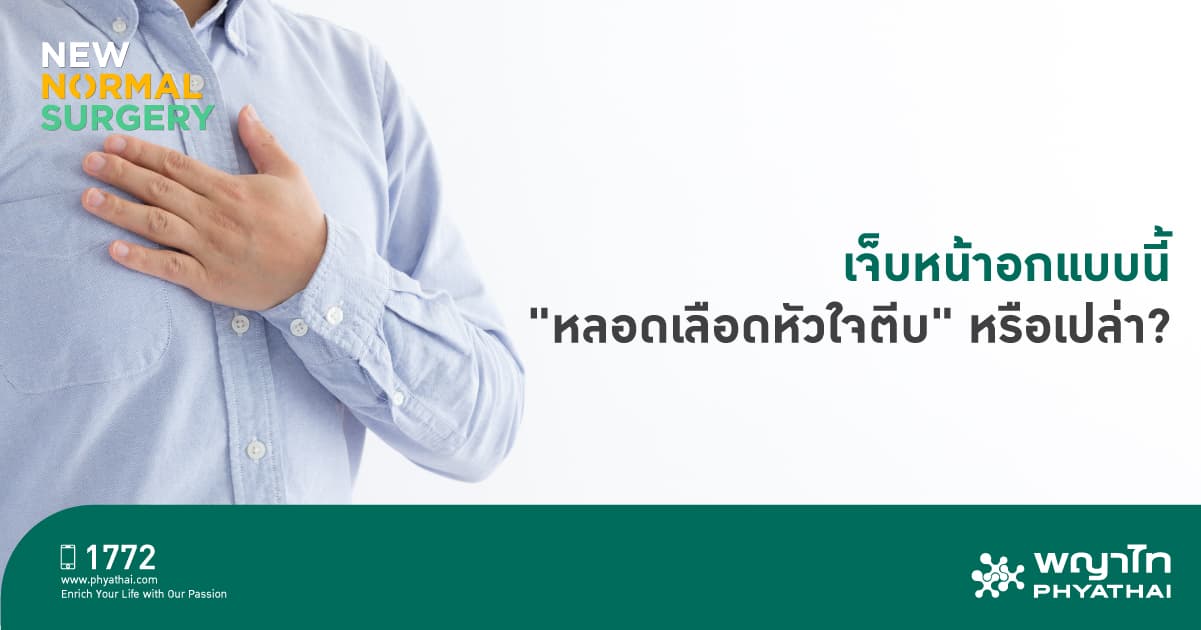
“Coronary Artery Disease” is another severe condition that can cause sudden death in patients. With the current lifestyle of people today… we find that coronary artery disease is occurring in younger individuals, including the silent nature of the disease, causing over 50% of patients to show no symptoms! Dr. Chayut Cheewapruk, a cardiology and vascular specialist at Phyathai Nawamin Hospital therefore emphasizes the importance of health check-ups because if you wait until abnormal symptoms appear to see a doctor… it might be too late for effective treatment.
Risk Factors Leading to Coronary Artery Disease
Coronary artery disease is a serious illness with an increasing number of patients. The main risk factors that increase the chance of the disease are
- Daily behaviors and lifestyle habits such as lack of exercise, high stress levels, obesity or being overweight (BMI over 23, calculated by weight [Kg] / (height [m] squared))
- Having certain underlying diseases such as diabetes, high cholesterol, high blood pressure, which should be properly treated
- Unmodifiable factors include family history of heart disease and gender, with males having the risk of ischemic heart disease about 10 years earlier than females. Men usually develop coronary artery disease after age 45, while women typically after age 55
Chest Tightness, Leg Swelling: Warning Signs of Heart Disease
More than 50% of patients with coronary artery disease have no symptoms! In cases where symptoms occur, such as chest tightness… the characteristic symptom is left-sided chest pain, a dull pressure-like pain as if something is pressing down, which may radiate to the jaw or left arm, lasting about 5-10 minutes. The pain increases with exertion and subsides with rest. Some patients may also experience other symptoms such as swelling in both legs, or needing to sit up at night to breathe due to tightness, which improves when sitting but returns when lying down. Other signs include palpitations, dizziness, frequent fainting, bluish hands or nails, coughing up blood, and abdominal swelling. These signs can also indicate heart disease.
Diagnosis of Coronary Artery Disease
If patients have indicative symptoms such as increased fatigue during work, intermittent sharp chest pain, fainting, palpitations, or frequent dizziness, they should undergo heart examinations. An electrocardiogram (EKG) is used to assess heart rhythm, detect heart enlargement, and identify signs of coronary artery disease. If abnormalities are found, further tests such as echocardiography (Echo) are performed to evaluate blood flow, heart muscle contraction, and heart valves. If suspicious signs are detected, doctors may conduct a treadmill stress test (EST). If there is a risk of artery blockage, a more precise diagnosis is necessary. Currently, computed tomography coronary angiography (CT coronary artery) is used to check for blockages in the three main coronary arteries (two on the left and one on the right). If abnormalities are found, coronary angiography (CAG) is performed to plan further treatment. Therefore, heart disease treatment depends on what the doctor finds, such as the severity of artery blockage.
Behavioral Adjustments to Prevent Coronary Artery Disease
- Control weight according to the 4 principles (4 A’s):
- A1: Avoid “Alcohol” because alcoholic beverages are high in calories, leading to excess energy intake. If not burned off, it accumulates as body fat.
- A2: Adjust “Diet” by choosing low-fat, low-salt foods (since high salt or sodium intake raises blood pressure and increases heart workload), and reduce excessive sugar intake. Typically, a meal is divided into four parts: half or two parts should be fiber-rich foods like vegetables and fruits, one-quarter should be unpolished rice such as brown rice, and one-quarter should be protein, preferably white protein like fish or chicken breast, avoiding red meat due to its high fat content.
- A3: “Exercise” with appropriate aerobic exercises involving large muscle groups such as running, jogging, or swimming at least 3 times a week for about 30 minutes each session continuously.
- A4: “Obesity” Weight loss should be appropriate by calculating BMI using the formula: weight [Kg] / (height [m] squared). If BMI is too high, reduce weight to bring BMI within 18-23, which is considered ideal.
- Reduce stress by avoiding excessive stress, not overworking, and ensuring adequate rest and sleep.
- Quit smoking because smoking is a major risk factor for ischemic heart disease.
Heart Disease… Can It Be Completely Cured?
First, we need to look at the definition of “heart disease.” In fact, heart disease includes many conditions, but generally, when people talk about heart disease, they mean coronary artery disease. Medically, heart disease includes valve disease, heart wall defects, abnormal heart muscle, or coronary artery disease.
Valve disease and heart wall defects can be completely cured with surgery. However, coronary artery disease, even after balloon angioplasty treatment, is not completely curable. Treatment can only manage symptoms and improve condition. Therefore, controlling factors such as blood pressure and lifestyle changes are necessary, including quitting smoking completely, exercising regularly, reducing stress, and maintaining BMI within the ideal range of 18-23.
Health check-ups are very important. As seen in many news reports, some people who exercise still die suddenly, and some die at their desks. This is because these people never had health check-ups. Our bodies are like cars that need regular annual inspections. If asked, “Which is more important, the car or our health?” Of course, it’s our health. Some people think they don’t need health check-ups because they have no symptoms, but if you wait until symptoms appear… it might be too late!!
