Q: What types of fixed dentures can be used to replace lost teeth?
A: There are 2 methods to replace lost teeth using fixed dentures: dental bridges and dental implants.
Dental bridges are partial fixed dentures that replace 1-2 missing teeth by making connected crowns, using the natural teeth on both sides of the gap as anchors. The natural teeth must be reduced in size to serve as the foundation for the bridge.

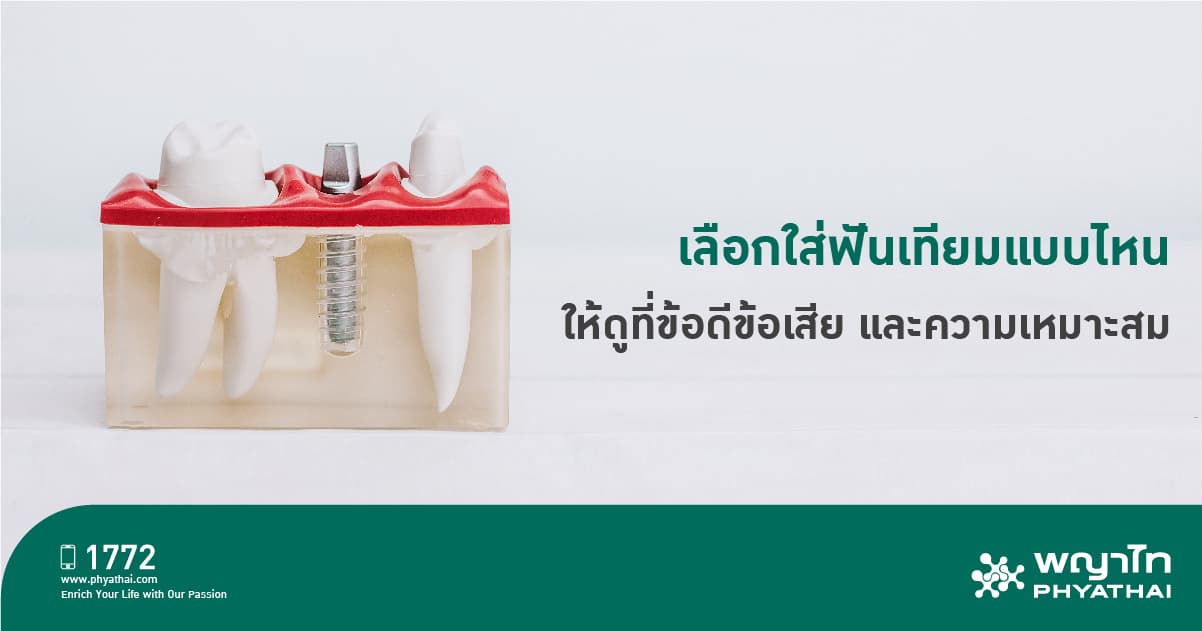
Dental implants are titanium screws shaped like tooth roots used to replace lost teeth. The implant is embedded into the bone at the site of the missing tooth, providing a replacement that functions as close to a natural tooth as possible.

Q: What are the advantages and disadvantages of dental bridges?
A: The advantages and disadvantages of replacing lost teeth with fixed dentures using dental bridges are as follows:
Advantages
- They are fixed dentures that do not need to be removed, making their function close to natural teeth.
- No surgery is required.
- Treatment time is only 1-2 weeks, which is shorter than dental implants.
- Less expensive than dental implants.
Disadvantages
- Natural teeth on both sides of the gap must be reduced, resulting in significant loss of natural tooth structure. Excessive reduction may cause tooth sensitivity or pain in the future.
- Cleaning is more difficult than natural teeth because regular dental floss cannot be used; special floss must be threaded under the bridge.
- The lifespan of the bridge depends on the strength of the anchor teeth. If the anchor teeth decay or become loose, the entire bridge must be removed and remade.
Q: In which cases are dental bridges suitable or unsuitable?
A: The suitable and unsuitable cases for dental bridges are as follows:
Suitable cases for dental bridges
- When replacing lost teeth with fixed dentures and there are natural teeth on both sides of the gap.
- Patients who have contraindications for surgery or fear surgery for implant placement.
- When the natural teeth adjacent to the gap have large restorations or crowns, making it suitable for bridges since some tooth structure is already lost, minimizing additional reduction.
Unsuitable cases for dental bridges
- When there is only one natural tooth adjacent to the gap.
- When the anchor teeth are weak, such as having large decay, significant tooth structure loss, or mobility.
- Not recommended for replacing gaps of 3 or more teeth because the anchor teeth would bear excessive load, risking loss of the anchor teeth.
It is recommended to consult a dentist for an oral examination before making any decisions.
Q: What are the steps for dental implant treatment?
A: The main steps for dental implant treatment are as follows:
- Visit a dentist for oral examination, X-rays, and 3D CT scan to plan treatment, estimate treatment duration, and assess if additional procedures like bone grafting or sinus lift are needed.
- The dentist places the dental implant screw into the patient’s mouth.
- Wait approximately 3-4 months for the implant to integrate with the bone.
- The dentist takes an impression of the implant to fabricate the implant crown.
- The crown fabrication takes about 1-2 weeks.
- The dentist places the crown on the implant for the patient.
Normally, implant treatment without bone grafting takes about 3.5-4.5 months.
Q: In which cases are dental implants suitable or unsuitable?
A: The suitable and unsuitable cases for dental implants are as follows:
Suitable cases for dental implants
- When replacing lost teeth with fixed dentures.
- Patients who can undergo surgery with no surgical contraindications and can manage surgical anxiety appropriately.
- Having sufficient bone volume at the implant site, as assessed by regular and 3D CT scans before treatment.

Unsuitable cases for dental implants
- Patients with medical conditions that are contraindications for implants, such as:
-
- Uncontrolled diabetes mellitus
- Severe osteoporosis
- Currently taking bisphosphonate drugs for osteoporosis treatment
- Undergoing cancer treatment with radiotherapy
- Heavy smoking (more than 10 cigarettes per day)
- Other life-threatening medical conditions
- Patients with fear of surgery
- Children with ongoing jaw and facial growth
It is recommended to consult a dentist for risk assessment before treatment. In some cases, consultation with the patient’s physician may be necessary.
Q: Can elderly patients receive dental implants?
A: Dental implants are designed to replace lost teeth in elderly patients. Therefore, age is not a limiting factor as long as the patient is healthy and has no medical contraindications for implant surgery.
Q: How long do dental implants last?
A: The lifespan of dental implants depends on many factors such as diet (hard foods or not), oral hygiene, presence of periodontal disease, teeth grinding, and regular dental visits, which vary by individual.
Research by R. Jung et al., 2012 found that dental implants remain functional in the mouth with an average success rate of about 96% after 10 years. Some studies report implants lasting up to 30 years.
After implant placement, regular dental check-ups every 6 months to 1 year are recommended.
Q: What are the advantages and disadvantages of dental implants?
A: The advantages and disadvantages of replacing lost teeth with fixed dentures using dental implants are as follows:
Advantages
- Function closest to natural teeth because they are fixed dentures that do not need to be removed.
- No need to reduce adjacent teeth, preserving natural tooth structure and reducing risks such as sensitivity, pain, or future root canal treatment.
- Can be cleaned with dental floss just like natural teeth.
Disadvantages
- Most expensive type of denture.
- Treatment takes a long time, about 3 months or more, because the implant needs time to integrate with the bone before the crown can be made.
- Requires surgery; patients with contraindications or fear of surgery may not be suitable.
Q: What are the components of a dental implant?
A: A dental implant consists of 4 parts:
- Implant crown is the crown placed on the abutment.
- Implant abutment is the connector between the crown and the implant.
- Abutment screw is the screw that secures the abutment to the implant (located inside the abutment).
- Dental implant is the titanium screw embedded into the bone.

Q: Is it advisable to extract a painful tooth without root canal treatment and then place an implant?
A: If the natural tooth can be preserved with sufficient tooth structure for restoration, it is recommended to consider preserving the natural tooth before extraction for implant placement, except when the painful tooth cannot be restored.
If experiencing tooth pain, patients should see a dentist to assess if the tooth can be saved. If so, root canal treatment will be performed to relieve pain, followed by restoration such as a crown or onlay to restore function.
Q: What materials are dental implants made of, and are they toxic to the body?
A: Dental implants are made from titanium, which is silver-colored, safe, and biocompatible with human tissues. Titanium implants have been used since 1965 when the first implant was placed in the human jawbone.
Currently, zirconia implants, which are white and compatible with gums and aesthetically pleasing, are increasingly used but still represent a small proportion compared to titanium implants.
Q: Why is a CT scan necessary before implant placement?
A: The main purpose of a CT scan is to assess the quantity and quality of bone in 3D at the implant site, which helps in treatment planning such as the number of implants needed, whether bone grafting or sinus lift is required.
It also allows the dentist to visualize important anatomical structures to avoid, such as nerves or sinuses, increasing patient safety.
Q: What materials are used for implant crowns?
A: Implant crowns can be made from various materials depending on function, aesthetics, and patient preference. Materials include full metal, metal-ceramic, or all-ceramic for better aesthetics. Consultation with a dentist is recommended to select the appropriate material.
Q: There are many implant brands on the market. How should one choose?
A: There are many implant brands from different countries such as Switzerland, USA, Sweden, Korea, etc. Consider product warranty, price, and design features that support different uses. Choose implants with reliable warranties, good reputation, and quality. Consult a dentist before treatment.
Q: If multiple teeth are lost, is it necessary to place implants for every missing tooth?
A: It is not necessary to place implants for every missing tooth. Fewer implants can be placed and then a bridge made on top of the implants. For example, if 3 adjacent teeth are missing, 2 implants can be placed and a 3-tooth bridge made on them. Other factors such as bone volume, occlusion, aesthetics, and hygiene must also be considered.
Although implant-supported bridges reduce costs, cleaning under the bridge can be more difficult.
Q: What happens if a tooth is extracted and no denture is placed for a long time?
A: If no denture is placed for a long time, adjacent teeth may tilt into the gap, and opposing teeth may over-erupt, narrowing the space and making denture placement difficult. Food debris can accumulate in the tilted teeth’s gaps, leading to decay.
Regarding bone, prolonged absence of an implant in the extraction site causes bone resorption and thinning, which may require bone grafting for implant placement later.
Q: Is dental implant surgery painful?
A: With modern technology, implants are much smaller (about 1 cm long) than in the past, reducing trauma and surgical wound size. Effective anesthesia controls pain well during surgery, so patients hardly feel pain during treatment.
Postoperative pain may be mild, but dentists provide effective painkillers. Some patients may not need pain medication or only one dose, depending on treatment complexity such as bone grafting.
Q: What is bone grafting? Is it necessary? Where does the bone come from?
A: Bone grafting is not necessary if there is sufficient initial bone volume. However, if teeth have been missing for a long time without implants, bone resorption occurs, reducing bone volume needed for implant stability, so bone grafting is required. Bone grafting can be done before or during implant placement. Treatment time increases by at least 6 months to allow the graft to integrate with the patient’s bone.
Bone can be taken from the patient’s own mouth or synthetic bone grafts from animals or manufactured materials. These grafts are sterilized and ground into a white sand-like powder, safe and specifically used for bone grafting.
Q: How should dental implants be cared for after placement?
A: Try to chew on both sides and avoid chewing very hard foods such as ice, nuts, or crispy pork skin. Avoid inappropriate use like biting crab shells.
Implant care includes flossing around the implant, using small interdental brushes, or water flossers depending on preference. Avoid food debris accumulation around the implant to prevent bone loss.
Regular dental check-ups every 6 months to 1 year are recommended to monitor implant condition.
Dr. Pongsarapee Kamolrungwarakul
Prosthodontics Specialist
Dental Center, Phyathai 2 Hospital
