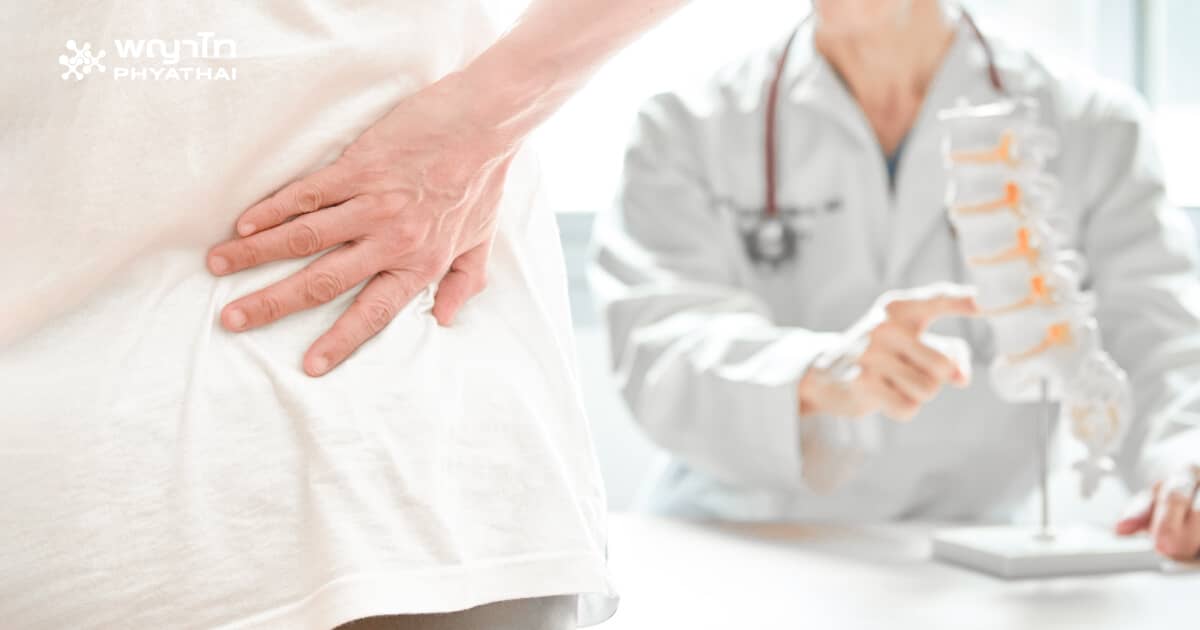
‘Hip muscles’ are the largest muscles in the body and are considered very important because they help support the body, allowing us to walk, sit, or stand steadily. They control balance and body movement and also distribute force to other muscles. If these muscles have problems, it can affect the back and knees, causing pain or injury. We can prevent these problems by doing an Orthoscanogram.
What is an Orthoscanogram?
Orthoscanogram is an X-ray imaging technique that provides a 2D image from the hip bone area down to the knee and foot. This X-ray is done in a standing position to show structural details, helping analyze problems related to bone structure, hip, bow legs, and leg length discrepancies. Sometimes these issues are not visible to the naked eye. When combined with a Whole Spine X-ray, it can help analyze office syndrome problems commonly found today.
Check body structure with Orthoscanogram and what can this program detect?
- Those who want to check for degeneration of body structures in the hip, knee, leg, and ankle areas, including those who use these parts more than average people, such as athletes or people who stand for long periods at work.
- Check for scoliosis, a condition that can be found from childhood and continue into adulthood. It often occurs without a known cause and sometimes is not clearly visible. Orthoscanogram helps clearly show which part of the bone structure has problems, allowing for proper and appropriate treatment based on the detected symptoms.
- Check for bow legs, which result from bone abnormalities and can be present from birth. The knees curve outward and the legs bend outward. Orthoscanogram helps show the degree of knee curvature to assist in correcting and adjusting the angle naturally.
- Check for leg length discrepancy, another problem found from childhood. Sometimes the difference between the left and right legs can be more than 2 centimeters. This abnormality may resolve naturally or may require surgery to promote bone growth. Orthoscanogram is a tool that helps doctors plan the correct treatment for leg length discrepancies.
- Used for pre-surgical preparation. Doctors use Orthoscanogram to evaluate before knee, hip, spine surgeries, including joint replacement or metal implant insertion, to view overall structure or adjust angles before surgery, such as for bow legs or other surgical areas.
Can people with office syndrome get an Orthoscanogram?
For those with office syndrome symptoms or long-term back pain, if initial physical therapy does not improve the condition, they can undergo an Orthoscanogram to detect additional abnormalities in the hip bone structure, which is often problematic in office syndrome patients.
How is Orthoscanogram different from CT Scan / MRI?
Orthoscanogram is an X-ray taken in a standing position to show bone structures under weight-bearing conditions, revealing problems during daily activities and helping plan proper treatment. CT Scan or MRI are done lying down, which may not clearly show issues in the back, hips, or joints because the back is extended when lying down, hiding problems that occur under weight. Orthoscanogram in a standing position is therefore more suitable to help patients live normal daily lives.
Advantages and accuracy of Orthoscanogram
The advantage of Orthoscanogram is that it reveals the condition of bones in the hip, knee, and lower joints, showing how much wear has occurred or which areas need special attention. Regarding accuracy, Orthoscanogram is medically accepted and can be used as a tool to detect abnormalities in the hip, knee, and leg bones.
Limitations of Orthoscanogram and preparation methods
Since Orthoscanogram is an X-ray taken in a standing position, the limitation is that the patient must be able to stand normally. For those who cannot stand, it is recommended to consult a doctor for alternative X-ray methods that can help with targeted treatment. There is no special preparation required for Orthoscanogram. Interested individuals can schedule an appointment for the examination as needed.
If you have chronic pain for a long time or feel abnormalities in the hip, knee, or both legs, do not ignore it. These parts bear body weight, assist in movement, and are used for walking daily. Orthoscanogram is an option that can help find the cause of these symptoms and can be used for preventive checks without waiting for health problems to occur.
