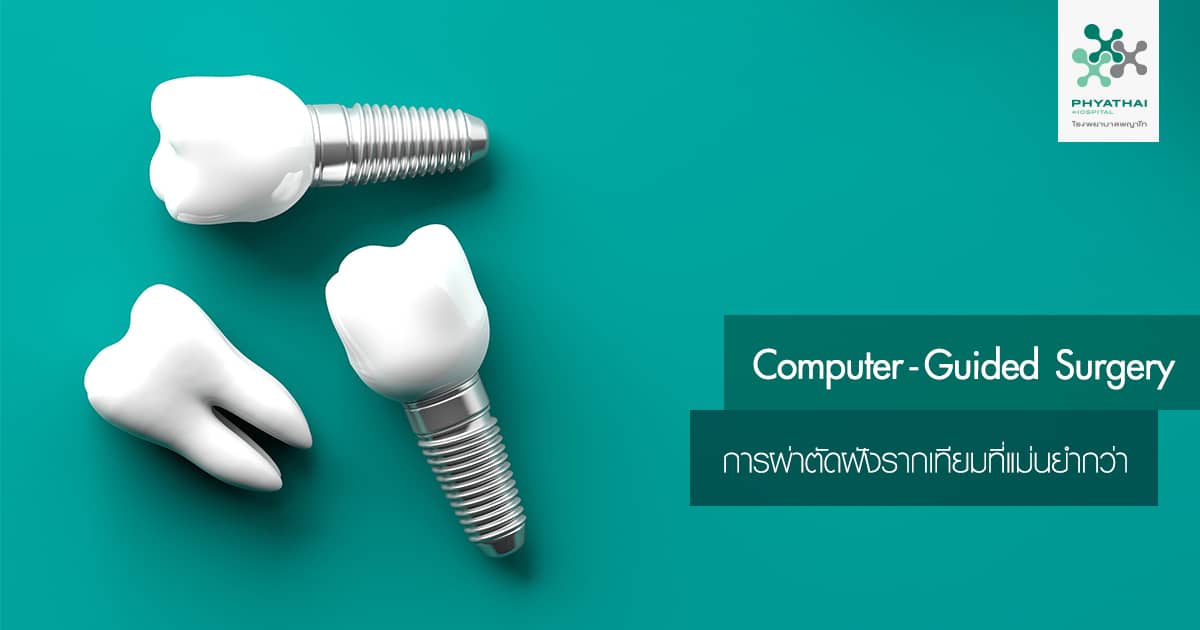
Dental implants are an effective method to treat tooth loss for patients. They can replace lost teeth and restore function close to natural teeth, making it an increasingly popular option among patients. However, the implant surgery procedure requires both expertise and skill from the dentist to achieve the most accurate and appropriate implant placement. Nowadays, Computer Guided Implant Surgery technology is used to assist in implant placement, allowing dentists to determine the implant position more precisely and efficiently. This technology also helps reduce the size of the incision, minimize post-surgical pain, and shorten the surgery time.
What is Computer Guided Implant Surgery?
Computer Guided Implant Surgery is the planning of implant placement using computer software before the surgery. During the planning stage, it is combined with 3D radiographic images (Cone – Beam CT) to find the most suitable position and size of the implant without affecting important oral structures that could cause harm, such as nerves or the maxillary sinus, etc. The 3D X-ray allows clear and complete visualization of the internal oral structures. Once the implant position is determined, the 3D image is used to print a positioning device for implant placement, which is then used during the surgery.
How is this technique “different” from conventional implant surgery?
The effectiveness of conventional implant surgery largely depends on the experience and skill of the dentist, as the dentist’s hands are the key factor in determining the implant placement. Using Computer-guided surgery to assist in implant placement helps reduce errors caused by the dentist, resulting in greater accuracy and efficiency.
Steps in Computer-guided surgery
- The patient must be evaluated by the dentist to determine if they are suitable for implant placement, whether they have any underlying conditions that contraindicate implants, and how many implant positions are needed.
- The dentist will take an impression or use an intraoral scanner to obtain a 3D image and store the patient’s oral data digitally. This data, combined with CT scan information, is integrated into computer software to design the correct and appropriate implant positions for each patient.
- After determining the size and position of the implants, the dentist will design the positioning device for the implants.
- The dentist then sends the data to a dental laboratory to print the implant positioning device, which is then used during surgery.
- On the day of surgery, the dentist administers local anesthesia to open the gums for implant placement and places the implants according to the planned positions using the positioning device.
- After implant placement, the healing period depends on the patient’s bone. For the upper jaw, it takes about 4 months, and for the lower jaw, about 3 months, to allow the bone to integrate directly with the implant. Afterward, when the patient returns to the dentist, an impression is taken to fabricate the crown on the implant, which takes about 1-2 weeks to produce before fitting it in the patient’s mouth. The entire process takes approximately 4-5 months to restore the missing teeth and return to normal function.
Advantages of using the computer-guided implant system
- Allows precise planning of implant placement
- Reduces errors in implant placement
- Shortens the implant surgery time
- Helps reduce incision size and patient pain
- Reduces recovery time
Disadvantages of using the computer-guided implant system
- This technique has limitations for patients with limited mouth opening, as special equipment is required for implant placement.
- Costs are higher compared to conventional implant surgery.
Dr. Pongsarapee Kamolrungwarakul
Prosthodontics Specialist
Dental Center, Phyathai 2 Hospital
