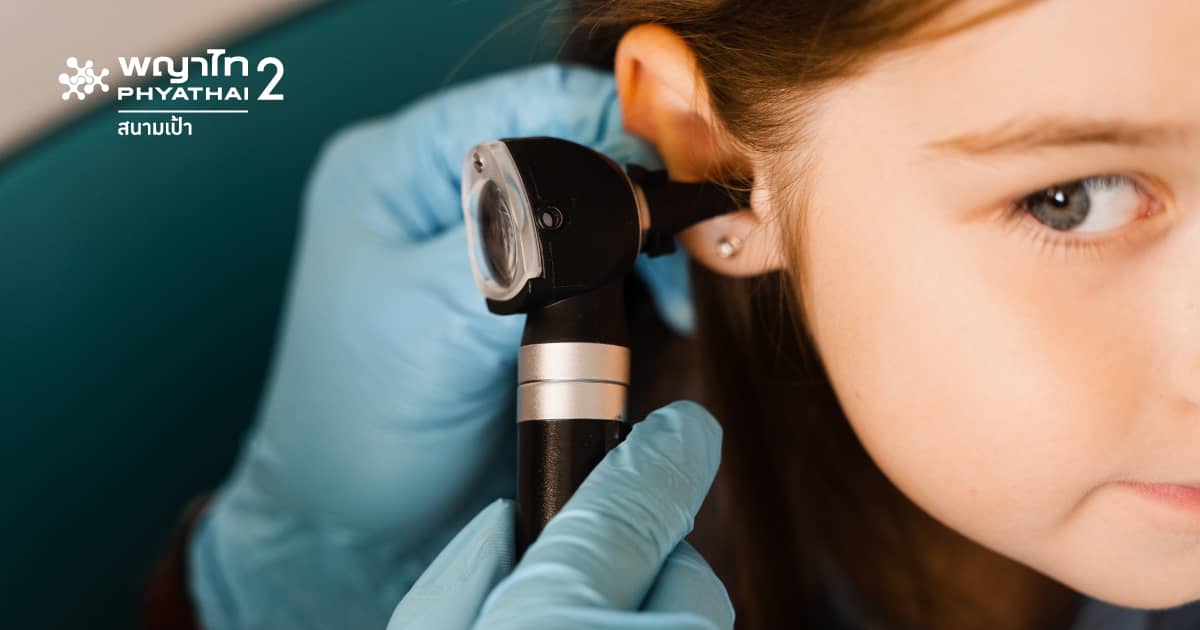
Hearing loss in children occurs more often than most people think. About 4 in 1,000 children are born with hearing loss, and by the age of 12, about 20% of children will have hearing loss.
Every development starts from clear sounds because the sounds heard lead to learning and communication, which are the essential foundations of various developmental aspects in children
Risk factors affecting hearing loss in children include a family history of deafness or unclear speech, maternal infections during pregnancy, premature birth, low birth weight, jaundice, certain infections related to the ear, use of ototoxic drugs, etc.
Signs Indicating Hearing Loss
In infants
- Does not respond to sounds, such as not startling or turning toward sounds
- Does not look toward or turn to the direction of sounds
- Does not babble or imitate sounds
In school-age children
- Does not follow instructions
- Repeats questions or needs things repeated
- Easily frustrated or has difficulty communicating
- Speaks loudly
- Needs to increase the volume of the TV or phone
- Delayed language and communication development
- Experiences learning difficulties or falls behind in school
Hearing loss screening in children is extremely important to enable timely diagnosis and treatment, which positively affects language development and other aspects of the child’s growth.
Hearing Assessment
1. Pure-tone Testing
- Assessment of hearing ability by determining the softest sound level at each frequency Pure-tone Testing which uses two types of sound conduction
- Air Conduction Testing: sound conduction through air via headphones performed in a soundproof room using headphones
- Bone Conduction Testing: sound conduction through bone involves attaching a small device behind the ear or on the forehead to test hearing
2. Speech Testing
- This test is performed alongside Pure-tone Testing to assess hearing ability and speech understanding at the detected hearing levels
3. Tests of Middle Ear
- Measures the movement of the eardrum and middle ear in response to air pressure and loud sounds, such as eardrum perforation, fluid or pus in the middle ear, middle ear infection, or malfunction of the pressure equalization tube in the middle ear
4. Auditory Brainstem Response (ABR) Testing
- This evaluates the nerve pathway between the inner ear and the brain. The test involves placing soft foam earphones into the ear canal and attaching electrodes on the forehead, behind the ears, or on both earlobes. The electrodes record brainwave responses to the test sounds, which are then interpreted by a computer. This test is used for children who cannot undergo Pure-tone Testing or who fail the Otoacoustic Emissions Test (OAE).
5. Otoacoustic Emissions Test (OAE)
- This test assesses the function of the inner ear by measuring the sound emissions from the hair cells inside the cochlea. A soft rubber-tipped probe is placed in the ear canal, which sends signals and measures the reflected sounds. The hair cells vibrate when sound waves hit them. In individuals with hearing loss, the hair cells do not function properly, and the results are displayed on the testing device screen.
Hearing loss in children and adolescents affects development
Screening to detect signs and address problems early is essential to prevent hearing loss
Do not wait for the “sound” to disappear from your child’s development
If you notice behaviors in your child that may indicate hearing problems, such as not responding to sounds, delayed speech, or learning difficulties, it is recommended to promptly seek evaluation by a specialist. Phyathai Hospital 2 has a team of otolaryngology specialists and modern diagnostic equipment to provide precise care for your child from the very beginning.
Because every sound is the beginning of important development, do not let silence become an obstacle to the future.
