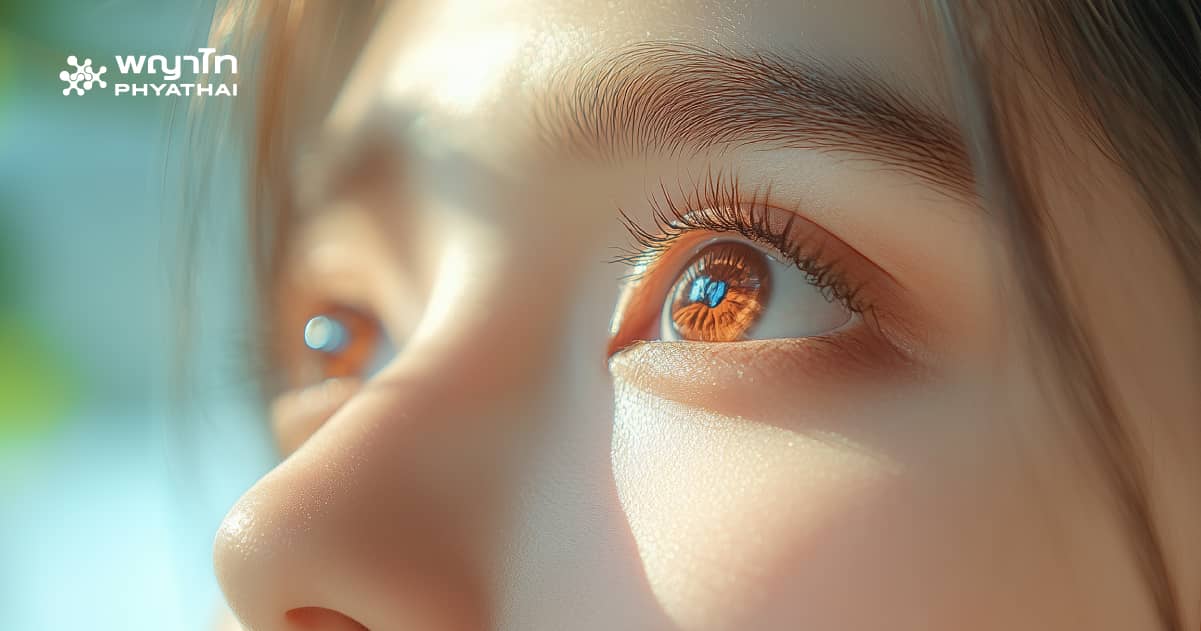
At the end of last year, there was shocking news from China about a Chinese woman who had to see a doctor due to eye inflammation caused by a bacterial infection from having a large accumulation of “eyelash mites”. This alarmed health-conscious people like us. So, what exactly are eyelash mites? Let’s hear the explanation from Assistant Professor Dr. Chanthana Sakunramrung, an ophthalmologist at the Eye Disease Clinic, Phyathai 3 Hospital, who explains about this organism.
“Eyelash Mites” – Organisms that live on our faces
Dr. Chanthana explains that eyelash mites were discovered over 150 years ago. They are a type of mite with 65 species, but only 2 species live on the human body: Demodex folliculorum and Demodex brevis. Both are collectively called “eyelash mites” (Eyelash Mites). Eyelash mites belong to a different order than dust mites. One type lives at the hair roots and hair follicles, while the other lives in the sebaceous glands attached to the hair follicles. Common areas where they are found include the face, hair, forehead, nose, and oily areas such as the chest hair of men.
Meanwhile, on our eyelids, there are both eyelashes and oil glands that produce oil along the eyelash shaft. The mites at the base of the eyelashes feed on hair cells, while those at the oil glands feed on the oil. We all have these eyelash mites without them causing problems or directly causing disease. When we shower and wash our hair, some mites fall off and die within 2-3 hours, except those clinging to towels or entering oily creams, which can live a bit longer.
Living in harmony but can also cause harm
Dr. Chanthana says that from the perspective of ophthalmologists or dermatologists, eyelash mites do not cause problems under normal conditions. However, during adolescence when acne begins, sex hormones cause the oil glands to enlarge, and eyelash mites may increase in number due to abundant food. This can lead to bacterial contamination, causing inflammatory acne. If the acne is treated and cleared, the number of eyelash mites can decrease.
Additionally, in some patients with weakened immune systems or elderly people whose oil glands are clogged causing oil buildup, inflammation can be triggered. The Demodex mites increase in number, especially those at the base of the eyelashes, producing white cell sheaths resembling dandruff on the eyelashes, causing eyelid inflammation, swelling, redness, and sometimes bacterial infection leading to eye infection, redness, and tearing. Treatment involves suppressing oil production.
Who is at risk of infection from “eyelash mites”
- People with lowered immunity, commonly due to stress
- Elderly people, especially men aged 70-80 years, because oil glands produce more oil and immunity decreases
- People with chronic illness, poor health, or underlying diseases such as diabetes
- People with naturally oily skin producing excessive oil
- People beginning to have acne may have skin infections
- People with chronic infectious diseases such as AIDS are also susceptible to infection
Avoid infection easily by doing these things
For general eye health care, Dr. Chanthana recommends washing hands thoroughly before touching the eyes. Other methods include:
- Washing pillowcases or bed sheets more frequently, about once every 2 weeks; discard if old
- Avoid sharing cosmetics with others to prevent cross-infection; if you have had eye inflammation and recovered, replace all cosmetics
- If you have inflammatory acne on the chest, prevent it by showering daily to wash off oil residues on the body
- Always shower after exercising
- Scrub off dead skin cells when showering to reduce microbes
- Use oil-free lotions or sunscreens to prevent feeding microbes
If infected, how to treat
Dr. Chanthana explains that treatment takes quite a long time, following the 2-3 week life cycle of eyelash mites. It takes about 1 month to eliminate mites at the base of the eyelashes. In the past, baby shampoo was used to wash and scrub the eyelash base daily until clean, but now there are special eyelash shampoos. Additionally, oral medications may be used to reduce oil production on the eyelids. If there is accompanying eye inflammation, antibiotics may be prescribed. If the affected area is the scalp, shampoos to reduce oil production are used.
Dr. Chanthana concludes that it is not necessary to use mite-killing medication because it is impossible to kill all mites. They are organisms that live with us symbiotically. We just need to keep our bodies healthy and not worry or be overly alarmed about having these mites. Medically, there is no fear. Treatment focuses on reducing inflammation and maintaining cleanliness to reduce the number of eyelash mites.
Assistant Professor Dr. Chanthana Sakunramrung
Ophthalmologist, Eye Disease Clinic
Phyathai 3 Hospital
