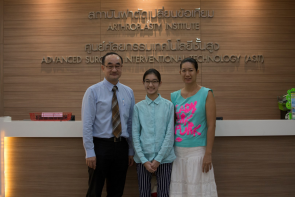

Many times what we see may not be as we think. This wonderful young girl is no exception. Miss Wiwarin Sulanchupakorn, 12 years old (Nong Plearn), is cute, cheerful, and determined, especially in the sport of bridge. She also has an interesting perspective. But little did anyone know that sometimes she experiences back pain due to scoliosis. Although it is not a frightening disease, it can affect daily life and may worsen. Today, Nong Plearn and her mother will share their experience of treatment before and after scoliosis surgery.
Q: How was the initial care and treatment?
Nong Plearn: My mother took me to see the doctor. The treatment started with wearing a brace. The doctor advised me to wear it all the time, but sometimes I got bored because it was hot and uncomfortable. Still, I wore it, although not always for the full duration prescribed by the doctor.
Nong Plearn’s mother: When she was very young, around 3-4 years old, there was no visible change. We paid special attention because her father also had scoliosis. When Nong Plearn was about 8 years old, we found out she had scoliosis by testing her ourselves, asking her to bend and touch her toes. After that, we took her to see a doctor at a government hospital, where the doctor prescribed a brace and scheduled regular follow-ups. During that time, we consulted several doctors to find the best option, but her condition did not improve and worsened. In Nong Plearn’s case, surgery was eventually necessary. We researched many specialists, and one of the names we had was Dr. Sombat Kunakornsawat, a spine surgeon at the Musculoskeletal Center, Phyathai 3 Hospital.
Q: Did the symptoms affect daily life?
Nong Plearn: For everyday life, it didn’t affect me much. The only issue was back pain when the scoliosis worsened. Even when resting, I felt pain, but stretching helped a little. My mother bought a pull-up bar for me, which helped for a short time. Hanging on it felt good for about 5 minutes, but then the pain would return.
Q: How did you decide on the surgeon, and how did Nong Plearn feel about the surgery?
Nong Plearn’s mother: The decision to choose Dr. Sombat Kunakornsawat for the surgery was based not only on recommendations from friends or the doctor’s expertise but also on direct consultation with him. This confirmed that he was the right doctor because he took time to talk patiently and explained the procedure in detail. We planned the surgery then and waited about 5 months to schedule it during the long school break so Nong Plearn would have enough time to recover.
Nong Plearn: When I first found out I needed surgery, I cried. But as time passed, I stopped thinking about it. When the surgery date was set, I wasn’t scared because I thought, if I have to do it, just do it. I was very tired of the pain. Also, before the surgery, I had to prepare for the 32nd National Youth Bridge Championship (where I won a silver medal in mixed team bridge), so I didn’t have time to think about the surgery. The day after the competition, I had the surgery immediately. At the time of this interview, I was only 3 days post-op, so physical changes were not very noticeable yet. However, the X-ray results were clear: before surgery, my spine was severely curved, almost like an S shape, but after surgery, it was much straighter. The surgeon was very friendly, took time to talk, understood my feelings, and was kind and not strict.
Q: What message would you like to share with other families?
Nong Plearn’s mother: I want every family to observe their children for signs of scoliosis so they can seek treatment early if detected. For families with children who have scoliosis, don’t neglect it, but don’t panic either. For me, it’s not a serious disease, but surgery carries risks, so it’s important to choose a specialist. Dr. Sombat Kunakornsawat is very skilled in this surgery. For care, children should exercise regularly in suitable sports with knowledgeable physical trainers to ensure the exercise is truly beneficial. After surgery, exercise should be stopped, and the child should strictly follow the doctor’s instructions.
Doctor’s Statement
 |
Dr. Sombat Kunakornsawat, spine surgeon, Musculoskeletal Center, Phyathai 3 Hospital, the surgeon for Miss Wiwarin Sulanchupakorn (Nong Plearn), has scoliosis of unknown cause, which accounts for about 80% of cases. Her spinal curvature is about 90 degrees Celsius, causing an outward appearance of leaning, raised shoulder, and one protruding scapula. If left untreated, the curvature will worsen as she is still growing. The treated scoliosis angle is between 40-45 degrees Celsius. In her case, surgery is indicated to prevent further curvature. The surgery aims to restore balance to the body. The spine is like a bonsai tree that we want to shape. Our surgery involves cutting, bending, and using screws and hooks to hold and correct the spine as much as possible. With advances in surgical technology, the materials used are strong, making post-op care easier. Nong Plearn can move and perform daily activities with the exception of bending, lifting heavy objects during the first 3 months. After that, she can live normally. |
Scoliosis generally occurs in two types: idiopathic scoliosis, which accounts for 80%, and scoliosis with known causes, about 20%. The latter includes congenital scoliosis, neuromuscular scoliosis, or scoliosis associated with spinal tumors. Diagnosis of the type can be confirmed by MRI.
For patients diagnosed with mild curvature, treatment with a brace can prevent worsening. The key indication for bracing is if the curvature continues to worsen despite wearing the brace, indicating the disease progression will not stop, and surgery is required.
“Surgical treatment always involves providing patients with complete information, including possible complications. Although the risk of leg weakness after scoliosis surgery is less than 1%, patients must be informed in detail. Modern scoliosis surgery is quite safe due to advanced medical technology. An important tool used during surgery is the nerve monitoring device, which alerts the surgeon if nerves are stretched excessively during the procedure.”
The devices used to hold or correct the spine are made of strong titanium material that remains in the body permanently, so there is no need for a second surgery to remove them, reducing patient concerns.
If scoliosis is left untreated, it can cause long-term problems depending on the affected spinal region. For example, thoracic scoliosis over 60 degrees can affect lung function, causing children to tire more easily during sports. If untreated, the curvature will worsen continuously and affect breathing. Lumbar scoliosis can cause back pain, and as the patient ages, the back will become more crooked and visibly tilted.

Regarding scoliosis in children, from my personal experience, most parents worry about surgery and delay treatment, causing the curvature to worsen and making corrective surgery more difficult. Therefore, early diagnosis and prompt treatment lead to better outcomes.
Musculoskeletal Center, Phyathai 3 Hospital, Tel. 02-467-1111 ext. 3100 and 3112