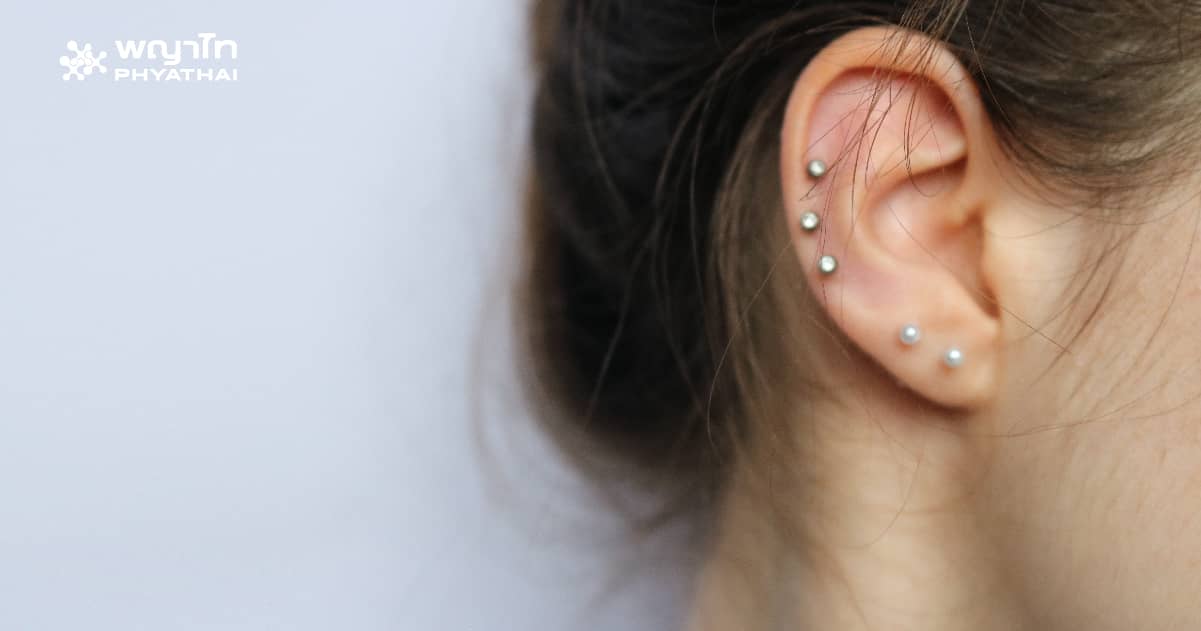
Currently, enhancing one’s appearance to look beautiful, outstanding, and boost self-confidence is something that both men and women always care about and prioritize. “Ear piercing” to wear jewelry or pierce the earlobe is also a popular fashion trend.
Wounds from ear piercing must be cautious of keloids
Did you know? Ear piercing is one of the processes that creates wounds on the ear, which if not properly cared for, can lead to “ear keloid disease”. This not only makes the ear look unattractive but can be severe enough to deform the ear. Therefore, to ensure everyone’s ear piercing goes smoothly and beautifully, getting to know ear keloid disease is something that should not be overlooked.
What is a keloid and why does it occur on the ear?
“Keloid” is a type of scar that is raised and can grow larger. It results from an abnormality of raised scars. Keloids differ from normal scars in that the scar is more raised and can expand beyond the original wound boundary. For example, a 1 cm cut wound, if it is a normal scar, will only have a raised scar of 1 cm in that area. But if it is a keloid, the scar will grow larger than 1 cm. If left untreated, it will continue to expand. Generally, keloids can occur anywhere on the body where there is a wound, but they are most commonly found on the chest, shoulders, upper back, as well as the ears and areas of frequent movement such as joints.
Who should be cautious? At risk of ear damage from keloids?
Keloids are a scar abnormality that anyone, regardless of gender or age, can develop. However, they are more common in people with darker skin, colored skin, or African descent, who have a risk of keloids up to 5 times higher than white people. Keloids are also more frequently found in teenagers than adults or the elderly because teenagers’ bodies are still growing. If they get ear piercings, ear gauges, or wounds and do not care for them properly, they are at higher risk of developing ear keloids and keloids on other scars. Additionally, pregnant women should be cautious about scar formation as they are at higher risk than normal people. Keloids can also be inherited genetically!
How dangerous is it to have ear keloids?
Whether it is ear keloids or keloids in other parts of the body, the main severity is mostly related to aesthetic impact. The worst case for ear keloids is that if left untreated for a long time, it can deform the ear because keloids can continuously grow without limits. They can also cause itching, and if scratched until wounded, infections may occur and become dangerous. However, ear keloids do not affect hearing; those affected will still have normal hearing ability like others.
Is it just ear keloids or ear cancer?
Normally, ear keloids can be identified by the naked eye. Keloids are not tumors; when touched, they feel soft and elastic like an eraser, and the skin over the raised scar is smooth. If it is ear cancer, the wound will be painful, and the tumor grows faster than a keloid. Keloids gradually enlarge within 1-3 months after the wound occurs, but ear cancer tumors grow rapidly within 1 week and are clearly visible. The wound may break open on its own without scratching, there is no itching, but there is pain. Lastly, ear cancer is usually found in the elderly, unlike keloids which are mostly found in teenagers.
How to treat ear keloids?
The treatment approach for ear keloids depends mainly on the size of the keloid. The treatment methods are as follows:
-
Keloids smaller than 1 cm
Treatment involves steroid injections to reduce the keloid size. The doctor will schedule monthly steroid injections until the scar shrinks. The steroid injection method for ear keloids is intralesional, meaning the injection is directly into the keloid mass, not into the bloodstream.
-
Keloids larger than 1 cm
Treatment involves surgery combined with steroid use. Generally, doctors do not recommend surgery alone because it has a high chance of recurrence since surgery creates a new wound, which can cause keloids. Therefore, steroid injections are necessary to inhibit scar growth, usually administered after surgery.
Surgery involves lifting the ear skin to preserve the ear shape, then removing only the keloid mass, closing the wound tightly, and then injecting steroids on the day of stitch removal. In some cases with a higher risk of keloid recurrence, doctors may combine surgery with radiation therapy. Radiation acts similarly to chemotherapy by helping inhibit cell proliferation, reducing the chance of keloid recurrence. Additionally, the drug “Mitomycin” may also be used to prevent recurrence, but this is considered on a case-by-case basis.
How to protect yourself from ear keloids?
The main prevention method for ear keloids is to avoid causing wounds on the ear, especially for those at higher risk of keloids. If possible, avoid ear piercing altogether. For those wondering if they are at risk of keloids, an easy way to check is by observing “vaccine injection scars on the shoulder.” If there is a raised scar, there is a higher chance of developing keloids. You can also observe “scars or acne on the chest.” If these become more raised, it indicates you are in a high-risk group for keloids. If you find yourself at risk, you should be cautious with surgeries, ear piercings, and take good care of your wounds by cleaning them well and avoiding scratching to prevent infection, which will help reduce the chance of keloid formation.
Although ear keloids are not life-threatening, they can significantly damage confidence and quality of life. Moreover, if left untreated, there is a higher chance of infection from scratching, which can be dangerous. Therefore, if you notice abnormal symptoms such as raised scars larger than the original wound on your ear or other parts of your body, do not ignore them. You should promptly consult a doctor and receive treatment early to restore confidence and ensure your safety as much as possible.
