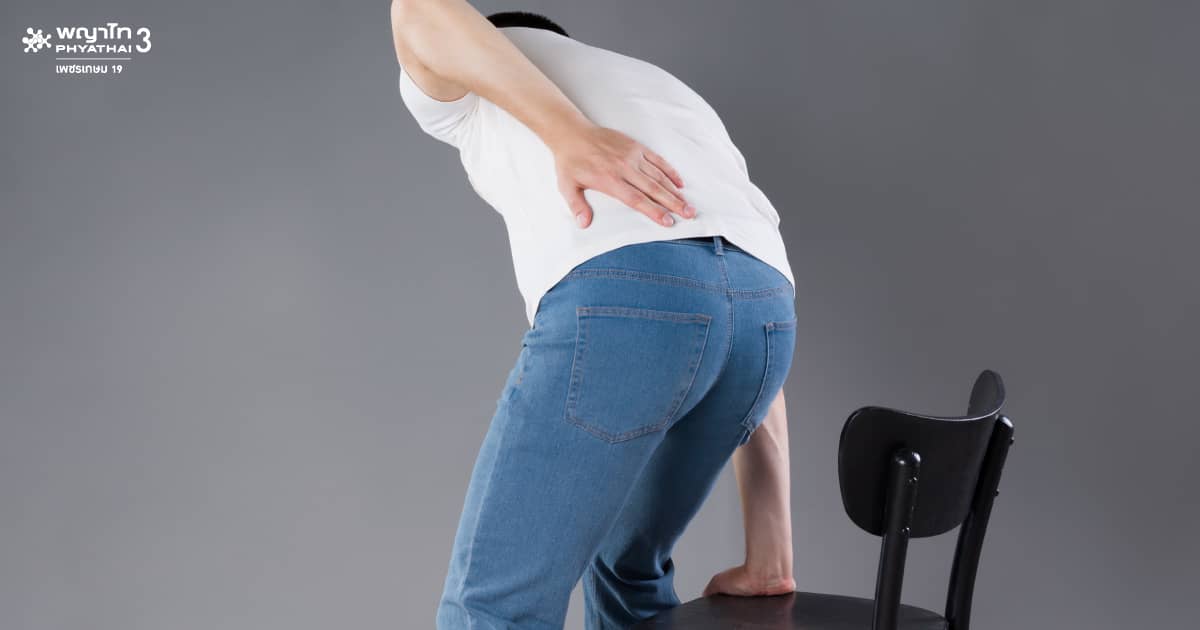
Back pain is a common symptom that can happen to everyone due to the lifestyle behaviors of modern people who have to sit and work continuously for long periods. It also includes doing activities beyond their limits, such as playing sports, exercising excessively, lifting heavy objects beyond their strength, etc., all of which can cause back pain. However, sometimes back pain may not just be ordinary pain but a sign of a dangerous disease called “herniated disc pressing on the nerve.” Although nowadays it can be completely cured with Microscope-assisted endoscopic surgery technology, preventing oneself from being at risk of this disease is still a better option.
Getting to Know Herniated Disc Pressing on the Nerve
Normally, the intervertebral discs of young people or intact discs are “soft” to be flexible and absorb shocks caused by movements in daily activities, whether walking, jumping, or playing sports. The key component that makes the intervertebral discs soft is water. However, when the discs are overused, overloaded, and used improperly, it leads to “degeneration.” The water percentage in the discs decreases, causing them to become hard and shrink instead of soft and flexible. This causes the discs to press on various nerves during movement, and if they press on any part, pain will occur in that area.
Herniated disc pressing on the nerve is a disease caused by disc degeneration commonly found in the elderly and young people with inappropriate lifestyle behaviors.
What Kind of Pain? Warning Signs of Herniated Disc Pressing on the Nerve
Since pain is a basic symptom that can occur with any disease, many patients do not realize they have herniated disc pressing on the nerve when they experience back pain and therefore do not seek treatment, causing the disease to worsen. Therefore, if back pain occurs, it is necessary to carefully observe whether it is ordinary pain or a warning sign of a serious disease. The warning signs of herniated disc pressing on the nerve can be observed as follows:
- Pain radiating from the back down to the thigh, back pain radiating down the leg
- Numbness and muscle weakness along with pain
- Pain is more severe than general muscle pain
- Pain when coughing or sneezing is a clear dangerous sign
What Behaviors Increase the Risk of Herniated Disc Pressing on the Nerve
Generally, people at risk of herniated disc pressing on the nerve can be divided into two main groups: adults to elderly people aged around 40 and above, and those who like heavy exercise, adventurous activities, have had accidents before, including office workers who sit for long hours in poor posture. In summary, risky behaviors that accelerate disc degeneration and should be avoided include:
- Lifting excessively heavy objects or lifting heavy objects in the same posture for a long time
- Bending or stooping frequently
- Eating excessively leading to overweight
- Sitting and working in front of a computer for long periods
- Playing extreme sports that involve frequent jumping, impact, and back shocks
Surgical Treatment for Herniated Disc Pressing on the Nerve
Initially, after the doctor diagnoses by taking history, asking symptoms, and performing an MRI scan, for some patients with mild symptoms and no indication for surgery, treatment will be with oral medication combined with physical therapy. However, if symptoms do not improve and pain worsens, surgery is the last resort to definitively stop the disease progression. Currently, surgery for herniated disc pressing on the nerve can be effectively performed using minimally invasive endoscopic technology or Microscopic Spine Surgery, which uses a small camera inserted into the affected area. The advantages of this endoscopic surgery include:
- Minimally invasive surgery with an incision of only 1-2 cm, inserting a camera and specialized surgical instruments
- Endoscopic surgery allows precise identification of the affected area, reducing the risk of complications
- Small incision surgery results in less blood loss, less pain, faster recovery, quicker discharge, and lower recovery costs
- Faster recovery allows patients to return to normal life sooner
After Microscope-assisted endoscopic surgery for herniated disc pressing on the nerve, patients recover quickly. However, for safety control during the initial period, patients still need to rest and undergo close physical therapy to prevent postoperative complications. Postoperative treatment focuses on physical rehabilitation and behavioral adjustments in activities such as sitting, walking, lying down, and lifting to prevent recurrence.
Did You Know!!
Carrying heavy bags, wearing high heels, and smoking
These three behaviors contribute to faster disc degeneration, which increases the risk of developing herniated disc pressing on the nerve.
Dr. Teerachai Phanitpong
Neurosurgeon and Spine Surgeon
Phyathai 3 Hospital
