When the knee joint is severely degenerated due to aging or other factors such as usage or accidents, it causes patients to suffer from pain and a decline in quality of life due to knee osteoarthritis. Knee replacement surgery is therefore the solution that can effectively treat the condition and help patients regain a good quality of life.
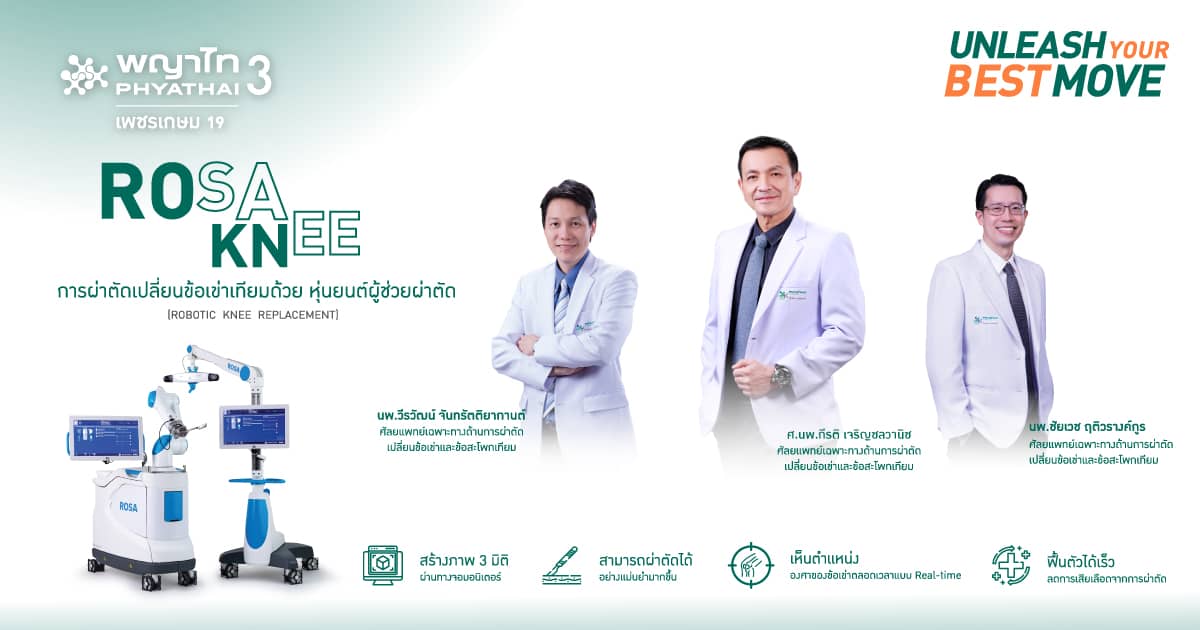
What is beyond the term knee replacement surgery today is that Phyathai 3 Hospital has taken a step further with robot-assisted knee replacement surgery (Robotic Knee Replacement). Eh! Robots? Will the robot perform the knee surgery by itself? How can safety be assured? And patients want to have surgery with the doctor they choose… These are many questions that people wonder about. Let’s find the answers about robot-assisted surgery together with Prof. Dr. Keerati Charoencholwanich, a consultant physician at the Muscle, Bone, and Joint Center, Phyathai 3 Hospital.
Robot-assisted knee replacement surgery (Robotic Knee Replacement) is a medical technology developed to help make knee replacement surgery more efficient. “The robot acts as an assistant to the surgeon during the operation, with the surgeon controlling its use; the robot does not perform the surgery by itself.”
An Assistant That Enhances Accuracy
In robot-assisted knee replacement surgery, the surgical robot helps create images of the knee, producing 3D images displayed on a monitor. This differs from the previous method of planning surgery based on X-ray images, allowing the surgery to be appropriately tailored to the anatomy of each patient.
During surgery, the surgeon can see the position and angle of the knee in real-time with accuracy similar to a GPS tracking system. If the patient’s leg moves even slightly, the robotic system detects and immediately adjusts the position. This allows the surgeon to cut only the degenerated joint surface and accurately place the prosthetic knee in the exact original position with precise alignment and prosthesis positioning. It also helps balance the joint gap to stabilize the knee. The surgical wound is smaller, and there is no damage to the surrounding ligaments and tissues. Patients can bend their knees close to normal and can stand, sit, and walk from the first day after surgery.
Robot-assisted surgery is minimally invasive, causing less trauma and blood loss, reducing surgical complications, shortening recovery time, and lowering the risk of future errors such as loosening or collapse of the joint that may require revision surgery.
Robot-assisted knee replacement surgery is suitable for patients with chronic knee pain from osteoarthritis or any degenerative joint disease. It is also beneficial for cases where previous knee replacement surgery was done by conventional methods but complications arose, causing abnormalities such as limited knee bending, stiffness, inability to fully extend or bend the knee, loose or dislocated knee, or prosthetic knee function that is not natural (e.g., inability to sit on the floor, kneel, squat, or sit cross-legged). Preparation for robot-assisted knee replacement surgery is the same as for conventional knee replacement surgery, with no differences.
Postoperative Care for Robot-Assisted Knee Replacement Surgery
Generally, patients stay in the hospital for about 1-3 days and receive care according to a rehabilitation plan. They are advised on self-care by the medical team, nurses, and physical therapists who assist patients in exercising their legs and knees to build strength.
After surgery, it is important to avoid touching the surgical wound, keep the wound dry, and not remove the dressing by yourself until the doctor permits.
Highlights of Robot-Assisted Knee Replacement Surgery
- Increases medical accuracy and reduces surgical errors (human error)
- Reduces complications during surgery, such as incorrect ligament cutting
- Safe, as surgeons have clear visualization, reducing injury to surrounding muscles and ligaments
- Smaller incisions and less blood loss make surgery safer and reduce postoperative pain
- Faster recovery; patients can stand or walk just 1 day after surgery
- Helps balance the prosthetic joint precisely for each individual, allowing natural knee function such as sitting on the floor, squatting, kneeling, sitting cross-legged, as well as running or exercising
- Enables a quick return to normal life and improves quality of life without enduring chronic knee pain
- Extends the lifespan of the prosthetic knee for longer use
The Muscle, Bone, and Joint Center at Phyathai 3 Hospital not only uses robot-assisted surgery to treat patients with knee osteoarthritis but also emphasizes postoperative rehabilitation. In addition to the medical and nursing teams providing care, there is a nutrition team managing diet and physical therapists assisting with exercise to enhance the effectiveness of osteoarthritis treatment comprehensively in all aspects.
