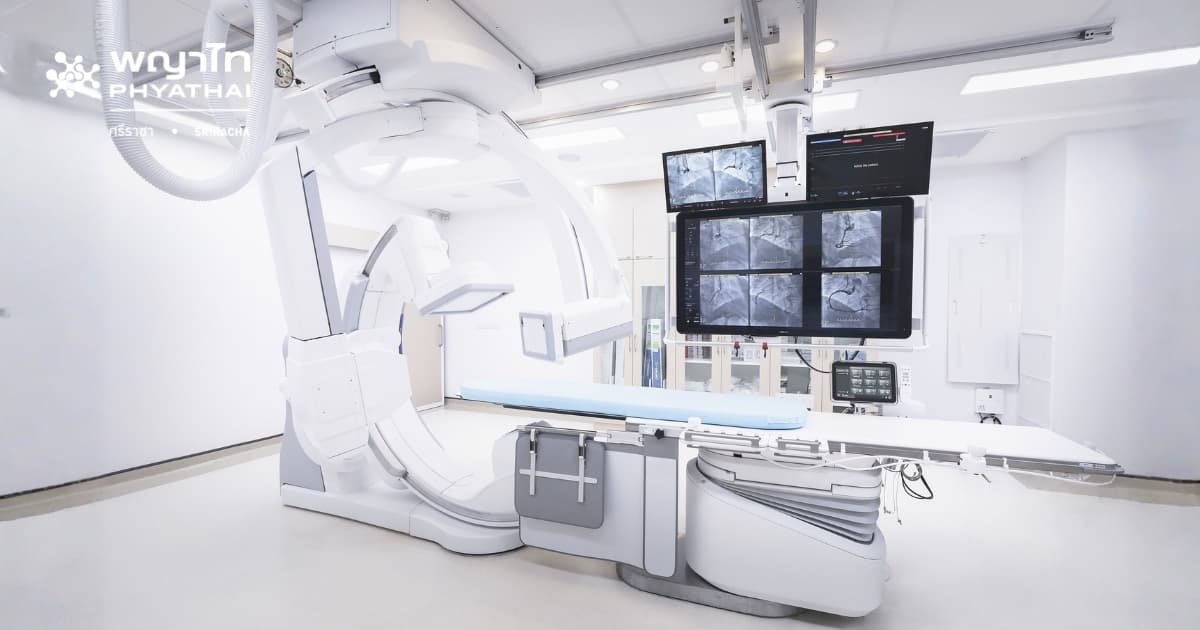
Coronary Angiogram and Balloon Angioplasty with 2-Plane Imaging Technology to Enhance Accuracy in Treatment Planning
Coronary artery stenosis or blockage is an urgent condition. Undergoing a “coronary angiogram” or “balloon angioplasty with stent placement” requires both the expertise of the physician and technology that provides the clearest images of the blood vessels to reduce risks and improve treatment effectiveness.
2-Plane Imaging Innovation: A Key Aid in Treating Heart Vessel Diseases
At the Heart and Vascular Center of Phyathai Sriracha Hospital, we utilize biplane X-ray imaging technology to elevate coronary artery treatment, featuring advantages that address patient concerns.
- Clear views from all angles at once Normally, traditional angiography shows images from only one plane, but this technology allows doctors to see the coronary arteries in 3D from both front and side views simultaneously, enabling precise planning for vessel dilation.
- Reduced contrast dye volume Since imaging is captured from two angles in one session, the amount of contrast dye administered is reduced, which benefits kidney function in some patients.
- Improved treatment efficiency This technology provides clearer visualization of the treatment site, enhancing maneuverability during catheter insertion, which helps manage time better and reduces radiation exposure for patients during the procedure.
What Heart Conditions Does This Technology Help Treat?
Our Heart and Vascular Center uses this high-resolution equipment in various cases:
- Coronary Angiogram (CAG) for detailed diagnosis of coronary artery stenosis or blockage
- Balloon Angioplasty and Stent Placement (PCI) to accurately position stents and reduce the risk of complications
- Intravascular Ultrasound (IVUS)
- Fractional Flow Reserve (FFR) measurement
Why Choose a Heart and Vascular Center Equipped with High-Precision Technology?
Heart care is not just about curing but about helping patients return to life with confidence.
- Specialized medical team We work as a multidisciplinary team including cardiac surgeons, anesthesiologists, and specialized nurses.
- Facility readiness The catheterization laboratory (Cath Lab) is designed to handle emergencies 24/7.
- Safety standards Emphasis on preventive care and close follow-up after procedures.
How to Prepare for a Coronary Angiogram?
If you or a family member experiences chest tightness and the doctor recommends a coronary angiogram, here are some basic guidelines:
- Fast from food and drink for 6-8 hours as advised by the doctor
- Inform about any allergies to medications, contrast dye, or underlying conditions (especially kidney disease and diabetes)
- Prepare a list of regularly taken medications for the doctor’s assessment before treatment
Frequently Asked Questions (FAQ)
Q: Does the new heart angiogram technology cause pain?
A: The procedure uses local anesthesia at the catheter insertion site (wrist or groin). Patients remain conscious but may feel slight warmth during dye injection. The precise technology helps make the procedure quicker.
Q: How long is the hospital stay?
A: For diagnostic angiograms, observation may last only a few hours or an overnight stay. If balloon angioplasty is performed, the doctor will decide based on the patient’s condition.
Q: Is the cost significantly higher?
A: Although it is advanced technology, precise treatment often reduces the need for repeat procedures or complications, making it cost-effective in the long term for heart health.
If you experience easy fatigue, chest tightness, palpitations, or have risk factors for coronary artery disease, don’t let small signs become big problems.
The specialized medical team is ready to provide comprehensive care, from diagnosis to precise treatment.
