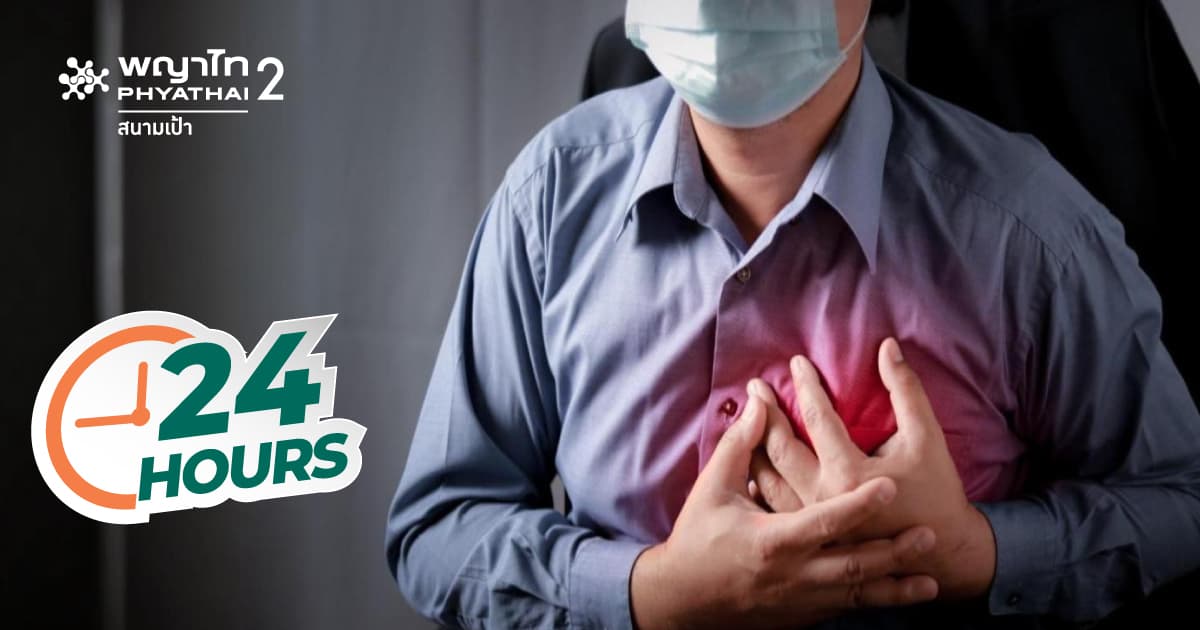
Cardiovascular diseases are among the leading causes of death among Thai people, and the trend continues to rise every year. These diseases are often caused by inappropriate lifestyle behaviors, such as consuming high-fat foods, lack of exercise, insufficient rest, or having underlying diseases that are not properly controlled or treated, such as diabetes, hypertension, and hyperlipidemia. These are significant risk factors for developing severe heart conditions, such as ‘acute heart failure’ or ‘acute myocardial infarction,’ which can lead to death if not treated promptly.
The Emergency Cardiac Critical Care Center provides comprehensive services 24 hours a day.
To help reduce risks and mitigate the impact of heart diseases, Phyathai 2 Hospital has established the Emergency Cardiac Critical Care Center, staffed with a team of specialist doctors and equipped with modern technology to treat patients with severe cardiac conditions, providing services 24 hours a day. Every step is designed to be performed rapidly, from initial patient reception, examination, diagnosis, to treatment, all carried out in the shortest possible time with the highest efficiency. This is a critical factor in saving the lives of patients in emergency situations.
At Phyathai 2 Hospital, we enhance cardiac care with advanced technology and innovations, covering all stages of comprehensive care 24 hours a day.
We are committed to utilizing state-of-the-art medical technology in diagnosing and treating heart disease patients, ensuring the highest precision and effectiveness. We employ advanced tools and techniques so that every patient receives the best possible care in all situations.
- Hybrid Operating Room for Cardiac Surgery, Modern Technology, and 24-Hour Service our operating room is designed as a Hybrid Operating Room, suitable for performing complex procedures such as TAVI, EVAR, TEVAR, Mitral Clip, and Hybrid CABG. It is an advanced surgical room that enables collaboration among multidisciplinary teams, such as cardiac surgeons, radiologists, and anesthesiologists. The room is equipped with FlexMove technology, allowing 360-degree X-ray imaging, enabling physicians to clearly and precisely visualize lesions or surgical targets, particularly for heart surgeries. This technology helps reduce surgical time and complications
The Hybrid OR can support both open-heart surgery and cardiac catheterization in the same room, enabling rapid and highly efficient treatments. It is thus fully prepared to support emergency surgeries, such as for coronary artery disease and heart failure, ensuring that patients receive timely treatment 24 hours a day.
- Cardiac Catheterization Laboratory (Cath Lab) Supports diagnosis and treatment of patients with coronary artery stenosis through cardiac catheterization techniques, including balloon angioplasty and stent implantation
- Coronary Care Unit (CCU) The CCU is a crucial part of the Heart Center, responsible for closely monitoring and treating heart disease patients who are at risk of critical conditions or are already in crisis. It provides rapid response to emergencies such as acute myocardial infarction or heart failure. The CCU is staffed by specialized cardiologists and highly experienced nurses who provide continuous 24-hour care.
- Cardiac Patient Care Using ECMO (Extracorporeal Membrane Oxygenation) ECMO is used to support heart and lung function in critically ill patients, such as those experiencing severe heart failure or severe lung infections. Blood is drawn from the patient’s body, oxygenated and cleared of carbon dioxide through the ECMO machine, and then returned to the body. This allows the heart and lungs to rest and recover. ECMO increases the survival chances for patients with severe cardiac or pulmonary failure, under the close care of specialized medical teams.
- Balloon Pump (Intra-Aortic Balloon Pump – IABP) In cases requiring increased blood flow and reduced cardiac workload, such as in heart failure or during cardiac surgery, a catheter with a balloon is inserted into the aorta. The balloon inflates during diastole to increase coronary artery perfusion and deflates during systole to reduce afterload, helping the heart pump blood more efficiently.
Advanced Technologies and Innovations in Heart Disease Treatment
There are various methods for treating heart disease, with each technique selected based on appropriateness to achieve the best outcomes. The choice of treatment depends on multiple factors, such as the severity of the disease, the patient’s physical condition, and the suitability of the available technology, as follows:
- Percutaneous Coronary Intervention (PCI)
This method treats patients with coronary artery stenosis or blockage without the need for open-heart surgery. A catheter is inserted through a blood vessel at the groin or wrist to reach the blocked coronary artery. Blood flow is restored by using balloon angioplasty and placing a stent to keep the artery open and prevent re-narrowing. The advantages of this technique include quick procedure time, short hospital stays, reduced risk of acute heart attacks, and faster recovery. - Coronary Artery Bypass Grafting (CABG) This treatment is intended for patients with severe coronary artery stenosis or multiple blockages, particularly when PCI is not a suitable option. CABG surgery reduces chest pain and lowers the risk of acute heart attacks. Blood vessels from other parts of the body, such as arteries from the chest or arms, or veins from the legs, are used to create a new pathway for blood to flow to the heart effectively. CABG surgery can be divided into two main types:
· On-Pump CABG: Uses a heart-lung machine during surgery.
· Off-Pump CABG: Does not use a heart-lung machine, allowing the heart to continue beating during the surgery.
- Transcatheter Aortic Valve Replacement (TAVR) TAVR is a method to replace the aortic valve without open-heart surgery, suitable for patients who are high-risk for traditional surgery, such as the elderly or those with other complications. A prosthetic valve is delivered through a catheter inserted via the groin or another access point, positioned at the aortic valve, and deployed to replace the damaged valve. This procedure helps reduce recovery time and minimizes the risks associated with open-heart surgery, enabling patients to return to daily life more quickly.
All these techniques are not only highly effective but also rely on modern medical technologies, and must be performed by specialized medical professionals to ensure the best possible outcomes for each heart disease patient.
Equipped with Advanced Innovations and Technologies for the Diagnosis and Treatment of Heart Disease
We are committed to utilizing state-of-the-art medical technologies for the diagnosis and treatment of heart disease, ensuring the highest precision and effectiveness. We employ advanced tools and techniques to thoroughly and rapidly assess the condition of coronary arteries, such as:
- Coronary Angiography (CAG) This technique is used for diagnosing heart disease in patients who are at risk or exhibit symptoms indicative of coronary artery problems, such as chest pain, shortness of breath, or a family history of heart disease. In this procedure, a contrast dye is injected into the blood vessels through a catheter, and X-ray imaging is used to visualize blood flow in the coronary arteries. This allows physicians to clearly assess the condition of the arteries, detect any narrowing or blockages, and identify the exact locations that require treatment, whether through balloon angioplasty or stent placement.
- Electrocardiogram (ECG) This technology monitors the heart’s electrical activity and rhythm to diagnose arrhythmias, such as abnormal fast or slow heartbeats, which may lead to serious health issues like cardiac arrest. ECG can also detect conditions such as acute myocardial infarction, left ventricular hypertrophy, and abnormal electrical conduction in the heart. The ECG procedure is simple, painless, risk-free, and takes less than 10 minutes.
- Coronary Blood Flow Assessment Using FFR (Fractional Flow Reserve) and IVUS (Intravascular Ultrasound) These tools help physicians accurately and effectively evaluate the coronary arteries and blood flow, guiding the selection of the most appropriate treatment, as follows:
- FFR (Fractional Flow Reserve) measures the pressure difference across a coronary artery narrowing, helping physicians assess how much the narrowing affects blood flow. This allows precise decision-making on whether treatment should involve stent placement or bypass surgery.
- IVUS (Intravascular Ultrasound) uses ultrasound imaging inside the blood vessels, providing a detailed view of the arterial walls. It accurately identifies the location and characteristics of narrowing, enabling physicians to plan the most effective treatment.
Personalized Cardiac Rehabilitation Program and Continuous Care
After the treatment of heart disease, health rehabilitation is an essential step to help patients return to a strong and active life. Phyathai 2 Hospital has developed a Personalized Cardiac Rehabilitation Program, designed to support sustainable healthy lifestyle changes, such as appropriate exercise, proper diet and nutrition management, and stress management — all key factors in preventing recurrent heart disease.
In addition, patients’ conditions are closely monitored by a team of specialized cardiac nurses who provide guidance on ongoing treatment and help patients continuously improve their lifestyle habits. The program also promotes self-care at home, enabling patients to maintain a good quality of life in their daily activities.
Emergency Cardiac Critical Care Center Providing Sustainable and Holistic Heart Health Care
The Emergency Cardiac Critical Care Center at Phyathai 2 Hospital focuses on utilizing modern medical technologies for heart disease treatment, from accurate diagnosis to highly effective treatment techniques. With a team of specialized cardiologists and a dedicated multidisciplinary team, we provide attentive and comprehensive care. We also offer holistic programs for sustainable heart health rehabilitation.
If you or your loved ones are at risk of heart disease, do not hesitate. Let the Emergency Cardiac Critical Care Center at Phyathai 2 Hospital be part of your journey to strong and lasting heart health.
