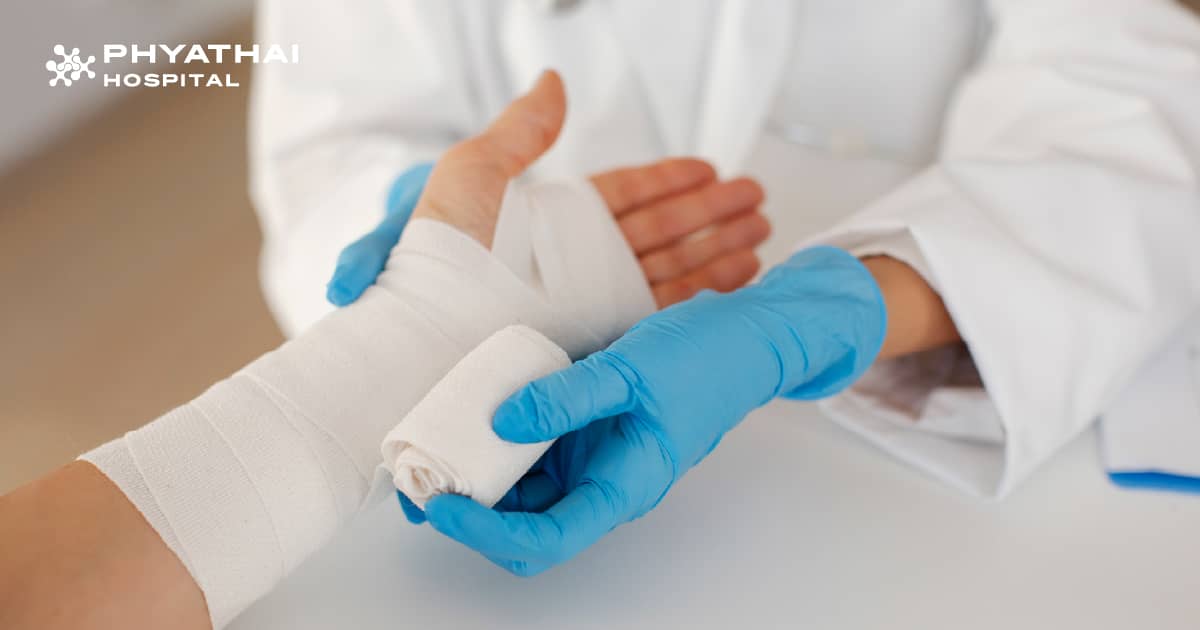
Understanding how your body heals is the first step toward effective wound care. A wound is any injury that causes damage to your body’s tissues. From a simple scrape to a complex surgical incision, all wounds require proper attention to prevent infection and ensure a smooth recovery.
Key Takeaways
- Wounds are classified as either closed (skin intact, e.g., bruises) or open (skin broken, e.g., cuts). Their severity is also graded from Class 1 (clean) to Class 4 (dirty/infected), which guides the necessary wound care.
- For minor wounds, you should clean the wound with soap and water, stop the bleeding with pressure, and then apply ointment and cover it with a bandage.
- A wound is considered chronic if it hasn’t healed in four weeks. Factors like age, underlying diseases, smoking, and poor blood flow can all contribute to chronic wound formation.
Table of Contents
- Types of wound
- Types of wound healing
- How to take care of wound by yourself
- Wound healing stages in adults
- Hemostasis phase
- Inflammatory phase
- Proliferative phase
- Remodelling stage (Maturation phase)
- Clinical Significance
- Excessive Wound Healing
- Chronic Wound Formation
- Other Complications
- wound care at Phyathai Hospital
Types of wound
In medicine, a wound is simply any damage to your body’s tissue, including skin, mucous membranes, and internal organs. Wounds can be categorized into two main types: closed wounds and open wounds.
- Closed Wounds: is one where the outer skin remains intact, but the underlying tissues have been damaged. Examples include contusions (bruises), lumps (hematomas), and non-blanchable redness over a bony prominence where the skin is still intact.
- Open Wounds: An open wound is one where the skin is broken or split, exposing the underlying tissues to the external environment.
Wounds can also be classified based on their cleanliness and condition, which is the reason why wound care is critically important
- Class 1 (Clean) : These are uninfected wounds with no inflammation. They’re usually closed and don’t involve the respiratory, digestive, or urinary systems.
- Class 2 (Clean-Contaminated) : These wounds are similar to Class 1, but they involve a controlled entry into the body’s internal systems, such as the respiratory or digestive tract, without major contamination.
- Class 3 (Contaminated) : These are fresh, open wounds that have been exposed to contaminants, such as a break in sterile procedure or a leak from the gastrointestinal tract. They are also characterized by acute inflammation.
- Class 4 (Dirty-Infected) : These are wounds that are already infected. They often result from traumatic injuries that weren’t properly treated and contain dead or unhealthy tissue.
Types of wound healing

Wound healing is categorized into three main types: primary, secondary, and tertiary wound healing. Proper wound care is crucial for each of these distinct open wound healing stages.
- Primary Healing (or Primary Intention)
-
-
- This is the simplest type of healing and occurs in clean wounds with a minimal amount of tissue loss and edges that can be brought together easily, like with surgical wounds.
- These wounds heal quickly with minimal scarring.
-
- Secondary Healing (or Secondary Intention)
-
-
- This healing process is for wounds with extensive tissue loss, or those that are infected. The edges of these wounds cannot be pulled together.
- The wound must be left open to heal from the bottom up. This process involves the formation of new tissue (granulation tissue), which fills the wound before the skin closes over it.
- This process takes longer and often results in more significant scarring. This is the healing method seen in many chronic wound types, such as pressure ulcers or venous leg ulcers.
-
- Tertiary Healing (or Tertiary Intention)
-
- This is a delayed form of primary healing. It’s used for wounds that are initially left open to be cleaned and managed, usually due to infection or swelling.
- Once the wound is clean and healthy, typically after 4-6 days, it is then surgically closed, much like a primary intention wound.
- This approach combines aspects of both primary and secondary healing to ensure the wound is clean before final closure.
How to take care of wound by yourself
If you have a minor injury, follow these steps for basic wound dressing at home:
- Clean the Wound : Immediately wash the area gently with clean water and mild soap. Carefully remove any dirt or debris.
- Stop the Bleeding : Apply light pressure to the wound with a clean cloth or bandage until the bleeding stops.
- For Burns : If it’s a burn, run cool water over it or apply a cool, wet cloth. Don’t pop any blisters that form.
- Apply Ointment and Cover : Put a thin layer of antibiotic ointment or petroleum jelly on the wound. Cover it with a clean bandage.
- Ongoing Care : Clean the wound twice a day with soap and water, then apply a fresh bandage and more ointment. Avoid using harsh products like hydrogen peroxide or alcohol. Continue this process until the wound is fully healed.
Some wounds need more than wound care at home. If you have a deep or gaping wound, or a bite injury, you may need stitches or special wound care procedure from a medical professional.
Wound healing stages in adults

In adults, wound healing is a continuous process that occurs in four stages: hemostasis, inflammation, proliferation, and remodeling. Understanding these stages is key to effective wound care.
Hemostasis phase
The hemostasis phase is the first step in wound healing, and its job is to stop the bleeding. It happens almost instantly.
- When a blood vessel is damaged, it quickly narrows to slow blood flow.
- Platelets, tiny cells in your blood, rush to the injury site and stick together, forming a temporary plug.
- Next, a protein called fibrin creates a net-like structure. This net traps more platelets and blood cells, forming a firm clot that seals the wound.
This clot is essential for healing, but it can be dangerous if it breaks away and travels through the bloodstream, potentially causing a stroke or other serious health problems.
Inflammatory phase
The inflammatory phase begins right after an injury. Its main job is to clean the wound and prevent infection.
- Injured blood vessels leak a fluid that causes swelling, which allows essential healing cells to move into the wound area.
- During this stage, your body works to remove damaged cells, germs, and bacteria from the wound.
- White blood cells and other substances cause the familiar signs of inflammation: swelling, heat, pain, and redness.
This process is a normal and necessary part of healing. It only becomes a problem if it goes on for too long or is too intense.
Proliferative phase
The proliferation phase is when your body actively rebuilds the wound with new tissue.
- New tissue, called granulation tissue, starts to form. This tissue is typically pink or red and should not bleed easily. If it looks dark, it could be a sign of infection (that may be caused by poor wound care) or poor blood flow.
- The body creates new blood vessels to supply the growing tissue with oxygen and nutrients.
- Special cells pull the edges of the wound together, making it smaller.
- Finally, new skin cells begin to grow over the wound’s surface. This process, called epithelialization, happens best when the wound is kept moist.
Remodelling stage (Maturation phase)
The maturation phase is the final and longest stage of wound healing, where the new tissue is strengthened and refined
- The new collagen that was laid down in the previous phase is initially thick and disorganized. It is then remodeled from type III to type I, a more organized structure. This process is facilitated by enzymes called matrix metalloproteinases.
- The collagen fibers realign along lines of stress, increasing the tensile strength of the healing tissue.
- Cells that are no longer needed for wound repair are removed through a process of programmed cell death called apoptosis.
- This remodeling process typically begins around 21 days after the injury and can continue for a year or more.
- Even after a full year, the healed area remains weaker than uninjured skin, with only about 80% of its original strength.
Clinical Significance
Any disruption in the normal wound care process can lead to either an over-healing of the wound or the formation of a chronic wound.
Excessive Wound Healing
This type of healing is not fully understood, but it’s an abnormal response where the wound site has a prolonged, localized inflammation. It’s characterized by an excessive amount of collagen and other tissue, resulting in raised scars like keloids and hypertrophic scars.
Chronic Wound Formation
A chronic wound is defined as one that has failed to heal within four weeks. The main risk factors include
- Age and a weakened immune system
- Malnutrition and smoking
- Underlying diseases like diabetes
- Poor blood flow and oxygen supply to the wound
- Medical treatments such as radiation and chemotherapy
Common types of chronic wounds are vascular ulcers (venous or arterial), diabetic ulcers, and pressure ulcers.
Other Complications
Other issues can also arise, such as
- Poorly formed scars
- Excessive granulation tissue
- Abnormal wound contraction (either too little or too much)
- Other problems like painful scars, changes in skin color, and incisional hernias.
wound care at Phyathai Hospital
Understanding “what is wound care” is essential for proper healing. It involves everything from cleaning a minor cut at home to professional medical treatment for complex injuries. The right wound care approach, whether for a simple scrape or a chronic ulcer, is crucial for preventing complications and ensuring the body’s natural healing process can proceed efficiently through all four stages, from hemostasis to remodeling.
Proper and timely wound care is crucial for your health. Phyathai Hospital is your “Partner for Life,” with a team of expert doctors and nurses and modern medical equipment to ensure you receive the best possible care. Our multilingual staff can ensure you get the precise consultation and treatment you need for the best possible wound care outcomes.
- Call Center 1772 (press 9 for ENG)
- Email: [email protected]
- Facebook Page: Expat Health & Wellness by Phyathai
References (3-5 แหล่งอ้างอิง)
- Basic Wound Care. (n.d.). University Health Service. https://www.uhs.wisc.edu/medical/wound-care/
- Clinical Effectiveness Committee. (2023 February). Wound assessment and management. The Royal Children’s Hospital Melbourne. https://www.rch.org.au/rchcpg/hospital_clinical_guideline_index/Wound_assessment_and_management/
- Wounds – how to care for them. (2014, August 31). Better Health Channel. https://www.betterhealth.vic.gov.au/health/conditionsandtreatments/wounds-how-to-care-for-them