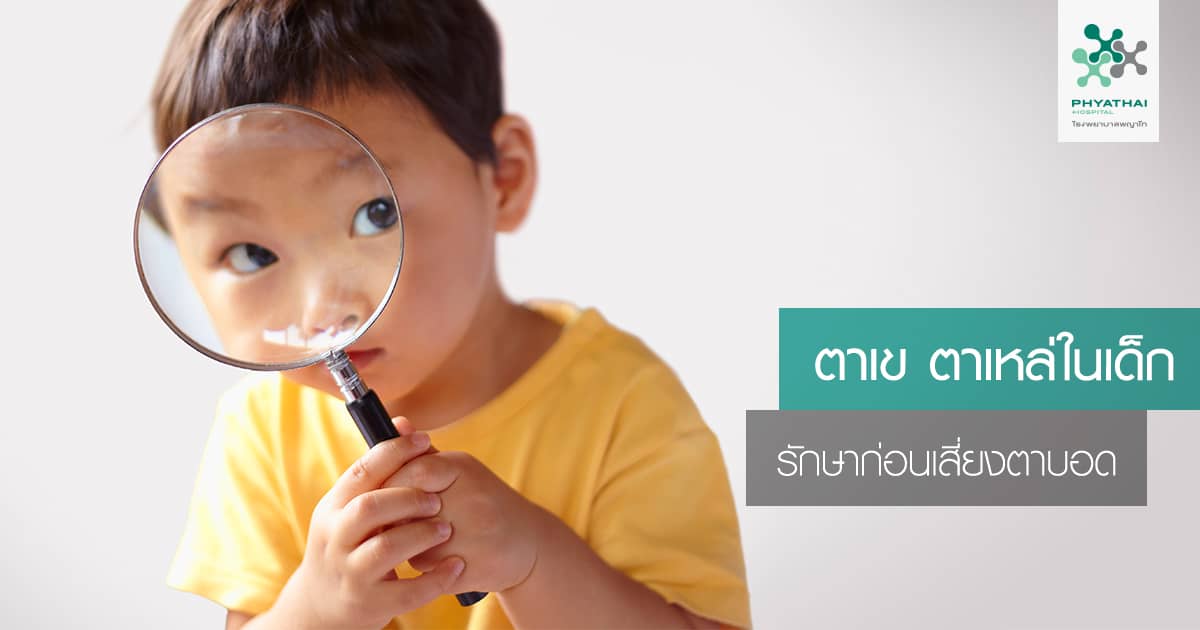
Strabismus (Crossed Eyes) is a condition where both eyes are not aligned and do not work together… when looking at the same object. The patient will use only the normal eye to focus on the object, while the deviated eye may turn inward, outward, upward, or downward, causing that eye to be unused. Pseudostrabismus is often found in children whose nasal bridge is not fully developed and have a wide epicanthal fold, making it appear similar to inward strabismus. However, as the child grows and the nasal bridge becomes higher, this condition will disappear.
How does strabismus occur?
- It can be caused by many factors, most of which are unknown. It is believed to be an imbalance between the two eyes.
- It results from abnormal brain signals to the eye muscles, causing the eye muscles to work unevenly.
- It is caused by abnormal development of the eye muscles.
- It is a result of paralysis or dysfunction of the nerves that supply the eye muscles, leading to strabismus.
- Abnormal vision is a common cause in children. It may be due to an abnormality in one eye from certain diseases, such as retinoblastoma, causing that eye to lose vision and be used less, resulting in strabismus.
- Strabismus caused by excessive focusing. Generally, children focus more than adults, but some children focus excessively, including those with severe refractive errors, which can cause strabismus and lead to prolonged focusing.
Impacts caused by strabismus
It not only causes loss of confidence but also affects personality. In children, when they reach school age, they may be teased by friends, causing them to refuse to go to school, suffer from mental health issues, become withdrawn, lose confidence, and it can affect social interaction and learning. In adults, eye abnormalities are more noticeable than other features. Some people with strabismus try to cover the affected eye with their hair, living as if hiding something, losing confidence, avoiding social interaction, and feeling inferior, which affects their personality. It also causes loss of opportunities in careers and many other aspects. Especially if strabismus is accompanied by vision problems, it can make normal life almost impossible. Therefore, surgery to correct strabismus is the best solution.
Is treatment necessary for strabismus in children?
The goal of treating strabismus in children is to eliminate amblyopia (lazy eye), as amblyopia can lead to blindness. It is important to understand that a child’s eyes are still developing. If strabismus occurs, the affected eye is used less, leading to amblyopia, which means the eye is underdeveloped. If left untreated for a long time, it may cause permanent blindness in that eye. Therefore, children with strabismus should receive early treatment, as it not only affects personality but also may cause loss of vision and affect their quality of life in the future.
How to know if your child has strabismus
You can observe from the age of 5 months onwards. If your child looks at the mother’s face with unusual eye movements or appears to have crossed eyes, suspect strabismus and take the child to see a doctor. At this age, it is possible to check whether strabismus is present.
Non-surgical treatments
- Wearing glasses to treat strabismus caused by refractive errors, such as farsightedness causing inward strabismus or nearsightedness contributing to occasional outward strabismus.
- Wearing prism glasses, which help refract light to fall correctly on the retina’s focal point.
- Eye muscle exercises.
- Medication treatment, such as Botulinum Toxin injections into the eye muscles, which weaken the muscle for about 2-3 months.
What to do if your child has strabismus with amblyopia (lazy eye)?
Children with strabismus and amblyopia need immediate treatment before strabismus surgery. Treatment should be done before the child is older than 7 years, as treatment is less effective after 8-9 years old, and the affected eye may become permanently blurred. Amblyopia treatment involves patching the good eye to stimulate the lazy eye to work. The patch should be worn for 2-6 hours daily until both eyes have normal vision. The duration varies for each case.
Surgical treatment for strabismus correction
Strabismus surgery is a minor operation called muscle correction, which involves adjusting the eye muscles and realigning them to normal. There are various techniques, and the doctor will choose the appropriate one based on the type of strabismus. The surgery is straightforward and performed outside the eyeball. Adults can have the surgery under local anesthesia, while children can have it from 2 years old, sometimes requiring general anesthesia. The results are good for both children and adults.
Side effects after surgery
The eyes will be aligned immediately, with possible slight redness, and the eye will recover in about a week. Patients can then return to a better quality of life, feeling like a new person.
Postoperative self-care
The doctor will patch the operated eye for 1 day, then the patient can use their vision normally. For young children, an eye shield is used during sleep to prevent rubbing. During the first week, avoid getting water in the eye to prevent inflammation or infection. The surgery leaves almost no scars or marks. Follow-up appointments are necessary to monitor any changes.
Benefits after treatment
- Aligns the eyes to look normal and beautiful, improving personality.
- Treats vision to improve the efficiency of both eyes, allowing 3D vision.
Many people believe that strabismus in children can resolve on its own as they grow up, but in reality, strabismus does not go away by itself. If patients do not receive proper treatment in a timely manner, it may cause permanent vision loss. Strabismus also causes amblyopia. Therefore, it is important to observe your child’s vision behavior or take them for an eye check-up with an ophthalmologist before school age to help prevent these problems.
