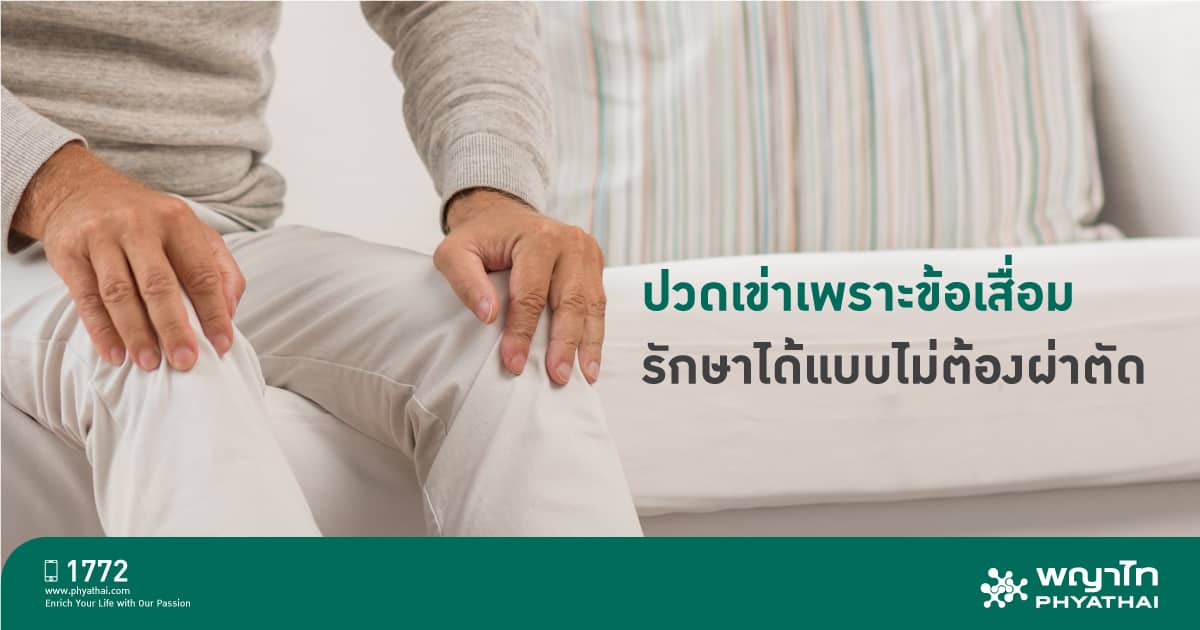
Before discussing the treatment of osteoarthritis, we must first understand that osteoarthritis occurs when the surface of the knee joint, which is cartilage, begins to wear down. This causes the joint surface to become uneven, leading to friction between the joints. As a result, the synovial fluid can no longer lubricate the joint as effectively as before, causing stiffness, tightness, and abnormal weight-bearing on the joint surface. Many patients feel knee pain, hear creaking sounds from the knee, and find daily activities increasingly difficult. If not properly treated, the symptoms will worsen.
Check? Are you experiencing any of these symptoms?
- Knee pain, difficulty moving, standing up, sitting down, or climbing stairs as smoothly as before
- Hearing noises when moving
- Knees bowing, making walking difficult and causing pain while walking
- Stiff knees, unable to fully straighten or bend the leg as before
The main reason many elderly people with these symptoms avoid treatment is because they ‘fear’ surgery to replace the knee joint and worry about not being able to live as before. They choose to endure the pain without realizing that such behavior worsens the degeneration. In reality, treating osteoarthritis does not always require knee replacement surgery. If the condition is not severe, there is also ‘artificial synovial fluid injection’ as another treatment option for osteoarthritis.
“Artificial Synovial Fluid Injection” – What is this treatment for osteoarthritis?
As mentioned, treating osteoarthritis does not always require knee replacement surgery because there are many other methods. One method supported by research to effectively relieve pain is artificial synovial fluid injection. Normally, everyone’s knee joints contain synovial fluid, mainly composed of Hyaluronic Acid, which is thick, viscous, and clear. It functions to lubricate the joint surface and absorb shocks, allowing us to walk or run smoothly. However, in osteoarthritis patients, this synovial fluid becomes less viscous, reducing lubrication and shock absorption, making walking or performing activities more difficult or stiff.
Therefore, injecting artificial synovial fluid or Hyaluronic Acid, which mimics the properties of natural synovial fluid, into the knee joint helps improve lubrication and shock absorption. It also stimulates the joint cells to produce more synovial fluid.
Clinical studies have found that artificial synovial fluid injection into the knee joint has the following benefits:
- Effectively relieves pain
- Reduces stiffness and tightness
- Improves knee joint function and mobility if treated early
Who is suitable for Hyaluronic Acid injection treatment?
- Patients with osteoarthritis severity ranging from early to moderate stages
- Patients who have taken pain and anti-inflammatory medications along with physical therapy but have not improved
- Patients who cannot undergo knee replacement surgery
In Thailand, there are several types of artificial synovial fluid injections, categorized by molecular weight. Currently, only one injection is needed for convenience, so patients do not have to endure multiple injections, and the treatment effect lasts 6-12 months.
