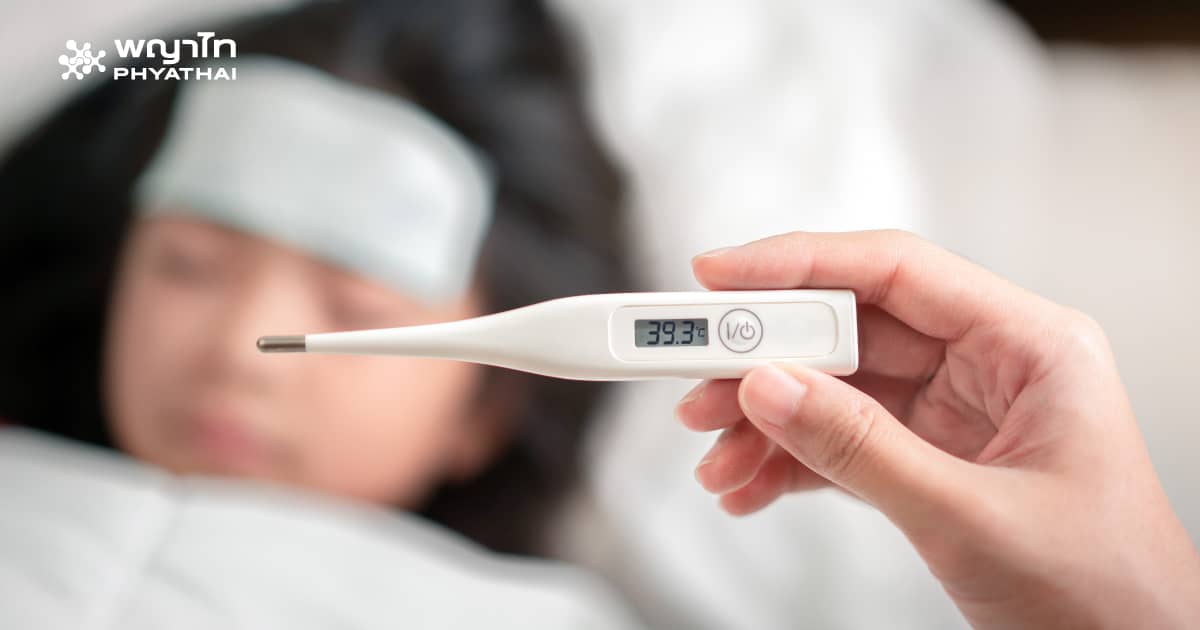
Kawasaki Disease is a syndrome characterized by high fever along with changes in the skin, mucous membranes, and enlarged lymph nodes in the neck. It is commonly found in Asian children, especially in Japan, Korea, Taiwan, and China. It is less common in European and American children and very rare in Black children. This disease is increasingly found in Thailand, but the exact incidence is unknown and it is not related to any particular season.
Kawasaki Disease is divided into 3 stages
- Acute stage
- Subacute stage
- Convalescent stage
Therefore, early diagnosis, especially within the first 5-7 days of illness, is very important to promptly provide treatment to prevent complications that may occur in the heart and coronary arteries.
Parents should be cautious! Kawasaki disease is common in young children
The exact cause of the disease is still unknown, but it is suspected to be related to genetics. It is mostly found in children, especially those under 8 years old, with the highest incidence between 1-5 years of age. It occurs in both sexes but is more common in boys than girls (approximately 1.5:1).
Warning signs parents should observe in their child
- The child will have a high fever; if untreated, the fever can last about 1-2 weeks.
- Red eyes, with redness in both conjunctivas without discharge, occurring about 1-2 days after fever onset and lasting about 1-2 weeks.
- Changes in the lips and inside the mouth, with dry red lips lasting about 1-2 weeks. The skin on the lips may crack, bleed, and peel. The oral mucosa is red, and the tongue appears red and bumpy like a strawberry (Strawberry tongue).
- The palms and soles become swollen and red but not painful. Later, peeling of the skin around the fingertips and toes occurs (about 10-14 days after fever onset) and may spread to the palms and soles. In some cases, nails may fall off, and 1-2 months later, transverse lines on the nails (Beau’s lines) may appear.
- Rashes on the body and limbs usually appear 1-2 days after fever onset and can vary in type. The rash lasts about 1 week. Some cases have rashes around the genital area, and about 60% have a red rash at the site of BCG vaccination on the shoulder.
- Enlarged lymph nodes in the neck, found in about 50-70% of patients, larger than 1.5 cm but not painful.
- Other possible symptoms include joint pain, non-infectious urinary tract inflammation, abdominal pain, diarrhea, meningitis, liver function changes, and some cases present with shock.
Some patients may not show all the criteria and are referred to as having Incomplete Kawasaki Disease or Atypical Kawasaki Disease.
Kawasaki Disease… the earlier the treatment, the more it reduces life-threatening complications
The main problem of this disease is causing complications in the heart and coronary arteries and inflammation of the heart muscle around the arteries, found in about 20-30% of cases if untreated within the first 7-9 days of illness. Severe complications can lead to death in about 1-2% of patients.
Therefore, patients must be diagnosed promptly within the first 7 days of illness and undergo cardiovascular system examinations including electrocardiogram (ECG), chest X-ray, and echocardiogram at the onset and after treatment to check for complications in the heart and/or coronary arteries. If complications are present, continuous care according to the severity of the disease is required.
How to diagnose “Kawasaki Disease”
Diagnosis of Kawasaki Disease relies on history and physical examination showing the described abnormalities, along with differential diagnosis from other causes. Blood tests, ECG, chest X-ray, and echocardiogram are performed to check for complications in the heart and blood vessels. Echocardiogram is repeated after treatment to assess the presence and severity of complications to guide further treatment.
Care and treatment of patients with Kawasaki Disease
- Administer high-dose Intravenous Gammaglobulin (IVIG) to reduce the risk of heart and coronary artery complications, reduce inflammation of the vessel walls to prevent aneurysms and myocarditis.
- Along with Aspirin administration.
- About 10% of patients are resistant to treatment and require additional medication.
Prognosis and disease course
The prognosis and disease course are good if the patient does not develop heart and coronary artery complications before and after treatment. After the fever subsides, blood-thinning medication (Aspirin) must be taken for about 60 days or until coronary artery aneurysms return to normal.
If the patient has no heart or coronary artery complications after treatment, they can play and participate in activities like normal children. About 5-7% of patients may develop heart complications such as coronary artery aneurysms (e.g., aneurysms larger than 4 to >10 mm). These patients have a risk of death and should receive continuous care from pediatric cardiologists with periodic echocardiograms according to the severity of complications. Some may require Exercise Stress Tests, Computer Tomography (CT), and cardiac catheterization to assess disease severity and plan ongoing treatment into adulthood.
*Children treated with Intravenous Gammaglobulin (IVIG) must avoid live vaccines for 7-9 months after treatment.
This disease can recur in about 3-3.5% of cases or 6.89 per 1,000 pediatric patients per year, especially in patients with complications. It is also more common in children within the same family or with blood relations, occurring in about 1-2% of cases.
