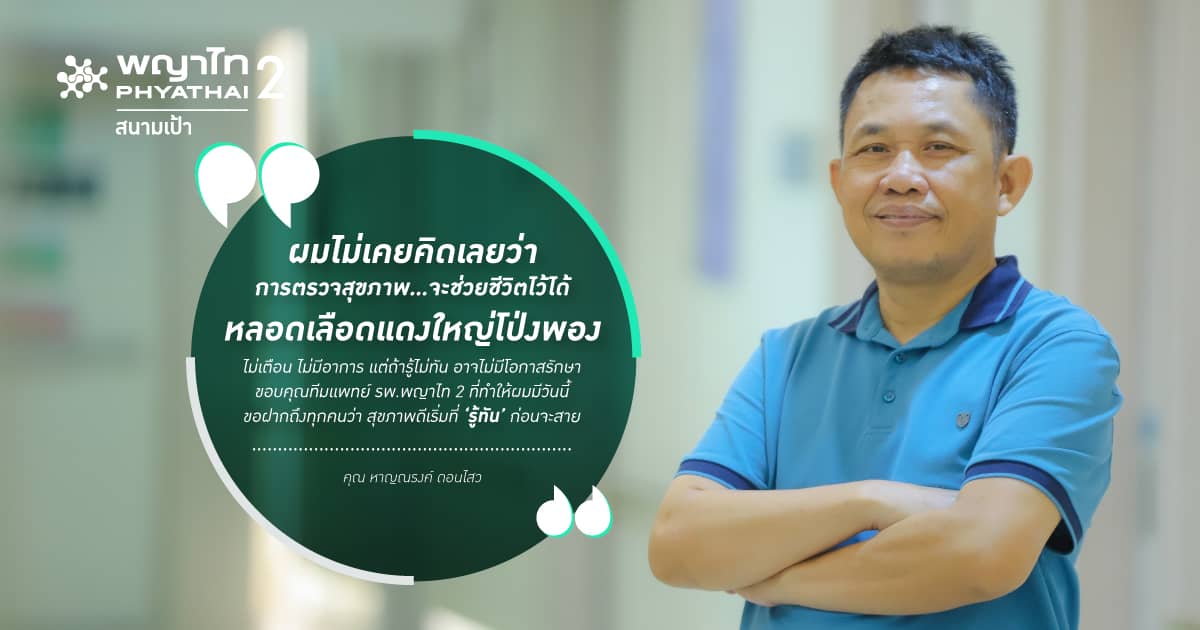
Sharing Experience of Treating Abdominal Aortic Aneurysm
“Do I have an abdominal aortic aneurysm?”
A warning from a survivor and deep insights from the treating physician. Behind the silence lies a condition that can take life unexpectedly.
“Ruptured blood vessel in the abdomen”… may sound like an accident that happens to others, but did you know this condition can happen to you without any warning signs, pain, or symptoms? At the critical point, there may be no chance to reach a doctor. Abdominal Aortic Aneurysm (AAA) is one of the most frightening silent threats in the vascular system and is a disease many people do not know they have.
Discovered by accident… and it changed life forever
Khun Hanarong Donsai, 52 years old, went for his annual health check-up as usual. Just by requesting an additional kidney X-ray, something “unknown” was found inside him.
“I had no symptoms at all. The doctor just said they saw an abnormal blood vessel and asked me to do a CT Scan. After that… the doctor told me I had an abdominal aortic aneurysm.”
“I was very shocked because I thought medication would cure it, but the doctor said if I didn’t have surgery… I could die immediately.”

Hear from the doctor: This disease never gives advance warning
Assoc. Prof. Dr. Kittichai Luangtaweeboon, Director of the Vascular and Thoracic Surgery Center at Phyathai 2 Hospital, is the doctor who treated Khun Hanarong and is one of the leading vascular surgeons in Thailand.
“This disease is when the abdominal aorta enlarges abnormally, causing the wall to thin out like an overinflated balloon.”
“If left untreated for long enough or with high blood pressure, the vessel can rupture, causing rapid blood loss and possibly death within minutes.”
The abdominal aorta is the main artery that carries blood from the heart to the lower body. If it ruptures, even a hole as small as 1 centimeter can cause 4–5 liters of blood to flow out within minutes.

Who should be cautious of this disease?
Although it is common in the elderly, the doctor emphasizes that “age is not a shield.” People generally think this disease affects those over 60, but Khun Hanarong was only 52 and had no symptoms. It was found by chance during a kidney check.
Key risk groups include
- Men aged 50 and above
- People with high blood pressure
- Those with a family history of vascular disease
- Smokers or former smokers
- People who do not exercise or have high blood cholesterol
Dr. Kittichai stresses, “Even without symptoms, if you are in a risk group, you should have an abdominal ultrasound or CT Scan at least once a year.”
Surgery is necessary because of the risk of “immediate rupture”
“When the doctor told me it was like a swollen sausage in my abdomen, and if it ruptured, I would lose all my blood within a minute, I was speechless…” said Khun Hanarong.

Dr. Kittichai explained, “If the diameter of the aneurysm is more than 5 centimeters, the chance of rupture is as high as 30–50% within 1–2 years.”
“Especially if there is blood dissecting into the vessel wall or an abnormal aneurysm (Dissecting Aneurysm), the risk of rupture increases alarmingly.” In Khun Hanarong’s case, the aneurysm was near the kidney and the artery supplying the leg, so the medical team had to choose the most secure treatment approach.
Open abdominal surgery: A decision that had to be made immediately. Although there is a less invasive endovascular aneurysm repair (EVAR) with smaller wounds and faster recovery, in this case, the medical team chose “open surgery” for clear medical reasons.
“Khun Hanarong is young, and the aneurysm is close to the kidney. Using a catheter requires repeated contrast injections every year, which affects the kidney.”
“But open surgery, although it requires longer recovery, can solve the problem permanently and does not require repeated contrast injections.”
Khun Hanarong agreed immediately.
“The doctor explained very well, so I was confident and didn’t hesitate. I quickly cleared my work and prepared as the doctor instructed.”

Fast recovery thanks to a comprehensive care team
Khun Hanarong had surgery last April and recovered within 1 month. He had no wound pain, no infection, and has returned to normal life.
“The doctor said I would fully recover in a month, and that’s exactly what happened.” After surgery, he received close care from the physical therapy team, including breathing exercises, walking training, and proper rehabilitation.
“The doctor advised me not to do heavy exercise for the first 2-3 months because the wound was not fully healed, but even this was beyond my expectations.”
“I really want to thank the medical team at Phyathai 2 Hospital, especially Dr. Kittichai, who explained everything clearly and straightforwardly, which gave me the confidence to decide on treatment quickly and recover in time.”
“All the doctors treated me like family, from before surgery to recovery. Thank you very much. If I hadn’t had the check-up here, I might never have had the chance to get treated.”
A message from the patient and the treating doctor
“Don’t wait until the blood vessel ruptures to find out you have this disease.” – Khun Hanarong
“Abdominal aortic aneurysm is truly a silent threat. Most patients have no symptoms and only find out when it ruptures, which is almost untreatable.” – Assoc. Prof. Dr. Kittichai
Check before it’s too late: Phyathai 2 Hospital is ready to care for you
Phyathai 2 Hospital offers age-specific health screening programs that can detect abdominal aortic aneurysm before symptoms appear, using accurate ultrasound or CT Scan technology, supported by a specialized medical team.
✅ Ready to care for you 24 hours a day
✅ Surgical and physical therapy technology for systematic rehabilitation
✅ Patient-centered treatment approach under JCI standards
“Silent symptoms… do not mean no disease” if you…
- Are over 50 years old
- Have a family history of vascular disease
- Have smoked
- Or have never had an abdominal health check
“Getting checked today could mean many more years of life” because the disease you don’t know you have… could be the most dangerous one.
