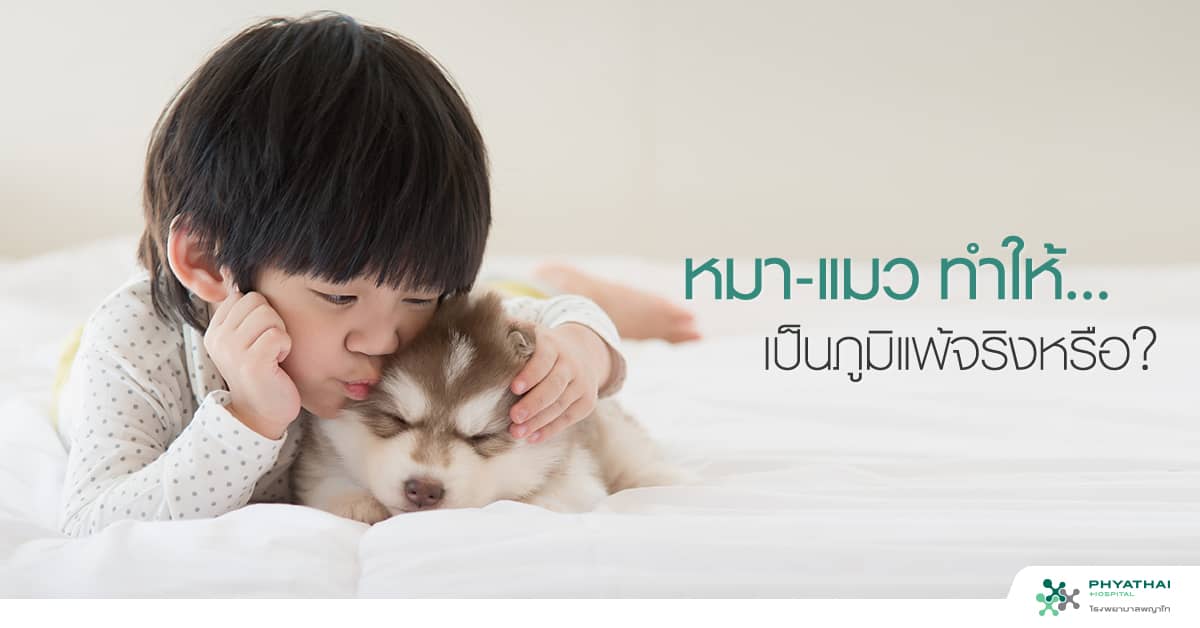
It is widely believed that “dog and cat hair” can cause people to develop allergies or trigger asthma and allergy symptoms. This raises many questions about what people who love or keep dogs and cats should do. Today, to create a better understanding of this issue, we will explore whether these beliefs are true or false.
Asthma and allergy flare-ups are not always caused by dogs and cats
The first thing we should understand is that not everyone who has allergies or asthma gets it because of dogs and cats. There are many factors that can cause allergy symptoms, sneezing, or chronic asthma, such as mold, dust mites, or other pollutants. It is not necessarily specific to dog or cat hair alone. Therefore, we cannot definitively say that “keeping dogs and cats causes allergies or triggers asthma and allergy flare-ups”. However, it is true that “dog and cat hair” is one of the triggers that can cause allergic reactions. Whether it triggers us or not needs to be clearly proven first. If it does, then we can proceed to find solutions on how to adjust our lifestyle to live happily and healthily with our beloved dogs and cats.
Solving the mystery: Why do people get allergic to dog and cat hair?
The reason people are allergic to dogs and cats is because they have fur. But in reality, most of us are not allergic to the fur itself as commonly believed. What we are allergic to are the “saliva” and “secretions” of dogs and cats, including urine, feces, and sweat. These substances stick to the fur, and if we are allergic to these secretions and come into contact with the fur, allergic reactions will occur.
Allergic reactions occur because whenever we inhale or come into contact with “foreign substances”, our body immediately recognizes them as “foreign”. The proteins or secretions from dogs and cats are different substances, different species from humans. Therefore, when they enter the body, the immune system reacts by recognizing “these as foreign substances” and triggers allergic reactions the next time we encounter them to signal that the body does not want these substances. This is the cause of allergic symptoms. Not everyone is allergic to dogs and cats, and people react differently depending on their individual immune responses.
Did you know that dog and cat hair comes in both large and small sizes? Large hairs are easy to see and can be removed with basic cleaning. However, small hairs are even smaller than PM 2.5 particles, making them invisible to the naked eye. In some cases, these hairs can remain for up to 6 months. For example, if dogs and cats are removed from the house but the house is not thoroughly cleaned, their hair can linger in the home for up to 6 months. Therefore, for those who are severely allergic to dogs and cats, cleaning the house and managing the space between pets and humans is very important and requires careful attention.
How to know if you are one of the people allergic to dogs and cats?
There are mainly two ways to observe or check if you are allergic to dog or cat hair. First, observe your behavior with dogs and cats. If you live with them all year round, eating, playing, and spending time together daily and have symptoms, it is difficult to say whether you are sick or if the symptoms are triggered by the pets because other factors may also cause symptoms. However, if you do not live with dogs and cats all the time, such as working abroad or in another province and only return home once or several times a year, but when you return and spend time with the pets you develop symptoms, this is a strong indication that the symptoms may be caused by the pets. Still, this cannot be confirmed with certainty. To be sure, you can do the second method, which is to get a blood test, Blood Allergy Test, or Skin Test. This will tell you exactly what secretions or foreign substances you are allergic to, whether it is dog or cat hair or if you are actually allergic to dust mites, cockroaches, pollen, etc.
Having asthma and allergies but want to keep dogs and cats, is it possible?
Generally, it depends on the severity of the allergic symptoms. If the symptoms are not severe, it is possible to adapt and find ways to live together with pets while using allergy medication. However, if the allergy is severe, there is a high risk involved in living with dogs and cats. Therefore, it is necessary to observe symptoms and gradually try to find ways to coexist safely. Moreover, foreign research has found that children under 1 year old who grow up with dogs and cats may develop immunity that prevents allergies. However, in adults, there is no evidence that people with allergies can adapt to no longer be allergic to those substances.
How to take care of dogs and cats
Whether or not there are allergy sufferers in the household, dogs and cats should be cared for hygienically to prevent the risk of diseases. The following guidelines should be followed:
- Regularly bathe dogs and cats to maintain cleanliness and prevent the accumulation of secretions. They should be bathed at least 2-3 times a week.
- Regularly clean the house to prevent the accumulation of dog and cat hair.
- Avoid using carpets, curtains, or stuffed animals with fur in rooms, as they can carry and accumulate pet hair.
- If possible, clearly allocate separate spaces between pets and humans to live safely together. You may designate areas for allergy sufferers, dividing risky zones that may trigger symptoms and safe zones where everyone can happily stay.
Not everyone is allergic to dog and cat hair, and the severity of allergic reactions varies. Therefore, do not assume that dogs and cats are always the cause of diseases or danger. Instead, investigate the cause and try to adapt to living with them first. For those who love animals, living with them and seeing dogs and cats play in your home is a happiness that can come true.
“Dogs and cats are not always the culprits
that cause allergies
Don’t be afraid or sad
until you have tried an Allergy Test”
Dr. Winai Boveja
Specialist in Respiratory Medicine
Phyathai 3 Hospital
