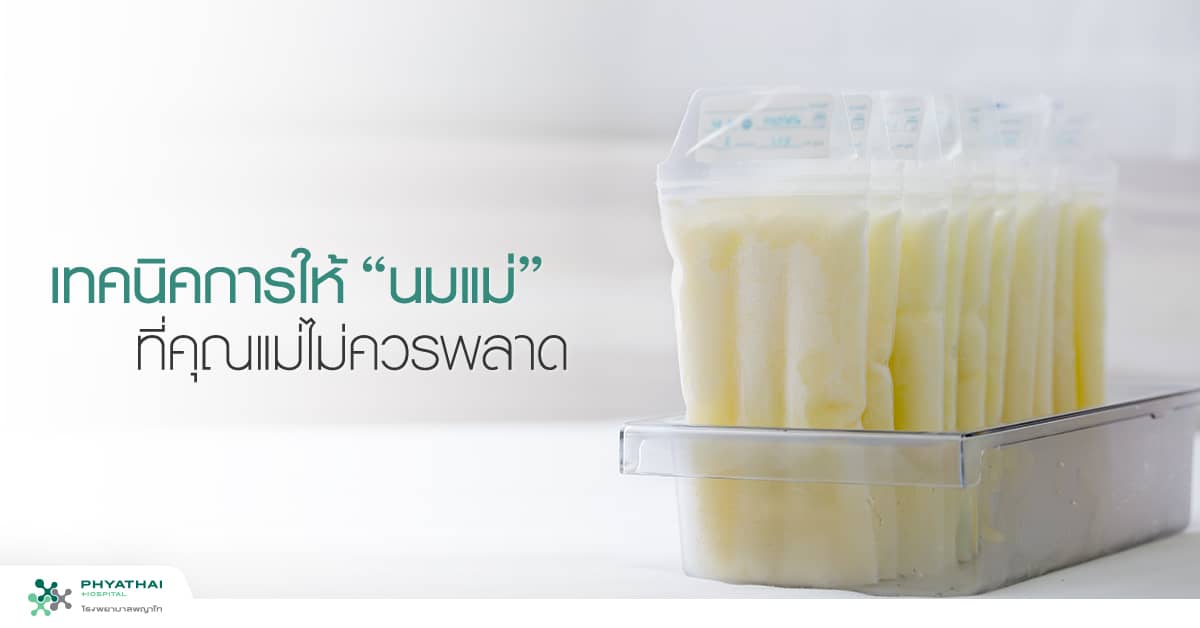
There is probably no food more beneficial and best for newborns than “breast milk.” It not only helps to satisfy the baby’s hunger but also acts like a vaccine rich in immunity, helping the baby to be strong and grow appropriately. Breast milk is also like a bond that transmits love and warmth from mother to child. However, good breastfeeding must be done safely, simply following the “1 2 3” principle: 1. Mother, 2. Breast milk, and 3. Baby. What are the details? Let’s understand with Dr. Wasan Nantasanti, a pediatric and neonatal surgeon at Phyathai 3 Hospital.
Mother, the source of essential nutrients
Good and safe breast milk must consist of the following 3 things
-
- Cleanliness
Before breastfeeding or pumping milk, mothers should wash their hands thoroughly and use a damp cloth to clean sweat and dirt around the breasts. Always wipe from the nipple outward to the areola, then change the cloth or rinse it with water and wipe from the inside out again. Both breasts should be cleaned. If using wet wipes, it is recommended to use alcohol-free and fragrance-free types. If the mother pumps milk, she should pump into a clean bottle and avoid using the same pump or bottle from the previous feeding without cleaning. Additionally, all equipment and bottles should be stored in a high, safe place away from animals and insects, with good ventilation and no dampness. The storage area should be separate from the diaper changing area.
-
- Food consumed by the mother
Breastfeeding mothers should drink plenty of water, about 3 liters per day, and eat clean food covering all 5 food groups. Medically, there are no forbidden or harmful foods, but the mother’s diet affects milk flow and composition. Mothers should be cautious, especially during the first month postpartum, as milk ducts are not fully expanded. Mothers should consume foods containing ginger to stimulate blood circulation, making milk flow easier. Foods like Kaeng Liang (Thai vegetable soup), banana blossom, dates, and avocado are high-calorie and can help increase milk volume. However, consumption of sweets with coconut milk, cheese, or bakery items with butter should be reduced as they make breast milk thick and fatty, which can cause milk lumps or blocked ducts. Excessively thick and fatty breast milk may also affect newborns, causing fat accumulation in the liver, potentially leading to liver and bile duct inflammation.
Medications: Most drugs that pass into breast milk affect the baby. Therefore, always consult a doctor before taking any medication or supplements, including milk boosters and galactagogues. Drinks containing alcohol and caffeine, such as tea and coffee, should be avoided. An easy way to observe is if the mother’s urine changes in smell or color after drinking, it means the drink’s components are absorbed into the bloodstream and can be passed into breast milk.
-
- Adequate rest and home environment
Postpartum mothers need plenty of rest. Mothers should try to sleep whenever the baby sleeps, especially at night, because the hormone that produces milk from the pituitary gland is secreted more at night, particularly during the first 10 days postpartum, which determines future milk volume. Therefore, mothers must rest well and reduce or avoid using all electronic devices at night. Most successful breastfeeding mothers have help or share household chores to allow maximum rest. The home environment should be quiet without loud noises, as noise disturbs the sleep of household members, especially the baby, who may startle, stop sucking, or wake up crying, causing the mother to wake and rest less.
Importantly, remember that the baby’s sucking stimulation is the most crucial factor for milk production. Therefore, before sleeping, mothers should set an alarm every 2-3 hours to wake and breastfeed the baby. If the baby refuses to suck, milk should be pumped immediately; otherwise, engorgement may reduce milk production or cause mastitis. Mothers should also be careful with tight bras or bindings, especially pressure during sleep, as these can cause mastitis.
Breast milk, the best immune reservoir for the baby
-
- How long can breast milk be stored?
Breast milk has an expiration date. No matter how much milk a mother stocks, it can be stored for no more than 1 year. Besides the rancid smell caused by air exposure, white blood cells and immune substances in breast milk gradually degrade over time and storage temperature. Bacterial growth may also occur.
The safe storage duration of breast milk to prevent bacterial growth is as follows:
| Hot weather | Cool weather | |
|---|---|---|
| Breast milk not refrigerated (27-32°C) | 2 hours | 3-5 hours |
| Air-conditioned room (20-26°C) | 3 hours | 6-8 hours |
| Cooler bag (15-20°C) | 8 hours | 8-24 hours |
| Shared freezer (frequent opening) | Separate freezer (infrequent opening) | |
| Regular refrigerator (1-5°C) | 24 hours | 3-7 days |
| Two-door freezer refrigerator (0 to -4°C) | 1-2 weeks | 4-6 months |
| Separate door temperature-controlled freezer (-15 to -23°C) | 3-6 months | 6-12 months |
However, always smell the milk after thawing to check if it has spoiled. After thawing, milk can be stored for no more than 24 hours in a regular refrigerator.
-
- Suitable milk temperature
Milk that is too hot is dangerous to the baby’s digestive tract, causing blistering or even stimulating tumors in the stomach. Heat above 40°C destroys white blood cells in breast milk. Milk that is too cold can cause hypothermia in the baby, which may cause some babies to stop breathing, especially premature infants. Suitable milk temperatures can be divided into 3 cases:
- For milk from stock, mothers should move frozen milk to the refrigerator for 1 day to thaw into liquid, then divide into bottles before warming.
- For freshly pumped milk stored in the refrigerator for daily use (not stock), warm or let it sit at room temperature for about 30 minutes before feeding.
- For formula milk, use boiled water cooled to room temperature, then pour into a bottle, close the lid, and use it to mix formula.
For warming milk, the doctor has a simple method to warm milk to the appropriate temperature without a bottle warmer as follows:
-
-
- Step 1: Use a coffee cup with a handle, fill half with warm water from a hot water flask (not exceeding 60°C) mixed with half room temperature water (1:1) to get about 40°C warm water.
-
(If using 95°C hot water, mix 1 part hot water with 4 parts room temperature water (1:4) before placing the milk bottle in it.)
-
-
- Step 2: Place the bottle containing breast milk from the refrigerator into the coffee cup for 5-10 minutes to reach about 25-30°C.
-
-
-
- Test the milk temperature by dripping some on the back of the hand; it should not feel hot or cold, indicating the milk is close to the mother’s skin temperature.
-
When to warm milk: For stored or bottled breast milk, the doctor recommends warming per feeding, only 1-2 ounces at a time. Generally, after the baby sleeps for 2 hours, warming milk can begin.
Importantly, warmed milk can be stored for another 2-3 hours at room temperature. If the baby has drunk from the bottle, it can be stored for no more than 1-2 hours. However, if the mother is skilled at breastfeeding and milk supply is consistent, pre-warming milk is unnecessary. Mothers may pump milk after breastfeeding to store as stock.
-
- Appropriate milk volume
Mothers should observe how often the baby urinates. If the baby urinates at least 6-10 times a day, the milk volume is adequate. If using diapers, babies often cry slightly when urinating, especially boys. Mothers can mark the wetness indicator on the diaper or observe the weight and thickness of the diaper when holding the baby to estimate urination frequency. The appropriate volume per feeding should neither be too little nor too much, varying by age and weight. The doctor summarizes into 3 age groups as follows:
-
-
- 0 – 3 days: Use the formula 10 cc/kg/feeding x 8 feedings/day (about 3 hours apart). For example, a 3 kg baby should receive 10 x 3 = 30 cc per feeding every 3 hours (30 cc = 1 ounce).
-
-
-
- 4 days – 1 month: Use the formula 4-5 ounces/kg/day divided into 6-8 feedings/day (about 3-4 hours apart). For example, a 4 kg baby should receive 4 x 4 = 16 or 5 x 4 = 20 ounces per day, divided into 2-2.5 ounces every 3 hours or 2.5-3 ounces every 4 hours.
-
-
-
- After 1 month: Use the formula 4 ounces/kg/day divided into 6 feedings/day (about 4 hours apart). For example, a 7 kg baby should receive 4 x 7 = 28 ounces per day, divided into 4.6 ounces every 4 hours or rounded down to 4.5 ounces every 4 hours, 6 feedings per day.
-
If formula supplementation is necessary, mothers should pump milk immediately and store it as stock to prevent prolonged engorgement, which reduces milk production or causes blocked ducts. After pumping until the breast feels empty, the baby can continue breastfeeding if the baby has consumed the appropriate amount of bottled breast milk or formula but is still hungry, to prevent overfeeding.
Baby, the mother’s heart
Generally, babies can safely breastfeed, but babies with the following conditions need help and treatment from specialists:
- Physical factors such as congenital heart disease, cleft lip and palate, tongue-tie, lip-tie, abnormalities of the esophagus and trachea structure, or Hirschsprung’s disease. These conditions can be corrected surgically.
- Physiological factors requiring time to correct, such as swallowing problems. Swallowing training improves sucking and reduces choking. Some problems can be managed by changing milk type, proper feeding position, and medication, such as acid reflux, bloating, and constipation.
- Hormonal factors such as hypothyroidism or adrenal gland dysfunction, which may cause lethargy or prolonged sleepiness. These can be treated with medication.
In summary, safe breastfeeding means the baby’s weight loss should not exceed 10% in the first 7 days. After that, weight should increase by 20-25 grams per day or 600-800 grams per month. Insufficient weight gain affects body function, may cause jaundice, and delay brain growth and development. Conversely, excessive weight gain over 30-35 grams per day or over 1 kilogram per month may cause obesity, breathing difficulties with unusual sounds, and may lead to overeating habits and obesity in the future. The doctor wishes all mothers success in breastfeeding, with healthy and strong babies.

Dr. Wasan Nantasanti
Pediatric and Neonatal Surgeon
High-Tech Surgery Center
Phyathai 3 Hospital
Make an appointment
