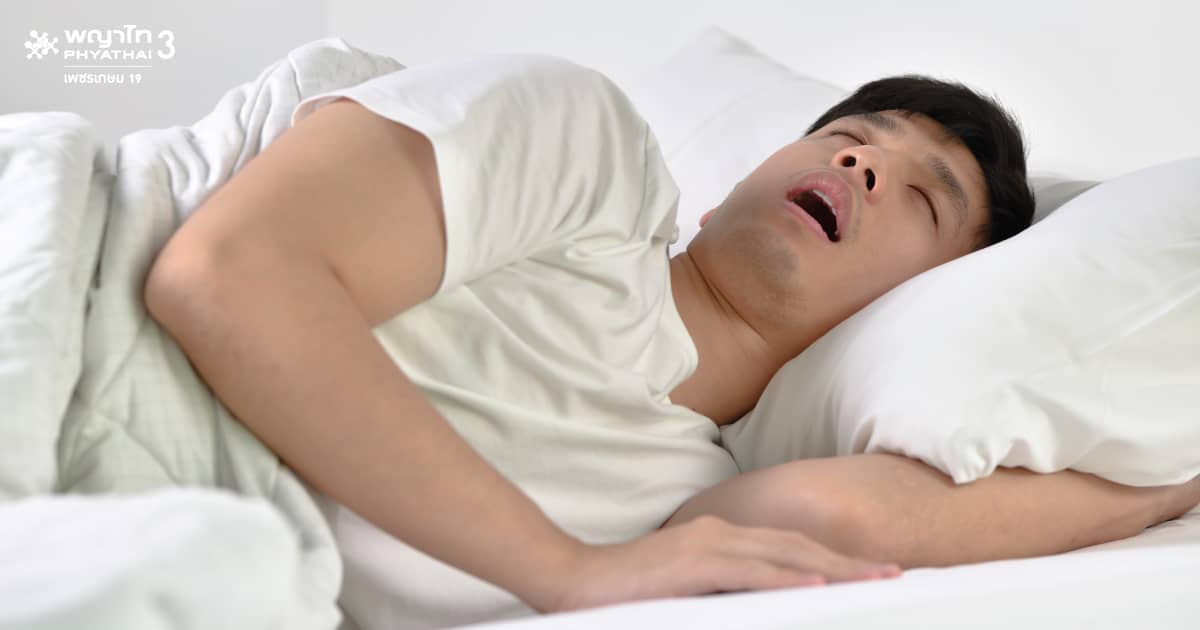
Don’t let snoring become chronic. You should see a doctor for proper diagnosis and treatment.
Snoring problems may occur with or without sleep apnea. But no matter what type of snoring you have, did you know… just sleeping and making snoring sounds enough for your bed partner to notice is a sign that you should see a doctor for an examination and receive treatment tailored to the cause.
Snoring problems are divided into 2 cases
- Common snoring found in the general population, where there is only snoring without sleep apnea. This case usually causes annoyance to those sharing the bedroom.
- Snoring with sleep apnea, where during apnea episodes, cells throughout the body receive insufficient oxygen. If left chronic for a long time, it may affect diabetes, cardiovascular disease, memory loss, or Alzheimer’s disease.
What factors cause snoring?
When we sleep deeply, the anatomy of various muscles in the oral cavity relaxes and sags, blocking the airway. It is found that over 80% of snoring sounds are caused by the vibration of the soft palate, occurring in 15% of men and 6.3% of women. Therefore, diagnosis to find the cause of snoring may require examination at multiple points.
Methods to treat snoring problems
- Non-surgical treatments include weight loss and exercise, avoiding medications or drinks that depress the central nervous system, changing sleeping positions, or possibly using a breathing aid device that delivers air pressure through the narrow throat to increase airflow during sleep (Continuous Positive Airway Pressure: CPAP).
- Surgical treatments depend on the cause and location of the snoring, such as:
- In cases of airway obstruction in the throat, such as enlarged tonsils, traditional tonsillectomy or laser surgery combined with tonsil repair, called LASER Tonsilloplasty, may be performed.
- In cases caused by a lax soft palate and elongated uvula, treatment options include:
- Using a scalpel and suturing to reshape the soft palate, called UPPP (Uvulopalatopharyngoplasty).
- Using laser-assisted surgery (LASER Anterior Palatoplasty) combined with suturing to reshape the soft palate and uvula, called Anterior Palatoplasty and Uvulopalatoplasty, which has advantages such as shorter surgery time, less bleeding, less postoperative pain, and faster recovery.
New technique… Treating snoring with spring thread insertion
Previously, snoring was treated by inserting Pillar implants into the soft palate to reduce the vibration causing snoring. However, some problems were found after treatment, so the method was developed from straight Pillar implants to spring threads instead. After inserting the spring threads, collagen forms around the threads, causing the soft palate to tighten, lift, and firm up, helping reduce soft palate laxity and decrease snoring.
The benefits of spring thread insertion not only help reduce snoring problems but also in patients with snoring combined with sleep apnea, spring thread insertion in the soft palate can help treat mild to moderate sleep apnea. Additionally, if patients need to use a Continuous Positive Airway Pressure (CPAP) device, spring thread insertion in the soft palate can enhance the effectiveness of CPAP treatment.
