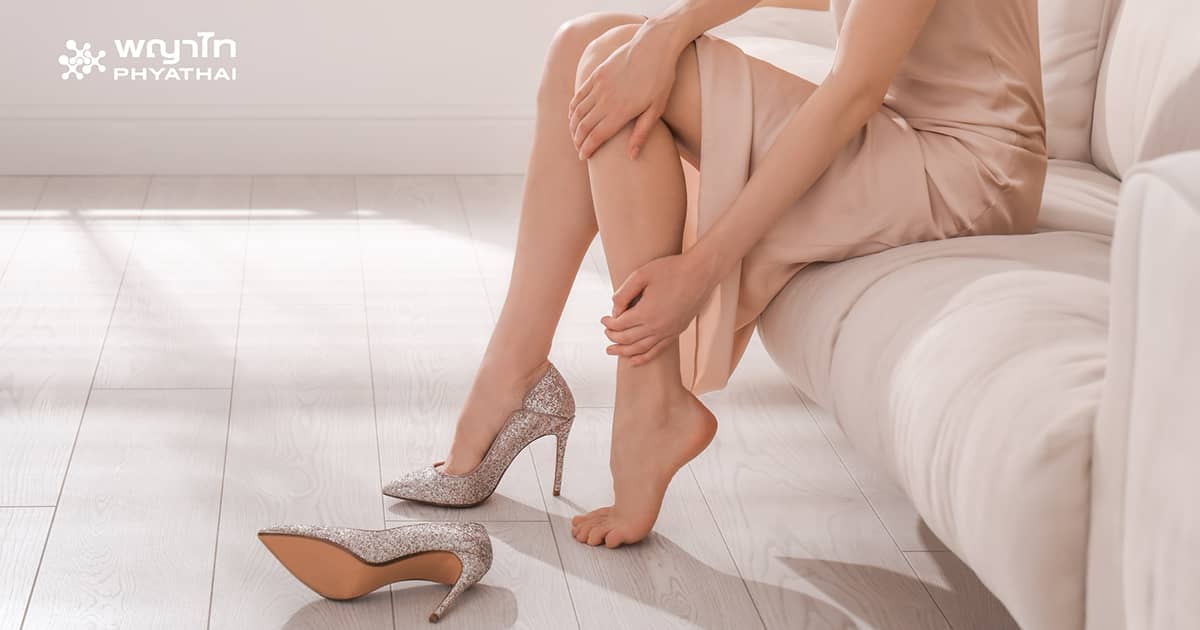
No matter what type you are—whether you sit for long periods, stand for long periods, or walk for long periods—you are at risk of “varicose veins”!
What causes varicose veins and how dangerous are they? Today, we will take a deep dive with Dr. Pongtawan Kalyapruk, a vascular surgery specialist at the Advanced Surgical Technology Center, Phyathai 3 Hospital, who will clearly explain every aspect.
What are varicose veins?
Varicose veins are a condition where small veins near the skin surface enlarge due to deterioration of the vein system’s function, causing increased blood pressure in the venous system. They are mostly found in the legs because the legs are continuously used, whether sitting, standing, or walking, which causes increased blood flow to the legs. The veins work harder and can easily deteriorate.
The most obvious sign is the appearance of dark blue or green veins on the legs in areas where they were not previously visible, along with clearly twisted veins on the skin surface.
Normally, veins function to carry blood from the lower body back to the heart. However, when the vein system malfunctions, blood flows backward to the lower body, increasing blood pressure in that area. The capillaries near the skin surface then enlarge, resulting in varicose veins.
Symptoms of varicose veins
Symptoms of varicose veins can be divided into 6 stages as follows:
Stage 1 Varicose veins are not clearly visible, but you will start to feel heaviness and discomfort in the legs when sitting, standing, or walking for long periods.
Stage 2 Capillaries in the legs begin to enlarge and may appear as red spider-web-like veins.
Stage 3 Varicose veins become larger and more visible on the skin, with increased twisting.
Stage 4Increased leg pain and fatigue when standing or walking for long periods.
Stage 5 Skin color on the lower leg near the ankle changes to brown or darkens.
Stage 6 Ulcers develop on the leg or foot due to chronic venous insufficiency.
Who is at risk of varicose veins?
- People who stand or walk for long periods
- People who sit for long periods or rarely change posture
- People who regularly wear high heels
- People who frequently lift heavy objects
- People who are overweight
Don’t wait for chronic varicose veins—see a doctor as soon as symptoms appear
Seeing a doctor early, when you first experience symptoms such as tightness or aching in the calf, or swelling in the legs after walking or standing for long periods, can reduce the risk of chronic vein damage and blood clots within varicose veins, as well as reduce the chance of complications.
How can varicose veins be treated?
Treatment methods vary depending on the stage as follows:
- Medication treatment is usually used in early-stage varicose veins. The medication helps stimulate the capillaries to function more effectively, improving contraction and blood flow, reducing blood pressure in the affected area, and alleviating leg heaviness and pain.
- Compression stockings treatment is used alongside medication, typically for early-stage patients.
- Surgical treatment is divided into two methods: open surgery, which involves tying off and cutting the veins causing varicose veins, and radiofrequency ablation surgery, which uses a small needle to puncture the problematic vein, inserts a catheter into the vein, and causes the vein to shrink to prevent blood flow through that area.
Radiofrequency ablation surgery—small incision
Radiofrequency ablation technology for varicose vein surgery is increasingly popular because it offers better results such as:
- Smaller incisions, reducing the chance of scarring
- Less pain after surgery
- Faster recovery
- Shorter hospital stay, usually only 1 night
- Ability to move and resume daily activities normally just 1 day after surgery
For those who sit, stand, or walk for long periods, follow these tips to reduce the risk of varicose veins
For those who need to stand or walk for long periods, doctors recommend the following:
- Regularly wear compression stockings to help improve vein function and prevent deterioration of the venous system, which reduces the risk of varicose veins.
- Change posture frequently to stimulate muscle activity and increase blood circulation, which also reduces risk.
