Bow Legs
The legs of normal children are not straight like adults. The more you look at them with your eyes, the more bow-legged they appear. This happens due to curvature of the knee bones. It usually occurs in children in the first 2 years. Another cause is that the other parts of the legs, whether they are the feet bones, shin bones or femurs or all three bone sections are twisted inward, so when a child sleeps with its legs outstretched, it can appear like there is a gap between the legs, making it seem like the child is bow-legged.
If the child is bow-legged, it is usually the case that the condition has developed since birth and both legs are equally curved, that is, if the left side is curved, the right side also has to be curved. However, as the mother continues to observe her child, as the child grows, the legs will gradually improve. The problem is that, because parents are always spending time with their child each day, they do not notice the change, even though the child continues to improve each year until about 2 years of age, by which point the child’s legs will appear like those of adults. On the other hand, if the child is bow-legged due to a bone disease, there will usually be abnormalities in other parts of the child’s body.
Flat Feet
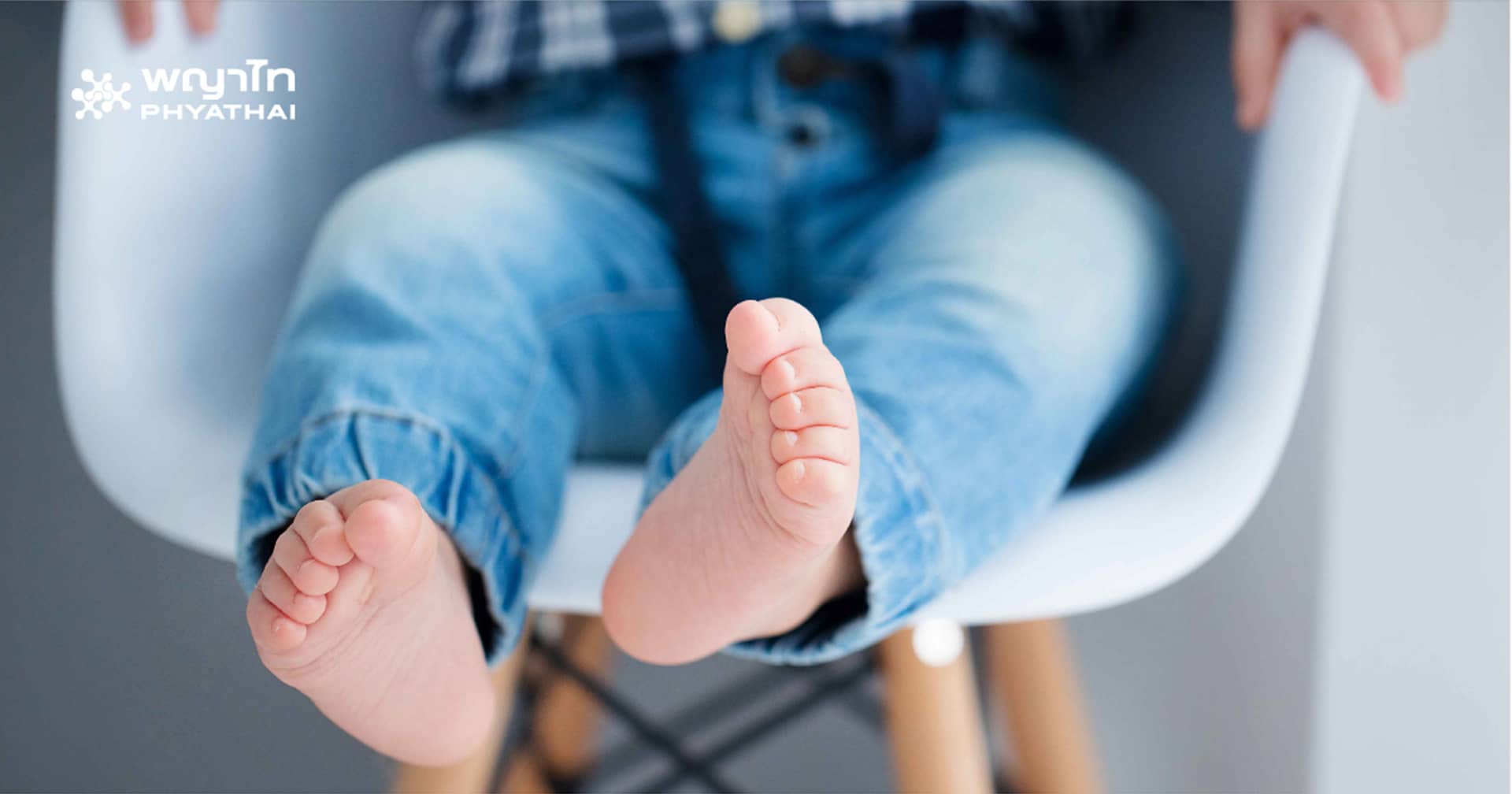
Flat feet or fallen arches is another common condition in ordinary infants. The condition happens while the child is still gestating due to the twisting and turning of the baby, which is supported and wrapped around by the uterus, leading to the bottom of the feet to bend out from the torso or to bend excessively inward. After birth, however, the feet will usually return to normal like ordinary children within 5 weeks after birth. Before the child can walk, the bottom of its feet will appear flat with no clearly visible soles as in older children. As the child starts to walk, both legs and the bottom of both feet will spread widely, and its body weight might fall on the inner side of the flat feet. Then, as the child grows older and can walk better and is able to stand straight and proficiently, with both feet directly next to each other, the body weight will fall along the axis of the leg bones and then toward the outside of the soles. By this time, the child will appear to be developing normally, with the formation of its soles.
Flat feet can be caused by genetics. If the child is more than 3 years old and it still has flat feet, this means that it has an abnormality, and you should quickly take the child to receive treatment. Possible symptoms include pain or aches in the calves in the late afternoon or evening hours or at night, when the child might wake up and cry due to calf pain and muscle cramps. Most children with flat feet do not enjoy running around or exercising outdoors like ordinary children due to experiencing pain or aches in their calves more rapidly that what would be normal, and when playing sports, the child might not be able to keep up with its peers. Furthermore, when the child has flat feet, there will also be signs of weakness in the hands and feet.
Treatment for Flat Feet
If a child still has flat feet after turning 3 years old, it should be taken to a doctor. If the child develops flat feet when it is 10-15 years old, the condition might have other causes such as tension in the Achilles tendon, arthritis or infection related to rheumatoid arthritis, although some cases might be due to congenital bone abnormalities, such as the bones of the feet being fused together to cause flat feet.
Club Feet
Club feet is a treatable condition with good outcomes if treated from a young age. For example, the child’s feet can be shaped to appear as normal as possible from infancy. Although the cause of this condition remains unclear, club feet is prevalent in 2 types as follows:
- Idiopathic clubfeet, which can be divided into stiff feet that cannot be reshaped as normal and soft feet that can be reshaped.
- Clubfeet due to diseases or abnormalities present in other parts of the body, such as locked joint cartilage or girdling by the placenta or neurological disorders.
For treatment to be effective, it must be administered early right after birth by bending the feet back into their normal shape and then using casts to control them, with additional bending and cast replacements every 1-2 weeks until the shape of the feet improve. If the child does not recover from the condition, surgery might be necessary. If the child’s feet are reshaped appropriately to the point that they recover well, the doctor will require the child to wear special shoes until about 5-7 years old. Surgery should be considered in cases where the feet are too rigid for reshaping.
