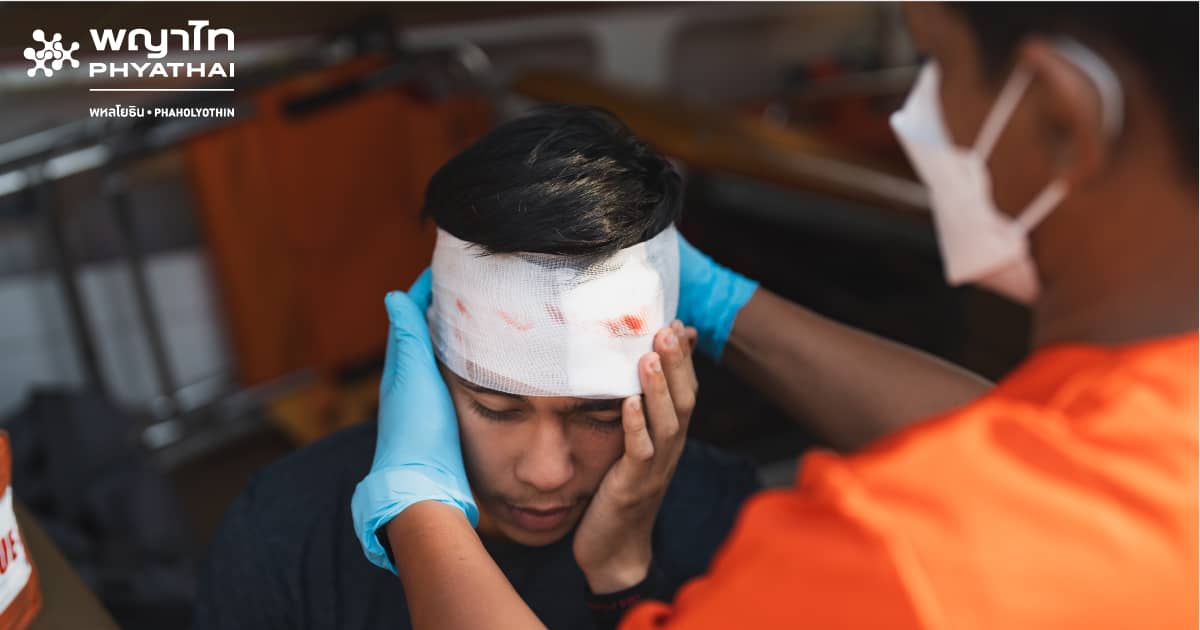
If you suddenly trip and fall, hitting your head on the ground, get hit by a hard object, or your head receives an impact from an accident, the symptoms that follow may start from just a headache, dizziness, or confusion, to loss of consciousness, or only have head wounds such as abrasions, swelling, and redness. Even if the symptoms seem minor, they should not be overlooked because the effects on the brain may appear later. Seeing a doctor for a check-up will help with monitoring, timely treatment, and reducing the risk of complications. Proper first aid before reaching the doctor is equally important.
First Aid Methods for Head Impact
Proper first aid helps reduce the severity of symptoms, lowers the risk of complications, and increases the chances of recovery by doing the following:
- Ask the injured person about their symptoms if they are still conscious, such as dizziness, nausea, or severe headache.
- If there is an open wound on the scalp, use a clean cloth to gently press to stop the bleeding. However, if a skull fracture is suspected, do not press directly on the wound; cover it with a clean cloth instead.
- Use cold compresses to reduce swelling by wrapping ice or a cold gel pack and applying it to the impacted area for 10-15 minutes every hour.
- Do not move or turn the head or neck unnecessarily. If a neck or skull fracture is suspected, wait for medical personnel to assist.
- Observe symptoms carefully. If there is weakness in the arms or legs, slurred speech, bleeding or clear fluid from the ears or nose, call an ambulance immediately and inform the doctor of the symptoms for further care instructions.
- Do not drink water or take medication on your own as it may cause choking or worsen symptoms. Wait for medical advice.
Dangers of Internal Brain Injury After Head Impact
Internal brain injuries caused by head impact can lead to several dangers, especially when the injury is severe, such as:
- Intracranial Hemorrhage may increase pressure inside the skull, causing severe headache, drowsiness, seizures, or weakness in the arms and legs. Without treatment, it may lead to loss of consciousness.
- Cerebral Edema results from fluid accumulation in the brain tissue, increasing pressure inside the skull. Symptoms may include severe headache, nausea, vomiting, blurred vision, or loss of consciousness. If the pressure is very high, it may compress the brainstem, affecting breathing and heart function.
- Psychological and Emotional Changes Brain injury may affect the areas controlling emotions and behavior, causing confusion, irritability, mood swings, or behavioral changes, which can impact daily life and relationships.
- Injury to the Frontal or Temporal Lobes may affect memory, speech, or motor control, leading to memory loss, speech difficulties, or loss of balance.
- Long-term Risks such as dementia, Parkinson’s disease, or epilepsy.
Checklist… Symptoms to Watch For and When to Go to the Hospital Immediately
After receiving first aid or medical examination, continuous observation of symptoms for at least 72 hours is necessary because complications may occur later. Avoid activities that may impact the brain, such as heavy exercise, driving, taking sedative medications, or drinking alcohol. Symptoms to watch for include:
- Neurological Symptoms
- Severe headache that does not improve or wakes you up at night
- Projectile vomiting or vomiting more than 5 times continuously
- Seizures, convulsions, or loss of consciousness
- Psychological and Behavioral Changes
- Severe confusion, slurred speech, difficulty communicating
- Unusual drowsiness, unresponsive to waking
- Temporary memory loss, unable to recall events before or after the head impact
- Physical Abnormalities
- Weakness, numbness, unsteady walking, loss of balance, or loss of sensation in limbs
- Blurred vision, double vision
- Signs of Severe Injury
- Clear or bloody fluid draining from the ears or nose
- Skull fracture or depression
- Severe neck pain, inability to move the neck
- Signs of Infection or Complications
- Fever over 5°C
- Abnormally slow pulse
Although a head impact accident may seem minor, neglecting symptom observation or improper first aid can lead to severe complications. To prevent complications, symptoms should be closely monitored. If severe symptoms are found, see a doctor immediately. Phyathai Phaholyothin Hospital has a specialized medical team and advanced technology for diagnosis, enabling rapid and accurate assessment. Patients receive appropriate and timely care, increasing the chances of faster recovery and reducing the risk of complications.
Assoc. Prof. Dr. Preeda Samritpradit
Specialist in Endoscopic Surgery
Phyathai Phaholyothin Hospital
