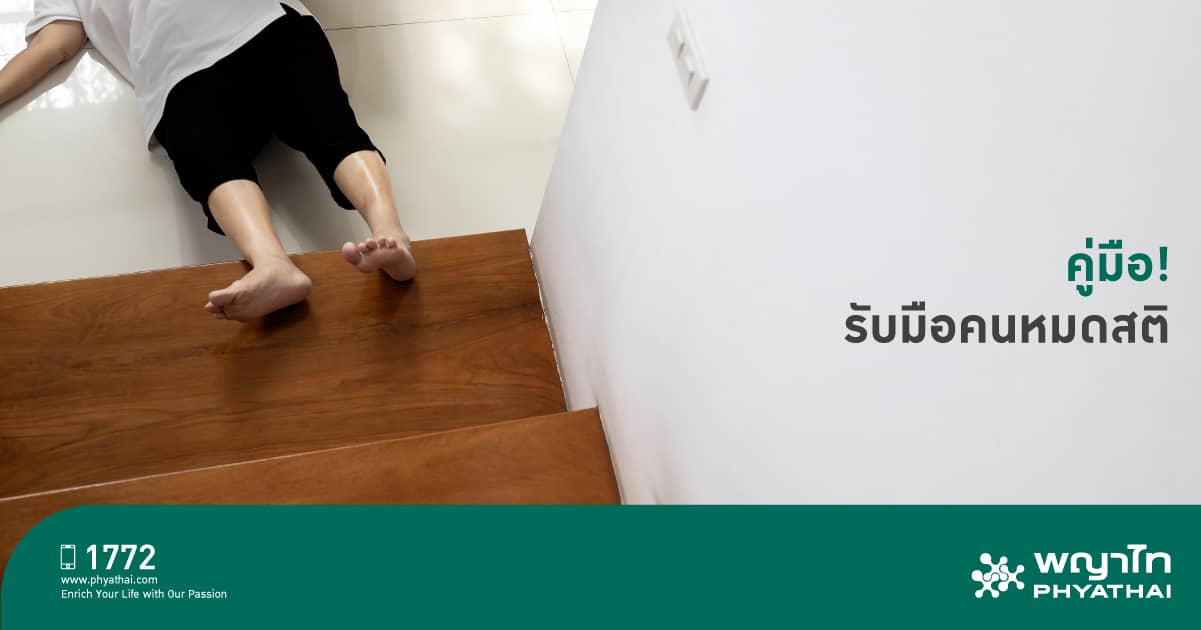
In daily life, we may have the opportunity to encounter unconscious patients at any time. What often comes to the mind of the helper is what to do when encountering this situation, or how to assist them safely. Some may even be too afraid to take any action. Therefore, if you do not want to hesitate in helping patients, let’s learn the correct and appropriate steps and methods.
- You must check whether the person is truly unconscious by calling the patient. Some victims may just be drowsy, so you should call the patient loudly while shaking their shoulders. However, be especially careful with accident patients as this may worsen their injuries.
- If the patient is conscious, immediately send them to the hospital to find the cause of the illness and receive treatment accordingly. There are many causes that can alter a patient’s level of consciousness, such as low blood sugar or increased pressure in the brain. Therefore, do not ignore the situation and send the patient to the hospital for treatment as soon as possible.
- If calling loudly and shaking the patient appropriately still results in unconsciousness, check the pulse at the neck, which is where the carotid artery supplying blood to the brain lies just beneath the skin, making it easy to feel.
- If the patient has a pulse, send them to the nearest hospital urgently to find the cause of unconsciousness.
- If the patient has no pulse, immediately perform chest compressions for basic life support by pressing on the center of the chest about 2 inches deep at a rate of 100 compressions per minute. If advanced life support has not been provided, alternate chest compressions with mouth-to-mouth resuscitation at a ratio of 30 compressions to 2 breaths continuously.
- Others who are not performing basic life support should immediately call advanced rescue units by dialing 1669 or the emergency number of the nearest hospital, preferably the hospital closest to the incident location.
- While the victim is under the care of the helper, do not leave the victim alone. Importantly, do not give food or water while the patient is unconscious as this may cause choking and affect the respiratory system.
These are simple steps that will help you assist victims confidently, quickly, and correctly because we cannot predict when we will encounter a victim, and one day the victim could be us.
Khun Sirikan Taothong
Emergency and Accident Department Manager
Internal Medicine Center, Phyathai Sriracha Hospital
Emergency and Accident Department Manager
Internal Medicine Center, Phyathai Sriracha Hospital
