What is Blood Glucose Monitoring (BGM)?
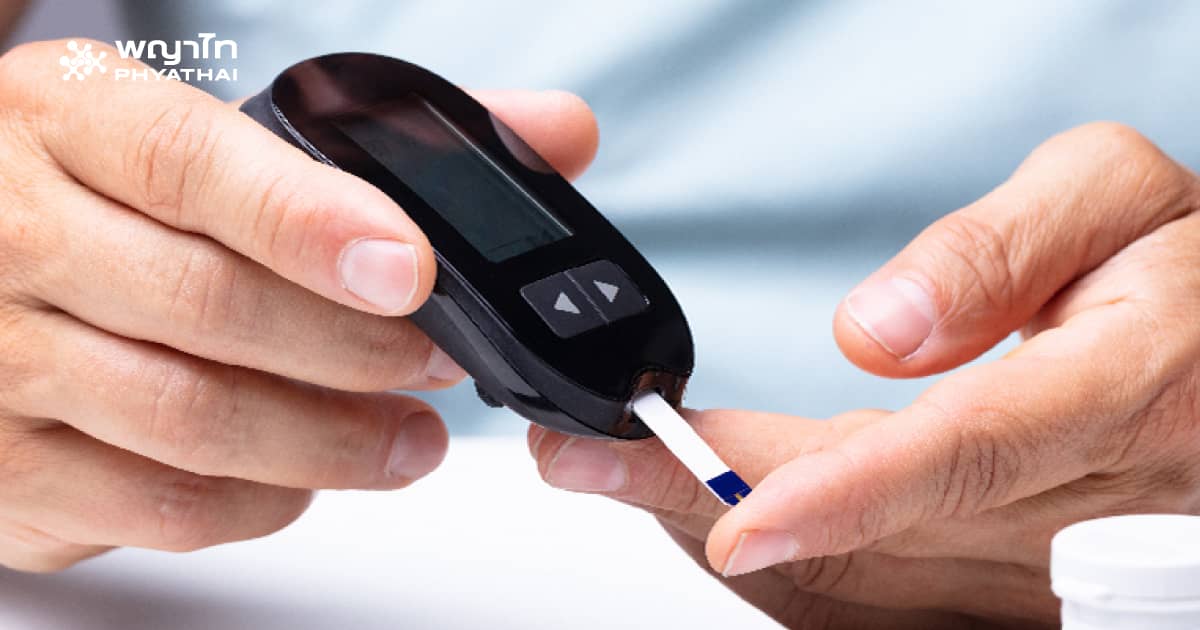
BGM (Blood Glucose Monitoring) is self-monitoring of blood sugar levels without having to go to the hospital. It is a test to track blood sugar levels in diabetic patients by using a pen needle to prick the fingertip, then placing a drop of blood on a test strip, and measuring the value with a device called a Blood Glucose Meter
Who should use a portable blood glucose monitoring device (BGM)?
Self-monitoring of blood sugar levels with a portable device is suitable for patients with high blood sugar levels at risk of diabetes and for both type 1 and type 2 diabetic patients for self-care and to inform the doctor during appointments. The necessity may be considered as follows:
- Diabetic patients who still cannot control their blood sugar levels adequately
- Those who need to regularly monitor blood sugar levels but find it inconvenient to visit the hospital frequently
- Those who want to continuously monitor diabetes treatment results for better self-care
- Doctors recommend strict blood sugar control
Preparation before measuring blood sugar with a portable device (BGM)
- Avoid all food and drinks, including chewing gum or sucking candy, for at least 8 hours before blood sampling
- When testing blood sugar before meals and 2 hours after meals, the reference values for interpretation differ
Steps for measuring blood sugar with a portable device (BGM)
- Wash hands thoroughly before every blood sampling
- Turn on the Blood Glucose Monitoring device and set it correctly according to the user manual
- Massage the fingertip to be pricked to improve blood circulation. Usually, blood is drawn from the middle or ring fingertip
- Use a 70% alcohol swab to clean the area to be pricked to prevent infection, and wait for it to dry before pricking
- Use the lancet device to prick the side of the fingertip
- Wipe away the first drop of blood with a dry cotton swab, then use the second drop on the test strip
- Insert the test strip into the Blood Glucose Meter
- Read the test result displayed on the screen and record the result every time
Benefits of blood sugar monitoring with a portable device (BGM)
Blood sugar monitoring with a portable device (BGM) has many benefits, such as
- Patients do not need to visit the hospital frequently, saving time and costs
- Helps patients better control blood sugar levels through appropriate diet, exercise, or medication based on their current condition or blood sugar levels
- Helps assess risk and reduce the chance of complications such as heart disease, kidney disease, liver disease, and vision loss from diabetic eye complications
- When patients bring their blood sugar records to the doctor, it helps the doctor have more information to adjust the treatment plan
Criteria for blood sugar levels for care and treatment
Blood sugar level criteria are measured in milligrams per deciliter (Mg/dL) and can be interpreted as follows
- Blood sugar levels between 70-100 Mg/dL indicate a normal condition
- Blood sugar levels between 100-125 Mg/dL indicate a risk condition or prediabetes
- Blood sugar levels above 126 Mg/dL indicate a high risk of diabetes, which requires a doctor’s diagnosis
For patients diagnosed with diabetes, blood sugar levels should be controlled as follows
- Blood sugar levels before each meal should be between 80-130 Mg/dL
- Blood sugar levels 2 hours after meals should be less than 180 Mg/dL
However, these numerical criteria should be considered individually for each diabetic patient, taking into account age, duration of diabetes, complications, and comorbidities to adjust diet, exercise, and medication appropriately.