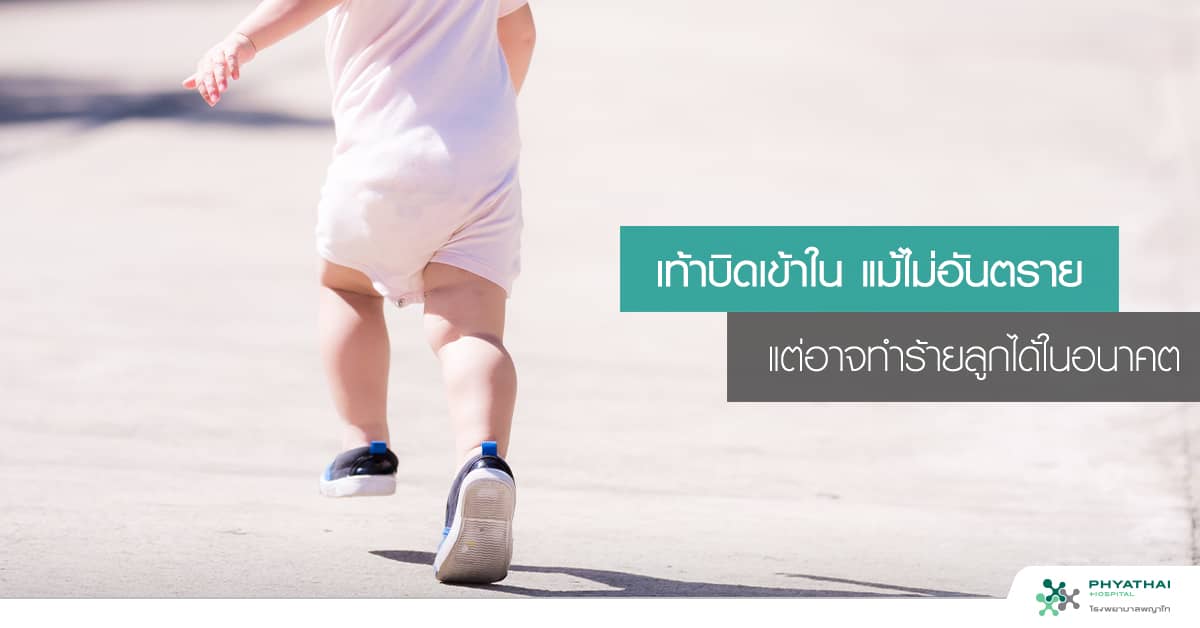
During childhood, it is a period when the body is still not fully developed. This is a time when many abnormalities may occur, affecting the physical and mental health of the child in the future. “Intoeing” is one of the common conditions found in both boys and girls. Although most cases are not seriously harmful, if not properly cared for, it may affect the child’s posture as they grow up. Therefore, understanding intoeing is important for all parents of young children to ensure their child grows up as healthily as possible.
What is intoeing and what factors cause it in children?
Intoeing is a noticeable foot deformity caused by abnormalities in three bone areas: the hip bone twisting forward more than normal, the shinbone rotating inward more than normal, and the foot bone twisting inward more than normal. It can be caused by one of these abnormalities or a combination of all three. Diagnosis to determine which bone is affected requires a physical examination. Intoeing is commonly seen in children aged 2-4 years and does not cause any pain, only the foot shape is turned inward, resulting in an abnormal walking pattern.
How to treat when your child has intoeing?
In reality, “intoeing” is a non-dangerous condition that can naturally resolve with age. We can gradually observe and treat symptoms as they appear. If by the age of 7-8 years the intoeing has not corrected itself, it may indicate a more serious abnormality requiring surgical correction. However, most children with intoeing do not need surgery because the foot usually rotates back on its own. Even if it does not fully correct, surgery is unnecessary as it does not cause difficulty in daily life. Surgery is reserved for severe cases where the foot is so twisted that walking is impossible, often accompanied by other conditions such as cerebral palsy. Surgery involves realigning the bones, inserting metal plates, and casting to secure the bones until healed. After the bones have healed, the child can walk normally again, typically within 1-2 months post-surgery.
If not corrected by surgery, how can intoeing be treated?
Non-surgical care to prevent worsening of intoeing can be done in several ways. For intoeing caused by excessive hip bone rotation, avoid W-sitting or sitting cross-legged with legs splayed out. Encourage sitting cross-legged instead to prevent further hip bone rotation and worsening of intoeing. For intoeing caused by excessive foot bone rotation, special corrective shoes may be used. However, children aged 2-7 years can still naturally outgrow the condition as their walking pattern can still change. By ages 8-9, walking patterns stabilize, and if intoeing persists significantly, consulting a specialist for further treatment is recommended.
“Intoeing” is a harmless condition that is clearly visible and does not cause pain. Over 96 percent of cases resolve naturally if no other diseases are present. If surgery is needed, it is curative and the condition will not recur. Therefore, parents should not worry or panic excessively if they notice intoeing but should monitor whether the condition worsens. If it does, consulting a doctor for a detailed diagnosis and appropriate treatment plan is advised to help the child grow into an adult with good posture and strong, normal feet.
