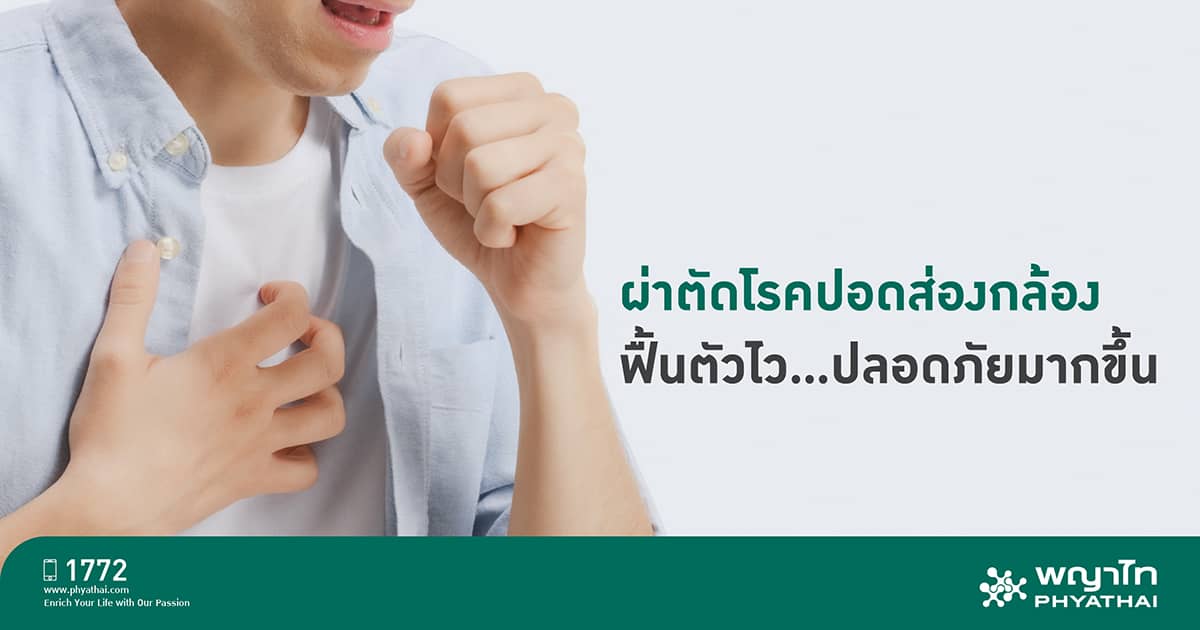
With the current high pollution environment, the trend of ‘lung diseases’ patients is increasing, including lung cancer, pneumothorax and other types of lung diseases. Some patients may require surgical treatment. ‘Lung surgery’ is considered major surgery. However, with the advancement of medical technology, lung surgery is no longer as frightening as in the past.
Meanwhile, Assoc. Prof. Dr. Sira Laothai, a specialist in lung and thoracic diseases and an expert in thoracoscopic surgery at Phyathai 1 Hospital said…
“In the early days of lung surgery, it was performed by opening the chest cavity, which required cutting several muscles and spreading the ribs to access the surgical site. This caused a high rate of complications and chronic pain after surgery. Nowadays, lung surgery has greatly developed, especially thoracoscopic surgery, which makes lung surgery safer. For patients without underlying diseases, the chance of severe complications is much lower than in the past, at only about 1 percent.”
After lung surgery… will life return to normal?
Patients who need lung surgery often worry about whether they can return to their normal daily life and breathe as before after the surgery. Therefore, before every lung surgery, doctors will conduct a pulmonary function test to assess whether the patient can tolerate the surgery. If lung function is insufficient, the patient may need alternative treatments. Besides pulmonary function testing, patients also need to be screened for other diseases, especially those that may cause complications during lung surgery, such as diabetes, hypertension, heart disease, and coronary artery disease.
How long is the recovery after lung surgery?
Recovery after lung surgery usually requires patients to stay in the hospital for about 2-3 days post-surgery, or longer if there are comorbidities. The key to recovery is lung exercises using a device called Incentive Spirometry to prevent lung collapse or incomplete expansion after surgery. The principle of this device is to encourage patients to take deep breaths so that the ball rises to the highest point and stays there as long as possible, allowing the lungs to fill with air fully and for the longest duration. After surgery, some patients may experience coughing, irritation, or sharp pain around the operated ribs due to nerve inflammation, but most symptoms gradually improve within 2-3 months.
Returning to normal life after lung surgery
When patients return home, most can resume daily activities such as walking to the bathroom or doing household chores independently. As they become more agile, they can perform outdoor activities. Exercise can be resumed close to previous levels after the recovery period. Additionally, doctors usually advise patients to avoid flying or deep diving for about 1-2 months after surgery. Regarding diet, patients can eat all types of food except those restricted by other existing conditions and should eat adequately for good recovery.
For those with ‘lung disease risk’ or suspicious abnormal symptoms, do not neglect or delay until the condition worsens into severe lung disease or advanced lung cancer. Promptly consult a doctor for diagnosis and timely treatment planning.
Assoc. Prof. Dr. Sira Laothai
Specialist in lung and thoracic diseases
Internal Medicine Center, Phyathai 1 Hospital
