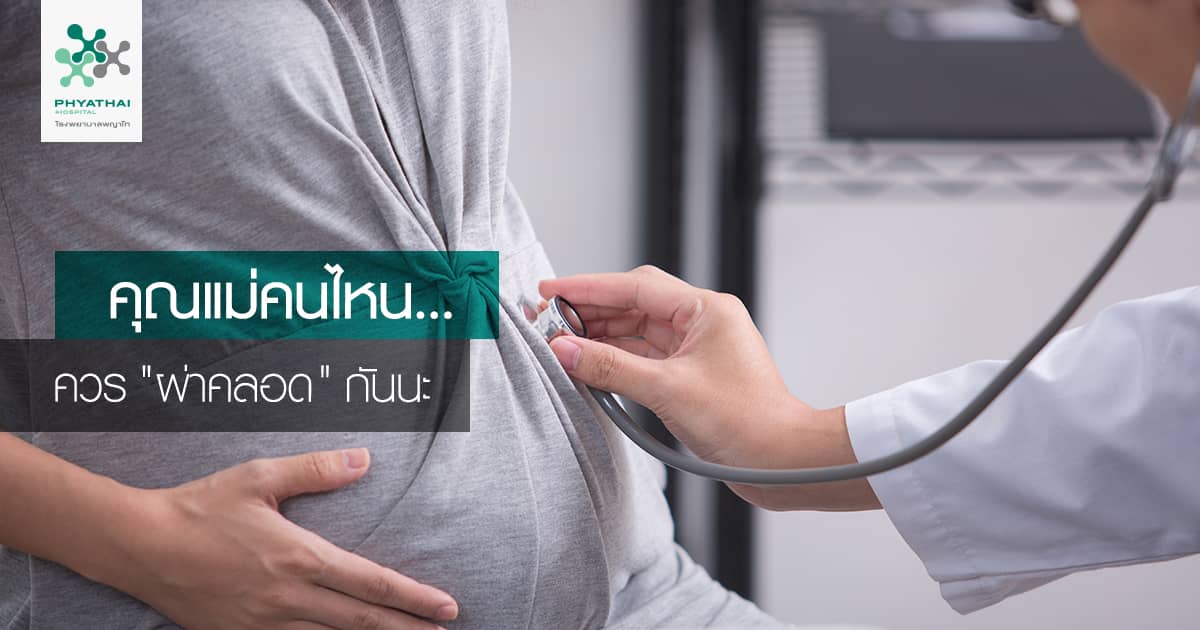
Cesarean Section is an option for delivery that helps ensure the safety of both mother and baby in cases of pregnancy abnormalities or indications for cesarean delivery. Although modern cesarean sections use technology to reduce the risks of complications during and after surgery, mothers still need proper knowledge and understanding to care for themselves and recover fully after the procedure.
In which cases? ..is cesarean section necessary
- Narrow pelvis condition: This occurs when the size of the mother’s pelvis does not fit the baby. It often happens with small mothers whose babies are larger than the pelvic size, making natural delivery impossible.
- The baby is not in a head-down position: The baby may present buttocks first or lie sideways, making natural delivery impossible as it could cause injury to the baby.
- The baby has oxygen deprivation or abnormal heartbeats.
- Placenta previa: Normally, the placenta attaches at the top. In placenta previa, the placenta moves down to cover the cervix, which should open for the baby to pass through, making natural delivery impossible.
- There is a tumor blocking the birth canal: A tumor located in the lower part of the uterus obstructs vaginal delivery and prevents the baby from coming out.
- Twin pregnancy: Natural delivery is not preferred because after one baby is born, the other may turn or flip inside the womb, which can be dangerous for the baby. Cesarean section is recommended for safety.
How many cesarean sections can be done safely?
Cesarean sections can be performed multiple times, but after the third time, the mother’s surgical risk increases. Each surgery causes internal scar tissue (adhesions) to form, which pulls nearby organs closer to the uterus during surgery, increasing the risk of injuring adjacent organs. Organs at risk during surgery include the bladder and the digestive system.
If the first delivery was by cesarean, is the next delivery also required to be cesarean?
If the mother had a cesarean section for the first delivery, the next pregnancy should also be delivered by cesarean because
The cesarean section causes a scar on the uterus. Therefore, in the next pregnancy, when the uterus expands and contracts, its elasticity decreases, causing tension when stretched. This may lead to uterine rupture, with about a 1% chance of rupture. Natural delivery is thus not a suitable option for mothers who have had a cesarean section before.
How to take care of yourself after a cesarean section
- The mother will recover within 12 hours and can be discharged from the hospital within 4 days.
- During hospital recovery, close monitoring occurs every 2 hours, with pulse and blood pressure measured every 4 hours.
- After discharge, the mother should take good care of the surgical wound, avoid getting it wet, and refrain from lifting heavy objects or straining the abdomen because the wound is fresh and at risk of infection, inflammation, and rupture.
- The abdominal scar may take some time, about 6 weeks, to heal completely and dry.
Dr. Tharinee Lamluek
Specialist in Maternal and Fetal Medicine
Women’s Health Center, Phyathai 2 Hospital
