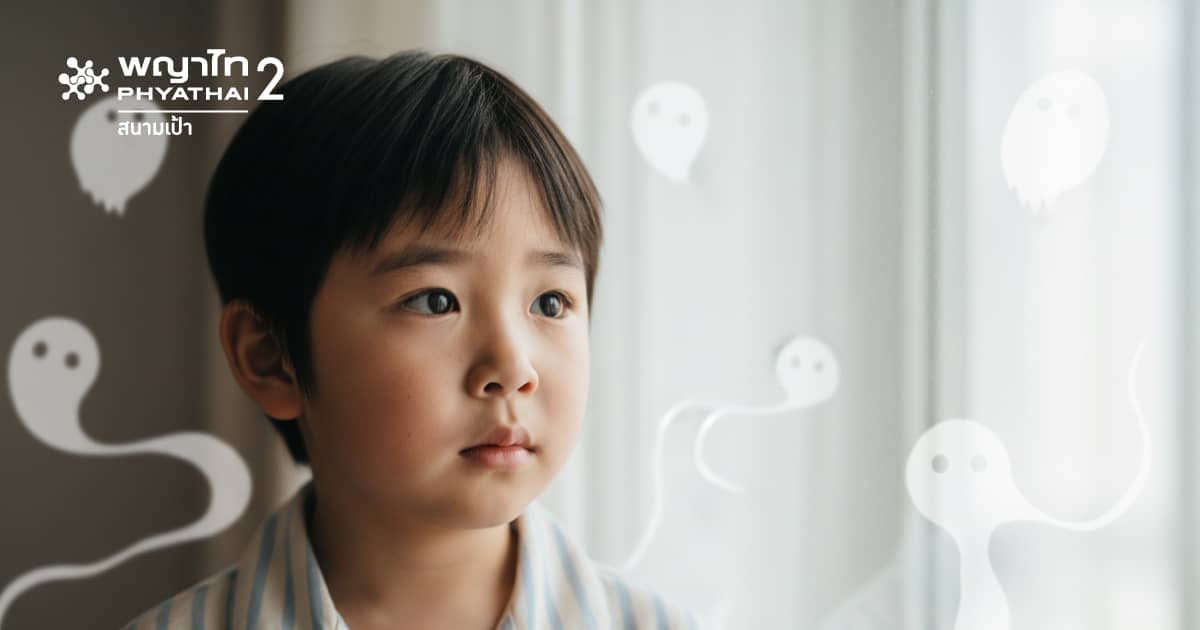
Sometimes parents may be startled or get goosebumps when they hear their child talk about an “invisible friend” or say they see a “ghost” or a “mysterious shadow” that no one else can see. Many families consider it just a child’s imagination, while some feel scared or worried that it might be related to the supernatural. However, medically, hallucinations or the belief in seeing things that are not real may be a sign reflecting physical or mental abnormalities that should be properly evaluated.
Is it normal for children to have a vivid imagination?
Children aged between 2–7 years are in a stage of rapid brain development, and their imagination system is very prominent. Children may create an imaginary world, have “imaginary friends,” or talk to things that do not exist. In most children, this is not a problem and usually disappears as they grow older. However, if that “imagination” starts to interfere with daily life, such as being so scared that they dare not be alone, having insomnia, or showing aggressive behavior, along with poor academic performance, parents should closely observe and take the child to consult a doctor.
Hallucination is not just about ghosts
First, we need to distinguish whether this is a hallucination or an illusion because illusion is a misinterpretation of something real, such as seeing a shadow of clothes as a person. This is common in children and usually not dangerous. However, hallucination is perceiving something that does not exist at all, such as seeing people or hearing voices when there is nothing there, which may be related to certain brain or mental conditions.
Medically, the term “hallucination” means perceiving something that does not exist, such as seeing images, hearing sounds, or feeling touches when there is nothing real. This can occur from various causes, such as:
- Certain types of epilepsy (Epilepsy with Visual Hallucination) Children may see flashing lights, moving objects, or shadows. It usually occurs suddenly and disappears within a few seconds. Sometimes it is accompanied by daydreaming or temporary loss of consciousness.
- Early-Onset Schizophrenia in children is relatively rare. However, it should be monitored if the child starts showing unusual behavior, such as talking to things that do not exist, believing they have special powers, often showing aggressive behavior, anxiety, or social withdrawal.
- Severe Anxiety or Post-Traumatic Stress Disorder (PTSD) Children who experience traumatic events, such as losing a loved one, accidents, or abuse, may have hallucinations as a brain response trying to process the repeated events.
- Autism Spectrum Disorder Some autistic children may talk about unrealistic things or focus on objects or imaginations that others find hard to understand. Although these are not true hallucinations, they may be misinterpreted.
- Use of drugs or poisoning from certain substances Some medications, such as those for ADHD, or substances that children may accidentally ingest, can cause hallucinations.
Red Flag Signs that parents should take their child to see a doctor
If behaviors related to “seeing ghosts” or the supernatural have the following characteristics, medical consultation should be sought immediately:
- The child shows increased fear, anxiety, or social withdrawal
- Talking to themselves or responding to things that do not exist
- Abnormal behaviors such as aggression, depression, or attention deficit
- Repeated hallucinations even in normal environments
- History of neurological disorders, epilepsy, or developmental abnormalities
Proper evaluation and care
To find the cause of hallucinations in children, a detailed history is necessary, including physical, mental, and environmental factors. Tests such as electroencephalogram (EEG), brain MRI, or psychiatric evaluation by a specialist may be required.
Proper care does not focus only on treating the disease but also includes understanding, family support, and providing a safe environment for the child.
Do not overlook “hallucinations” as just child’s play
Although having an imagination is normal for children, when “seeing ghosts” or “hallucinations” begin to affect behavior, learning, or the child’s quality of life, parents should be open-minded and not quickly judge it as “superstition” or “the child is lying.” They should listen, observe, and take the child for evaluation by a specialist to diagnose and plan proper care.
Assoc. Prof. Dr. Chidchanok Thianphat
Pediatric Neurology Specialist
Phyathai 2 Hospital
