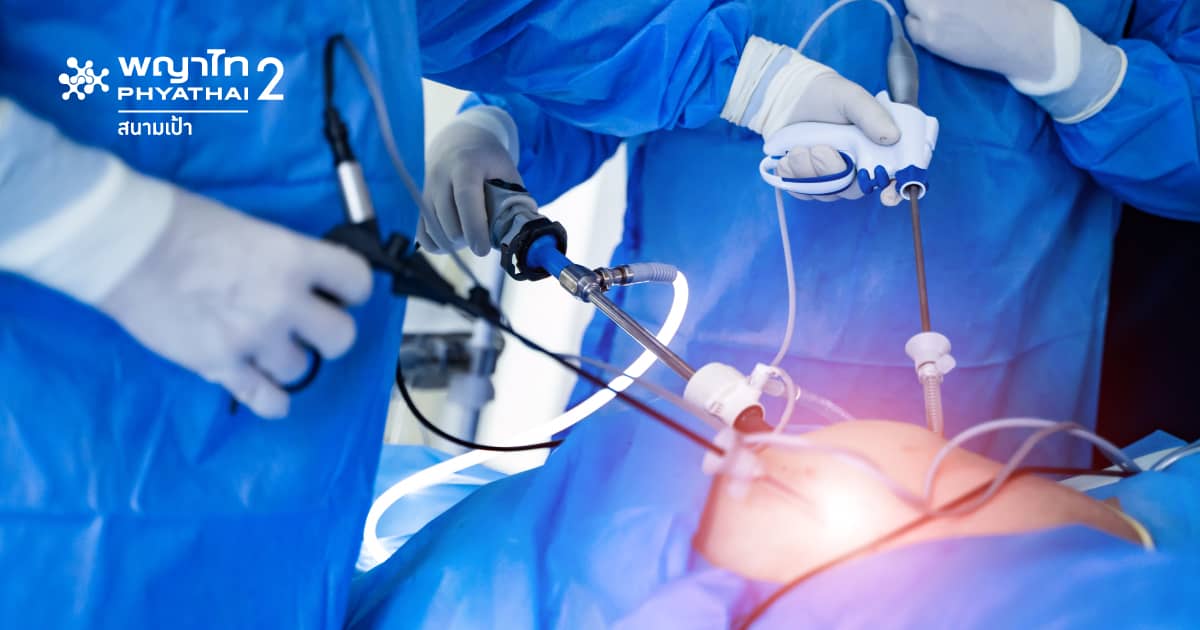
Innovations in Laparoscopic Surgery
By the Advanced Surgical Interventional Technologies Center (ASIT)
It is undeniable that surgical innovations that aid in rapid recovery have played a significant role in continuously advancing the effectiveness of treatments requiring surgery. The Advanced Surgical Interventional Technologies Center (ASIT) was established to holistically improve patients’ quality of life. This not only includes Minimally Invasive Surgery (MIS) or laparoscopic surgery performed by specialized surgeons but also encompasses diagnosis and treatment using some of the most advanced equipment in Thailand. Additionally, care and advice are provided by a highly experienced team of doctors, nurses, and staff to ensure comprehensive and complete treatment.
Understanding Minimally Invasive Surgery (MIS)
Laparoscopic surgery is performed by making small incisions in the skin at the treatment site to insert a camera and surgical instruments for the operation. The incisions are small, about 1-2 cm, to provide clear images and minimize damage to tissues and internal organs, reducing the risk of complications. Patients have a short recovery time, small wounds, and less pain.
How is MIS better than open surgery?
- The incision size is only 5-10 millimeters, whereas traditional surgery involves incisions 12-20 centimeters wide.
- The surgery time is faster.
- Recovery time is quicker than traditional surgery, which requires 7-14 days; in some cases, patients can return home immediately after laparoscopic surgery.
- Less blood loss and less pain compared to open surgery.
- Due to the high magnification of the camera, doctors can clearly see detailed areas inside the body that need surgery.
- Large wounds from traditional open surgery may cause abdominal adhesions post-surgery.
- Reduces the risk of postoperative complications.
- Patients can return to work and daily activities faster.
- An additional benefit of smaller surgical wounds is improved cosmetic outcomes.
Which diseases can be treated with laparoscopic surgery?
Almost all abdominal diseases can be treated with laparoscopic surgery.
- Gynecological laparoscopic surgeries include chocolate cyst removal, ovarian and fallopian tube tumor removal, uterine fibroid removal, and laparoscopic hysterectomy.
- General surgical laparoscopic procedures include gallstone removal, stomach and esophageal tumor removal, spleen surgery, inguinal hernia repair, diaphragmatic hernia repair, adhesion removal, colon tumor surgery, kidney and adrenal gland surgery, appendectomy, thyroid surgery, lung surgery, hemorrhoid surgery, gastroesophageal reflux disease surgery, liver cyst or tumor surgery, and pancreatic tumor surgery.
In-depth look at laparoscopic surgery methods
- Laparoscopic Cholecystectomy – Laparoscopic gallstone surgery involves inserting a camera into the abdominal cavity mainly through an incision below the navel. Carbon dioxide gas is released into the abdomen to create space for surgery. Instruments are inserted through 2-3 additional small incisions in the abdominal wall. The gallbladder is removed by cutting the cystic duct and cystic artery using clips or ligatures. The gallbladder is extracted through the incision below the navel, and the skin is closed with dissolvable stitches. Patients can usually go home about 24-48 hours after surgery.
- Laparoscopic Appendectomy – Using a laparoscope to remove the appendix. Advantages include less pain, faster recovery, fewer postoperative complications, and the ability to diagnose other abdominal diseases. The choice to use laparoscopic appendectomy should be made by the surgeon based on the individual patient’s condition.
- Laparoscopic Herniorrhaphy – Hernia repair can be done by traditional open surgery or laparoscopically. The principle involves using a synthetic mesh to cover the defect. Closing the defect from the inside yields better results than from the outside (similar to a bathtub plug).
Advantages of laparoscopic hernia repair
- Tension-free repair
- Less tissue disturbance
- Less postoperative pain
- Fewer complications
Laparoscopic Colectomy – Laparoscopic removal of the colon involves one incision about 4-5 cm long to remove the colon or tissue from the abdomen. Other incisions are usually about 0.5-1 cm. This is commonly done for colon tumors.
Laparoscopic Lysis of Adhesions – Surgery to cut and remove abdominal adhesions using a laparoscope, often performed in cases of bowel obstruction caused by adhesions.
Laparoscopic Gastrectomy – Surgery to remove pathological parts of the stomach using a laparoscope, commonly performed for stomach cancer, stomach ulcers, or perforated stomach.
Bariatric Surgery – Weight loss surgery for severely obese patients, usually performed laparoscopically. Patients typically have a BMI of 40 or a BMI of 35 with comorbidities. Surgery is considered after medical treatment has failed. There are two main principles:
- Restrictive surgery to reduce stomach size
- Malabsorptive surgery to reduce nutrient absorption
Laparoscopic surgery significantly reduces complications and is increasingly popular, with a rising number of bariatric surgeries performed.
Preparation before laparoscopic surgery
- Patients should understand the basic surgical procedure and cooperate with the medical team.
- If there are underlying diseases or drug allergies, inform the medical team beforehand as these may affect the surgery.
- Avoid alcohol consumption and smoking for at least 2-4 weeks before surgery.
- Prepare the body by eating nutritious food, exercising, and getting enough rest before surgery.
Postoperative care after laparoscopic surgery
- Follow the doctor’s instructions.
- Walk frequently to prevent abdominal adhesions.
- Avoid heavy work or lifting heavy objects.
- If any abnormalities occur, see a doctor immediately.
- Attend follow-up appointments regularly as scheduled by the doctor.
Are there any complications after surgery?
Most patients undergoing laparoscopic surgery do not experience complications. However, mild symptoms such as dull pain or soreness after surgery may occur, which can be relieved with pain medication.
