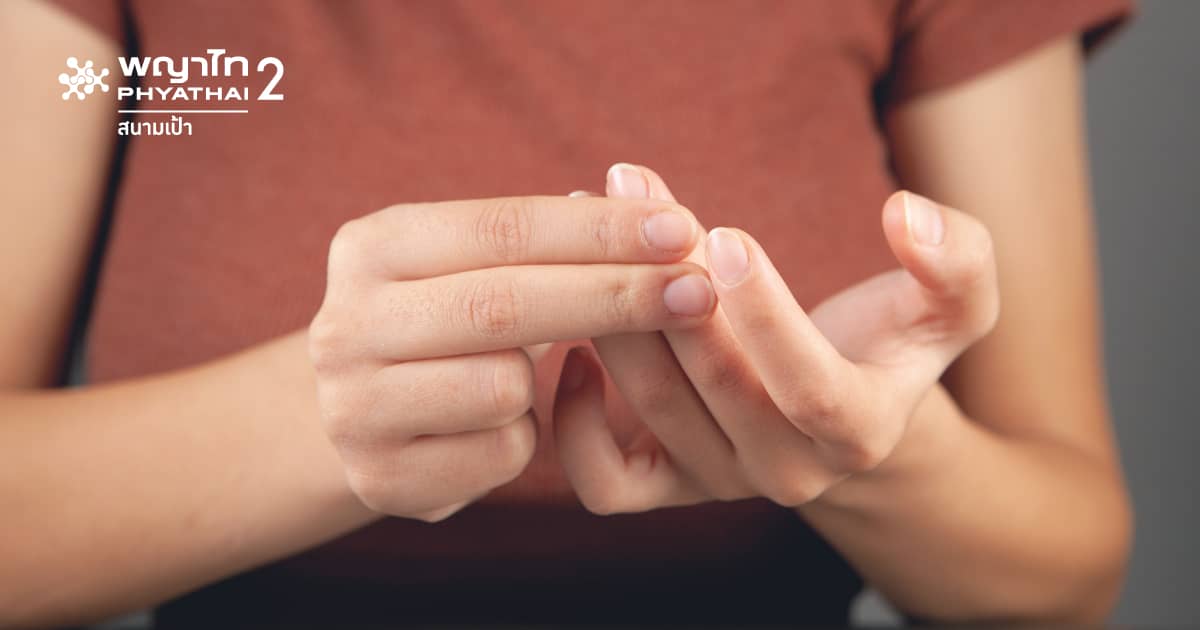
What is Trigger Finger?
Trigger Finger (Trigger Finger) or medically known as Stenosing Tenosynovitis is a condition where the finger tendon becomes inflamed, causing the finger movement to be rough. This results in the finger “getting stuck, bending, and then unable to straighten” or having a catching sensation as if something is locked.
This condition is commonly found in people who use their hands repetitively, such as typing on a computer, using a mobile phone, using tools, or housewives.
Symptoms of Trigger Finger
Patients usually start with mild symptoms, which may worsen if left untreated.
- Stiff finger, especially around the middle finger joint, accompanied by pain at the base of the finger
- A “clicking” sound or catching sensation when moving the finger
- Finger gets stuck bent and requires the other hand to push it straight
- In severe stages, the finger may lock permanently, either unable to straighten or unable to bend, and there may be bending of the middle finger joint with inability to fully straighten the middle joint
Causes of Trigger Finger
Trigger finger is caused by inflammation of the tendon sheath and tendon, making it difficult for the tendon to glide smoothly. Common risk factors include:
- Repetitive hand use such as typing, holding a phone, lifting objects
- Occupations that require hand strength such as technicians, vendors, office workers
- Women are more commonly affected than men
- Age 40 years and older
- Patients with chronic diseases such as diabetes or rheumatoid arthritis
How Many Stages of Trigger Finger Are There?
Dividing the stages helps to plan appropriate treatment.
Stage 1 Starts with pain but still able to move
Stage 2 Starts to have catching symptoms
Stage 3 Finger locks and requires assistance to push
Stage 4 Permanent finger lock, unable to bend or straighten the finger
Treatment for Trigger Finger
Treatment depends on the severity of the symptoms.
1. Non-surgical treatment suitable for early stages
- Rest the hand
- Take anti-inflammatory medication
- Self-physical therapy by trying to fully straighten the finger, especially the middle joint. Avoid pressing or massaging the painful area as it may increase inflammation
- Steroid injection to reduce inflammation
2. Surgical treatment for severe cases or when other treatments do not improve
- A minor surgery that takes a short time
- The doctor will open the narrowed tendon sheath to release it
- Helps the finger return to normal movement
- Quick recovery and good results
How to Prevent Trigger Finger
Although it is a common condition, it can be prevented.
- Avoid repetitive hand use for long periods
- Take breaks regularly, especially for people working in front of computers
- Stretch fingers and wrists regularly
- Adjust posture when using devices such as holding a mouse or phone
- Control underlying diseases such as diabetes
Frequently Asked Questions (FAQ)
Q1: Can trigger finger heal on its own?
A: In the early stage, it may improve if hand use is reduced and rested, but if symptoms worsen, you should see a doctor for treatment.
Q2: Is trigger finger dangerous?
A: It is not a serious disease, but if left untreated, it may cause permanent finger locking and stiffness of the middle finger joint, affecting daily life.
Q3: Does trigger finger require surgery?
A: Not necessarily for everyone. If treated early, it may heal without surgery.
Q4: Can using a mobile phone a lot cause trigger finger?
A: It is possible because it involves repetitive use of the finger tendons.
“Trigger finger” may start with mild symptoms such as finger stiffness or catching, but if left untreated for a long time, it may progress to permanent finger locking, significantly affecting daily life, especially in people who use their hands heavily or perform repetitive work regularly.
If you start to experience finger stiffness, difficulty bending and straightening, or a catching sensation when moving your finger, do not wait for it to worsen. It is recommended to see a specialist for evaluation to plan appropriate treatment from the early stage.
At Phyathai Hospital 2, care is provided by a team of orthopedic specialists with treatment approaches tailored to each patient, ranging from non-surgical treatment to minor surgery that helps restore normal finger function.
