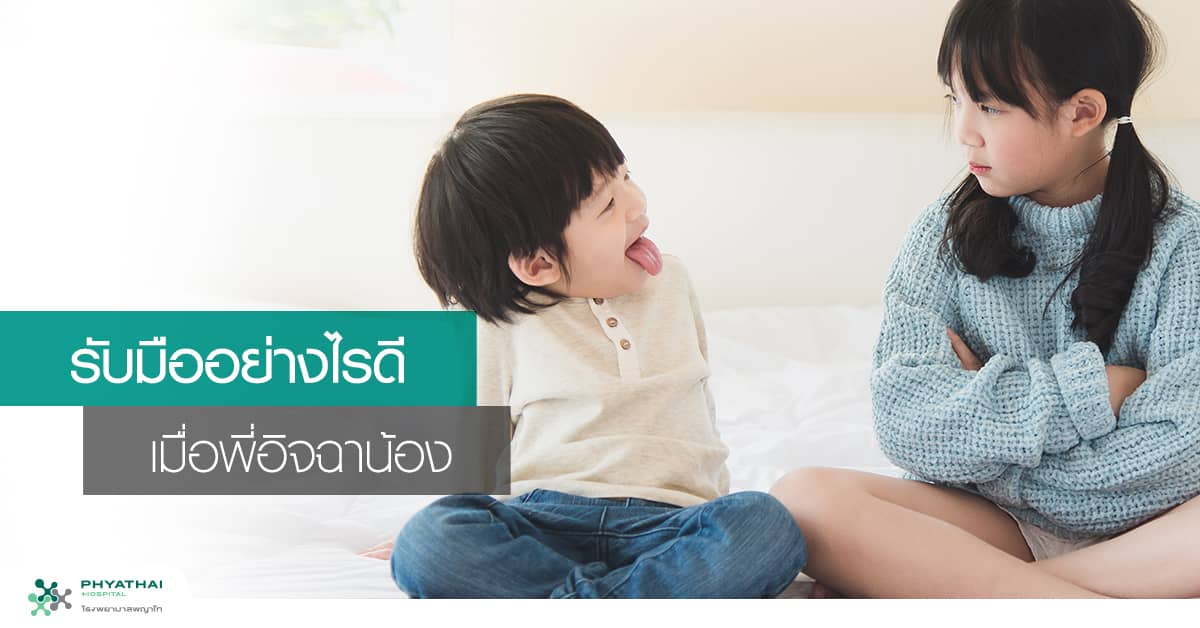
What is sibling jealousy? Why is it a problem for pregnant mothers?
Sibling jealousy behavior is a common behavior seen in older siblings when a new sibling arrives. It may manifest as regressive behavior, stubbornness, aggression, increased clinginess to caregivers, ignoring the younger sibling, saying they dislike the sibling or do not want a sibling, and eventually may include teasing the younger sibling. The reasons for these behaviors can be due to several factors as follows:
- Because the child feels they are about to lose a very special relationship. Most children are very close to their mother. Previously, the older sibling was the most important person to the mother, but when the mother has to care for the younger sibling, the older child feels they are losing this special relationship. However, if the older sibling has a good relationship with the father beforehand, it can help reduce this feeling.
- The age gap between the older and younger sibling. An age gap of about 2 years often causes the most problems because children at this age are still very attached to their mother. Having twins or an age gap of 3 years or more usually helps the older sibling adjust more easily.
- The older sibling’s temperament. Temperament is an innate personality trait that affects a child’s adjustment. Children with an easy temperament tend to adjust better than those with a difficult temperament or a slow-to-warm-up temperament.
- Adult management. If parents do not prepare the older sibling for the new baby or manage the situation improperly, it can increase the likelihood of the behaviors mentioned above.
How to cope when the older sibling is jealous during pregnancy
The way to prevent or ease the situation mainly depends on how the parents manage it. The important thing is to prepare the older sibling from the beginning by
- Talking to the older sibling only about the positive aspects of having a new sibling. No one should tease or make the older sibling feel uneasy about possibly losing importance when the new sibling arrives, such as saying, “When the baby comes, mom and dad won’t pay attention to you anymore” (said jokingly). Sometimes children cannot distinguish and may believe adults are telling the truth, which can cause jealousy.
- Giving the older sibling opportunities to interact. Talk to the baby while the mother is pregnant, or the mother can try holding a young child for the older sibling to see and observe their reaction, or invite the older sibling to play with the baby the mother is holding. This helps the older sibling gradually prepare emotionally. When parents buy things or set up the baby’s room, the older sibling should be involved in decision-making so they feel part of welcoming the new family member. Importantly, if the older sibling’s routine or living situation needs to change, such as changing caregivers, starting school, or changing sleeping arrangements, it should be done at least 2-3 months before the baby is born so the older sibling does not feel their life is changing because of the baby. If this is not possible, it is recommended to postpone changes until after the baby is born and the situation is stable, which usually takes about 2-3 months as well.
What if the older sibling is jealous while the mother is giving birth?
If the older sibling cannot go with the mother, inform them in advance who will take care of them during the mother’s delivery and give them a chance to see the baby, perhaps through photos or electronic media. If the older sibling can go with the parents, they should be given the opportunity to see and touch the baby so they feel involved from the start.
What to do when the mother and baby return home
If the older sibling does not go to pick up the mother and baby, remember to prioritize the older sibling first. When the mother enters the house, someone else may help carry the baby first because if the first image the older sibling sees after not seeing the mother for several days is the mother holding the baby, it may make the older sibling feel bad.
After that, when visitors come to the house, remember to give attention to the older sibling first because the older sibling was originally the first important person. Most people, when visiting or even when the father returns from work, tend to go to the baby first without realizing it. Therefore, the doctor recommends greeting the older sibling first and then letting them lead the way to the baby. If visitors bring gifts, it is good to inform them in advance to prepare a small gift to congratulate the older sibling on having a new sibling. If visitors do not prepare a gift, parents can prepare one themselves but secretly ask the visitors to give it to the older sibling first and let the older sibling be the one to bring it to the baby.
Additionally, the older sibling should be involved in caring for the baby. Allow the older sibling to hold, hug, and kiss the baby under parental supervision. Praise them when they behave well with the baby and point out good behaviors, for example, “You are so sweet for bringing milk to the baby. Look, the baby really likes it. Dad is very proud of you for helping take care of the baby.” Importantly, the older sibling should have private time with a familiar caregiver doing activities together for at least 20-30 minutes a day so they do not feel the baby is taking all their good time away.
If the older sibling can communicate well, parents may find a good time and atmosphere to ask how they feel about the new sibling. If the older sibling expresses dislike or does not want a sibling, do not scold them but give them a chance to explain why they feel that way and gradually find solutions. Importantly, do not force the older sibling to do things for the baby, such as saying, “You are the older sibling, so you must give to the baby,” because teaching in this way is coercive. The older sibling will give unwillingly and feel bad about giving. Therefore, good teaching about sharing should allow the older sibling to decide to give on their own and praise them when they do. This way, the older sibling will feel good about giving and want to give willingly in the future.
Even if parents prepare well, the older sibling may still show jealousy or possessiveness toward the parents sometimes. However, if parents manage the situation properly and appropriately, these behaviors usually do not last long and will eventually disappear. But if the behaviors last more than 2-3 months, worsen, or parents cannot manage them, it is recommended to consult a pediatrician specializing in development and behavior or a child psychiatrist for intervention. Leaving the situation untreated may cause the older sibling to develop stronger negative feelings toward the younger sibling, making it harder to resolve.
Understanding the feelings of the “older sibling” when losing a loved one
- Ages 0-2 years: At this age, children do not truly understand loss but can perceive changes in their surroundings, such as emotions, care, or disturbances, and sense the absence of the person who has left.
- Ages 3-5 years: Children begin to understand loss but think it is temporary and reversible. They often ask questions about the deceased, such as “When will dad come back?” “Is grandpa hungry?” “Will grandpa breathe after being buried?” Children at this age may link the cause of death directly to their own thoughts, for example, believing that because they did not drink milk as told by dad, dad died, or they may use imagination to explain death.
- Ages 6-8 years: Children start to understand that death is permanent and irreversible but may think it only happens to certain people, such as the elderly, disabled, or sick. They may associate death with their own safety, so adults should provide further explanations.
Appropriate coping by age group
- Ages 0-2 years: If the deceased was the primary caregiver, try to find someone to take over caregiving as quickly as possible. Do not delay or split the duties because consistency and stability are key for this age group. Try to maintain the same care routines as much as possible and avoid overindulging the child to compensate for the loss, as this can make adjustment harder.
- Ages 3-5 years: Since children at this age still think death is not permanent, they expect to maintain contact with the deceased, such as praying, writing letters, or talking to them, even if it is one-sided. Caregivers should explain honestly, for example, “Grandpa has died. His body no longer works. Grandpa cannot see, move, or hear anymore.” Avoid explaining about spirits or using phrases like “Grandpa is sleeping” or “Grandpa went to be with angels,” and avoid making heaven sound like a fun place, such as “Grandpa was taken by angels,” as this can confuse children. Children may ask repeated questions, so caregivers should be patient and answer honestly each time. As children grow, questions will decrease and understanding will improve.
- Ages 6-8 years: Although children at this age understand death better, they may have additional worries about their own safety. Adults should reassure them. For example, if a child with a single mother learns that a friend’s mother has died, they may worry a lot because they only have one mother. They may ask, “My friend’s mom died. Will my mom die too? If mom dies, who will take care of me?” Adults should answer honestly and not avoid the question with phrases like “Mom is fine, don’t worry” or “Mom is strong and won’t die easily,” as this does not ease the child’s worries and the questions will persist. Instead, answer directly, such as “Everyone will die someday, but most people live to be very old. If mom dies, you will have your aunt to take care of you until you grow up.” Children may also want to know what will happen to their life next, such as asking after a brother’s death, “Will I get his games?” Although adults may think this is an inappropriate question, for the child it is simply about understanding how their world will change. Sometimes children may ask many questions about death, so adults should answer honestly with calm emotions and provide hugs to make the child feel secure, warm, and safe. Avoiding answers makes the child feel the topic is forbidden but leaves them feeling insecure and may worsen their mental state.
Can the “older sibling” attend religious ceremonies?
Children should be allowed to attend religious ceremonies, possibly with someone they trust to care for them and answer questions honestly. Not allowing children, especially those over 4 years old, to attend can increase stress and anxiety and may cause them to imagine the ceremony as scarier than it really is.
And importantly! Do not tell children to endure, not to cry, or not to be sad, as this will cause them to suppress emotions and may lead to emotional or behavioral problems. Adults should allow children to express their emotions and feelings as they need and respond appropriately. Over time, children will gradually adjust.
Dr. Nattawan Charuworapolkul
Pediatrician specializing in child development and behavior
Child and Adolescent Health Center, Phyathai 3 Hospital
