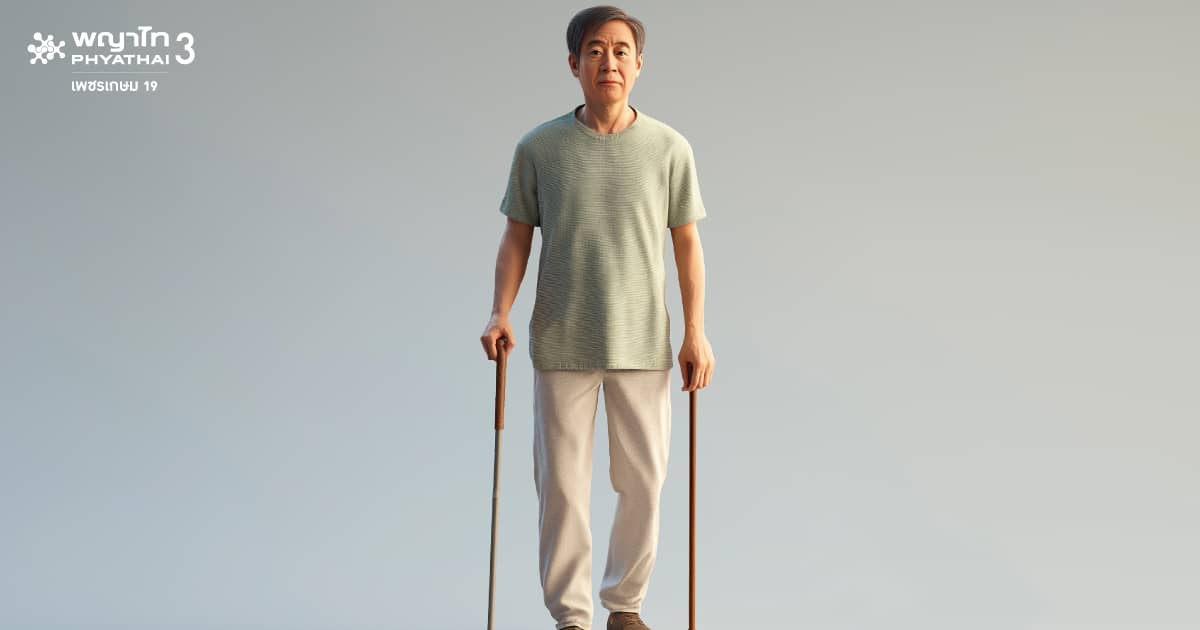
Although tremors can be caused by many reasons and are not always due to Parkinson’s disease, tremors caused by Parkinson’s are considered tremors that require close attention because they may eventually lead to dementia.
“Parents who fall often, suddenly falling while walking like this, may be a warning sign of Parkinson’s disease”
Tremors like this, what could be the causes?
When talking about tremors, most people usually think of “Parkinson’s” first because it is a common symptom, especially in the elderly. But in fact, tremors do not have only one cause. There are also tremors caused by
- Tremors… due to hyperthyroidism, but usually accompanied by palpitations, rapid heartbeat, unusual fatigue, and weight loss.
- Tremors… caused by certain medications such as bronchodilators or some anti-dizziness drugs.
- Tremors… of unknown cause, also called Essential Tremor, which is caused by abnormalities in the part of the brain that controls balance (Cerebellum), resulting in tremors. It is mostly hereditary, can occur from a young age, progresses slowly, and usually affects both hands. However! This type of tremor does not affect walking.
| Tremors… Unknown cause | Tremors… Due to Parkinson’s |
| Can occur at any age | Mostly found in the elderly |
| Caused by dysfunction of the part of the brain that controls balance (Cerebellum) | Caused by decreased dopamine in the brain |
| Both hands tremble, voice trembles, difficulty picking up objects, difficulty writing | Mostly tremors in one hand or may have no tremors at all |
| Does not affect movement, normal walking | Slow movement, difficulty walking, frequent falls |
| Disease progresses slowly | Disease progresses quickly, may lead to dementia |
What causes Parkinson’s?
Parkinson’s disease is caused by degeneration of nerve cells starting from the brainstem, leading to a decrease in the production of a substance called “dopamine,” resulting in abnormal body movements. It usually occurs in people aged 50-60 years and older.
Parkinson’s is not just tremors but also manifests as
One fact is that most patients come to consult doctors with difficulty walking, slower walking, stiff walking, feeling like walking on a mattress, and not walking as smoothly as before. “Some may have tremors in one hand or some may not have tremors at all.” Therefore, it is not just tremors but can also include symptoms such as
- Difficulty stepping, short steps, easy to fall
- Sleepwalking, frequent nightmares / insomnia
- Chronic constipation
- Soft voice, slower speech
- Including possible swallowing difficulties and frequent choking
How dangerous is Parkinson’s?
In the early stages, Parkinson’s may only affect daily life and increase the risk of accidents and frequent falls due to difficulty moving. However, if not properly treated, it may lead to dementia and inability to care for oneself in the future.
Is having a history of stroke increasing the risk of Parkinson’s?
One type of Parkinson’s disease is called Vascular Parkinsonism, which is Parkinson’s caused by ischemic or hemorrhagic stroke. It is mostly found in people with strokes in the central brain or near the brainstem, which directly controls movement. The danger of this type of Parkinson’s is that it does not respond well to Parkinson’s medications and must be treated together with stroke management.
If someone in the family has Parkinson’s, does it increase the risk?
The answer is yes, the risk increases because another type of Parkinson’s is called Familial Parkinsonism, which is Parkinson’s disease inherited genetically. If there is a family history of Parkinson’s, we may have a higher risk of developing it. However! It is important to emphasize that not everyone will get it; it depends on self-care as well.
Parkinson’s screening
In screening for this disease, neurologists start by taking medical history, examining symptoms, and performing neurological physical examinations. In some cases, brain MRI scans may be ordered to help clarify the diagnosis.
Can Parkinson’s be cured?
Because Parkinson’s is caused by degeneration of brain cells, it cannot be completely cured. However, it can be controlled and slowed down to maintain a good quality of life, especially if treatment is started early (Early Parkinsonism), which responds better to medication and has a Honeymoon Period allowing patients to live almost normally for 3-5 years. Currently, Parkinson’s medications have been improved and are available in various forms including oral, patches, and injections. These medications replace or balance dopamine levels in the brain.
Additionally, treatment can include deep brain stimulation (DBS) surgery, which involves implanting electrodes to stimulate parts of the brain directly related to Parkinson’s treatment.
If you don’t want to tremble from Parkinson’s, take care of yourself as follows
- Get enough rest and sleep well for at least 6-8 hours a day
- Avoid alcohol consumption and smoking
- Manage chronic diseases well and closely follow up with your doctor
- Exercise regularly
