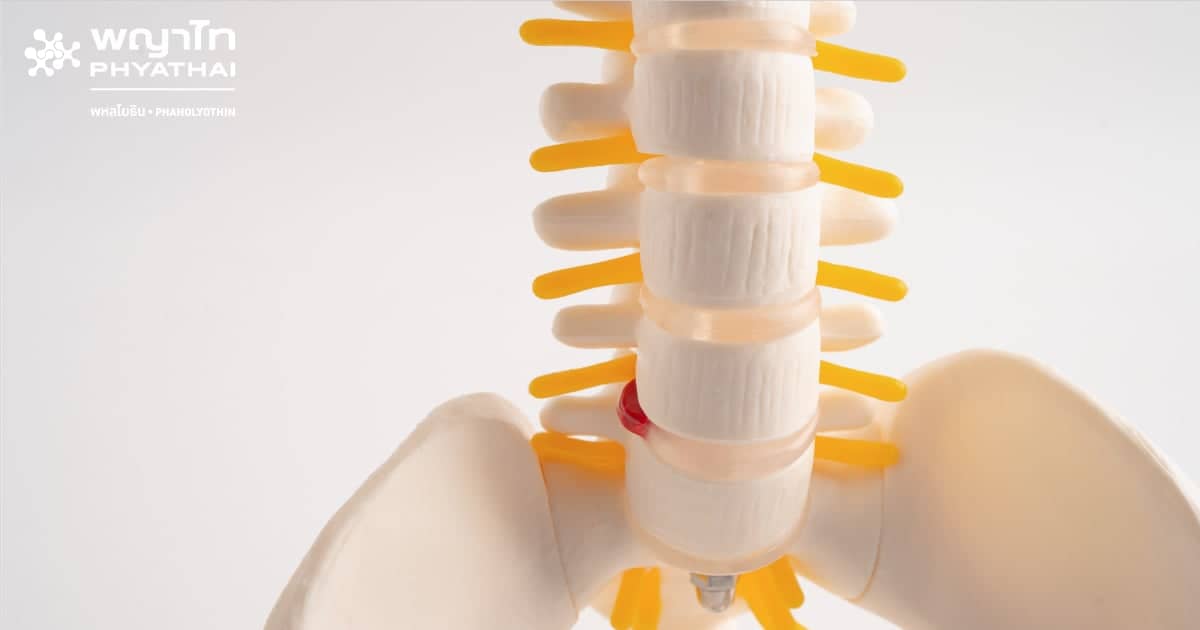
If you have chronic back pain, hip pain radiating down the leg, or neck pain radiating down the arm, along with numbness or weakness in the limbs that is not caused by general muscle pain, this may be a sign of a “herniated disc compressing the nerve.” This condition can result from various factors, including improper body use such as bending to lift heavy objects, sitting for long periods without changing posture, age-related spinal degeneration, accidents, or osteoarthritis causing spinal instability. If left untreated, this condition can severely affect the nervous system and movement, so it is important to get a diagnosis and receive appropriate treatment early.
What is a Herniated Disc Compressing the Nerve?
Herniated Disc is a condition where the spinal disc, which acts as a cushion to absorb shock and allows flexible movement of the spine, degenerates, ruptures, or bulges out of its normal position, pressing on nearby nerves within the spinal canal. This causes pain, numbness, or weakness along the nerve path being compressed. The symptoms can be treated in various ways depending on the type and severity.
Treatment of Herniated Disc Compressing the Nerve
Treatment usually starts with non-surgical methods such as pain medication, physical therapy, and behavioral adjustments, especially avoiding heavy lifting and moving the body correctly. The goal is to reduce pain and inflammation. In some cases, the herniated disc may shrink on its own, leading to symptom improvement without surgery.
If symptoms do not improve with these treatments or if the patient has severe symptoms at the first visit, such as significant muscle weakness or loss of bowel or bladder control, steroid injections or surgical treatment may be considered.
Current Surgical Technologies for Herniated Disc Compressing the Nerve
- Open Surgery is the traditional method requiring a large incision of about 6-10 cm, depending on the patient’s body type, such as the thickness of the back fat layer. The surgeon makes an incision in the middle of the back and uses special tools to retract muscles and bones to directly access the problematic disc. The part of the disc pressing on the nerve is then removed before closing the wound. This method results in a large wound due to muscle and bone dissection, so recovery is slower than other techniques.
- Minimally Invasive Surgery (MIS) uses an endoscopic camera inserted through a small incision of about 0.5-0.8 cm on the side or back of the body to reach the herniated disc pressing on the nerve without cutting muscles or healthy tissues. This reduces damage to surrounding tissues. After surgery, patients have only small wounds, less pain, and faster recovery.
Comparison of Characteristics of Each Herniated Disc Surgery Method
| Characteristic | Open Surgery
(Open Surgery) |
Minimally Invasive Surgery
(MIS) |
| Method Description | Large incision to directly access the herniated disc | Small incision using a camera to reach the problem area |
| Incision Size | Large wound, 6-10 cm | Small wound (0.5-0.8 cm) |
| Postoperative Pain | More painful than other methods | Less painful |
| Muscle and Tissue Damage | High | Low |
| Recovery Time | Slower recovery, longer time | Faster recovery, shorter time |
| Suitability | For severe symptoms, complex structures, or when other surgeries are not feasible | For moderate to mild symptoms |
| Accuracy | Accurate, direct access | Accurate |
| Complications | Higher risk | Lower risk |
What Should Be Considered When Choosing Surgical Technology?
Choosing the surgical technology for herniated disc disease should consider several factors such as symptom severity, patient’s physical condition, and risk of complications. These are evaluated by a specialist and based on imaging studies like MRI or CT scans. General guidelines are as follows:
- Open Surgery is suitable for patients with severe symptoms such as muscle weakness or bowel/bladder control problems, complex lesions, or when wide access is needed that other technologies cannot replace.
- Minimally Invasive Surgery (MIS) is suitable for patients with moderate to severe symptoms who do not yet require open surgery and want smaller scars or faster return to normal life due to quicker recovery.
How Long Does Recovery Take After Herniated Disc Surgery?
- Minimally Invasive Surgery: Recovery is fast within 1-2 weeks because the surgery precisely targets the problem area without extensive muscle cutting, resulting in only small wounds, less tissue damage, and better pain control after surgery. Most patients can walk soon after surgery.
- Open Surgery: Recovery takes the longest, generally about 4-6 weeks to return to normal life due to surrounding tissue damage, more pain, and longer healing time.
If you have back pain radiating down the leg or neck pain radiating down the arm, along with numbness and muscle weakness, these may be warning signs of a herniated disc compressing the nerve. Early diagnosis and proper treatment can significantly reduce the risk of complications. At Phyathai Phaholyothin Hospital, we have a specialized spine surgery team with advanced surgical technology providing comprehensive care in collaboration with multidisciplinary professionals. You can schedule a consultation with a doctor before deciding on the surgical method that best suits your symptoms and needs, helping you regain confidence in your life.
Assoc. Prof. (Special) Dr. Pornpavis Sripirom
Orthopedic Surgeon, Spine Specialist
Bone and Joint Institute
