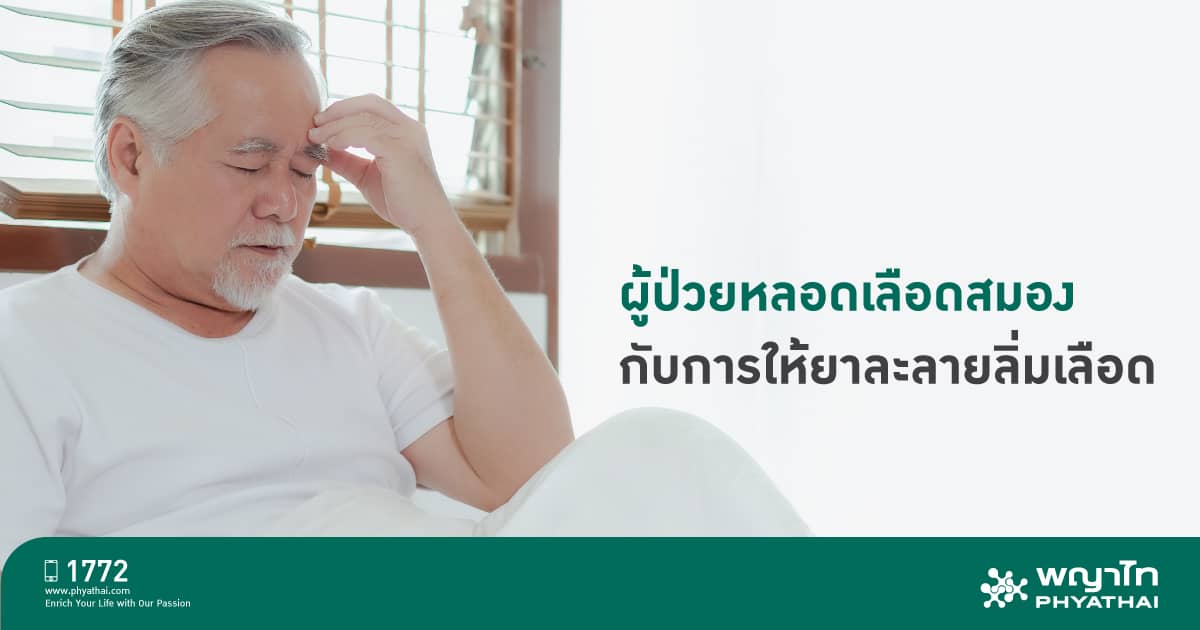
Stroke is a condition caused by loss of blood supply to the brain due to arterial obstruction preventing blood from flowing to the brain. As condition that can lead to paresis and paralysis, it is the number one cause of death and disability in the Thai population.
The Danger of Stroke
Stroke is divided into 2 types, namely, stenosis/occlusion and hemorrhagic stroke. Regardless of whether it is ischemic or hemorrhagic in nature, 10% of patients die within the first 1-2 weeks, and 30% of patients are at risk of developing disability due to brain damage and loss of oxygen and nutrients essential for maintaining living cells, similar to when trees that lack water and nutrients wilt and die. As a result, some patients have to be bedridden and cannot walk or they have to use equipment to assist themselves while walking.
Symptoms of Acute Ischemic Stroke or Occlusion
· Weakness in the limbs in half of the body or numbness in half of the body that occurs suddenly.
· Mouth or face contortions, loss of speech, inability to comprehend language, incoherent speech or unclear speech.
· Loss of vision in one eye or able to see only half of the field of view or double vision.
· Dizziness, vertigo, swaying and loss of balance similar to being drunk.
These symptoms occur suddenly and acutely without warning signs, so patients will not know about them in advance.
4.5 hours are the golden time for saving lives
and for antithrombolytic therapy for acute ischemic stroke.
As you know, the brain is an important organ. When an abnormality occurs as a result of arterial obstruction, urgent treatment is required to open the arteries and allow blood to recirculate to the brain suffering from the ischemic stroke as soon as possible. That is, the obstruction has to be cleared before brain cells die, which is within 4.5 hours, in order to allow brain cells to return to normal function by as much as possible.
One of the treatment methods for this condition is to administer clot busting medicine intravenously. Doctors use this technique to treat acute ischemic stroke patients who have no contraindications for the drug.
A study by the Brain and Neurological Center of Phyathai 2 Hospital found that administering clot busting medicine intravenously can cause complications but that 31-50% of patients who receive the drug experienced improved symptoms within 24 hours and will almost return to normal within 3 months. On the other hand, in patients who are not administered the drug, only 20-30% of patients experienced an improvement in their symptoms.
How can you reduce risk for stroke-related complications?
Studies found that patients have a risk of developing complications. However, appropriate patient screening can contribute to a reduction in complications. For example, in cases where there is cerebral hemorrhaging, the patient might require surgery in order to drain blood from the brain or other bleeding in various parts of the body, such as the digestive system and subcutaneously, in addition to being considered for drug allergies. In any case, doctors will choose the safest and most effective methods.
How is clot busting medicine administered in stroke patients?
Not every stroke patient is administered a clot busting medicine. This is because the drug has some disadvantages that can cause it to be difficult for bleeding to stop. Therefore, whether or not the drug is administered depends on the decision of the treating doctors. However, the drug has to be administered carefully, by which doctors require about 60 minutes to administer it. Then the patient requires close treatment and symptom monitoring in the intensive care unit.
For patients who are administered a clot busting medicine, they need to have the specified symptoms, which are calculated according to an international standard known as the N1H Stroke Scale. If the drug is administered later than it should, there is risk that the patient will experience disability. Therefore, before administering the drug, doctors have to know clearly the patient’s symptoms and thoroughly review the patient’s history. The patient also has to be sent to perform a CT scan. If there are no signs of hemorrhaging or no changes in brain imagery, the patient can be administered the clot busting medicine. However, the patient must have no prior history of drug allergies or contraindications for clot busting medicine.
What are the treatment options for cases where drug is not administered within 4.5 hours?
In cases where the patient arrives to the doctor later than 4.5 hours after onset of symptoms, if the patient has only minor paralysis or paresis, treatment can still be administered on time. On the other hand, for patients with severe symptoms and major brain damage and ischemic penumbra, although they can still recover after receiving good treatment, their recovery might be slow or poor.
In any case, whenever there are warning signs of stroke, you should quickly bring the patient to the hospital in order to see a doctor. Phyathai 2 Hospital can be contacted for emergency ambulance services through our 24-hour hotline by dialing 1772.
