Because accidents can happen anytime, be prepared to save lives immediately
During travel festivals or long holidays, many people often travel long distances by car, motorcycle, or airplane. However, what no one wants to happen is a “travel accident,” which can range from minor injuries such as abrasions and bruises to severe conditions like fractures, heavy bleeding, or unconsciousness.
Knowing basic first aid (First Aid) is therefore important because “proper assistance in the first minute” can reduce the severity of injuries and increase the chance of survival.
Steps for Basic First Aid When an Accident Occurs
1. Assess the safety of the area before providing assistance Do not rush to the injured person immediately, especially in risky areas such as roads with passing vehicles or places with exposed electrical wires, oil spills, or fallen objects. Make sure it is “safe for both the helper and the injured person” before approaching.
2. Check pulse, breathing, and responsiveness Call the injured person’s name or gently tap their shoulder. If there is no response, check if they are breathing.
- If not breathing start CPR (cardiopulmonary resuscitation) and call 1669 (emergency hotline) immediately
- If still breathing position the person to lie still with the head straight, avoiding excessive movement, especially of the neck and back
3. Do not move the injured person unless necessary except in cases of danger such as unsafe areas or risk of fire, explosion, etc. If a fracture or spinal injury is suspected, wait for rescue personnel or medical professionals to assist.
4. Do not immediately clean wounds with alcohol For abrasions or open wounds, rinse with clean water or saline solution (Normal Saline) and gently pat dry with a clean cloth. Then cover the wound with gauze to prevent infection. Do not apply alcohol or concentrated iodine directly on fresh wounds as it may irritate tissue and delay healing.
5. If there is heavy bleeding, apply pressure immediately Use a clean cloth or gauze to press directly on the bleeding area. Do not frequently lift the cloth as it may cause continuous bleeding. If bleeding does not stop, apply another layer of cloth on top without removing the original one.
6. If unconscious but still breathing position the person in the Recovery Position, which is lying on the side with the head slightly tilted back to open the airway and prevent choking.
First Aid for Muscle and Bone Injuries Using the R.I.C.E Principle
Muscle and bone injuries such as sprained ankles, muscle strains, or bruises are very common, especially during sports or daily activities. Proper first aid from the start can help reduce swelling, pain, and prevent possible complications. One of the commonly used first aid methods is the R.I.C.E. principle, which consists of 4 simple steps as follows:
- R – Rest (rest) Stop using the injured area immediately to reduce impact or pressure that may worsen the injury.
- I – Ice (cold compress) Apply a cold compress with ice wrapped in cloth or cold gel to the injured area for 15–20 minutes per session to reduce swelling, inflammation, and relieve pain, especially within the first 24–48 hours.
- C – Compression (compression) Use an elastic bandage to wrap the injured area loosely to help control swelling. Do not wrap too tightly as it may restrict blood circulation.
- E – Elevation (elevation) Raise the injured limb above heart level, such as placing the leg on a pillow, to help blood flow back and reduce swelling faster.
First Aid for Chemical or Smoke Dust in the Eyes
If this happens during travel (e.g., foreign objects from the vehicle in front splashing into the eyes or in a fire area), immediately rinse the eyes with clean water or saline solution (Normal Saline) by letting the water flow continuously over the eyes for at least 15-20 minutes. Do not rub the eyes under any circumstances. If pain or irritation persists, seek medical attention immediately.
How to Call Emergency Services (1669) Effectively
Provide complete important information Emphasize what should be reported to the operator for quick response, including
- Phone number of the caller with a callback number
- Location of the incident Provide the most precise details such as street name, kilometer marker, and important landmarks
- Type of accident and number of injured persons e.g., car crash, how many injured
- Prominent symptoms of the injured e.g., unconsciousness, heavy bleeding, deformed limbs
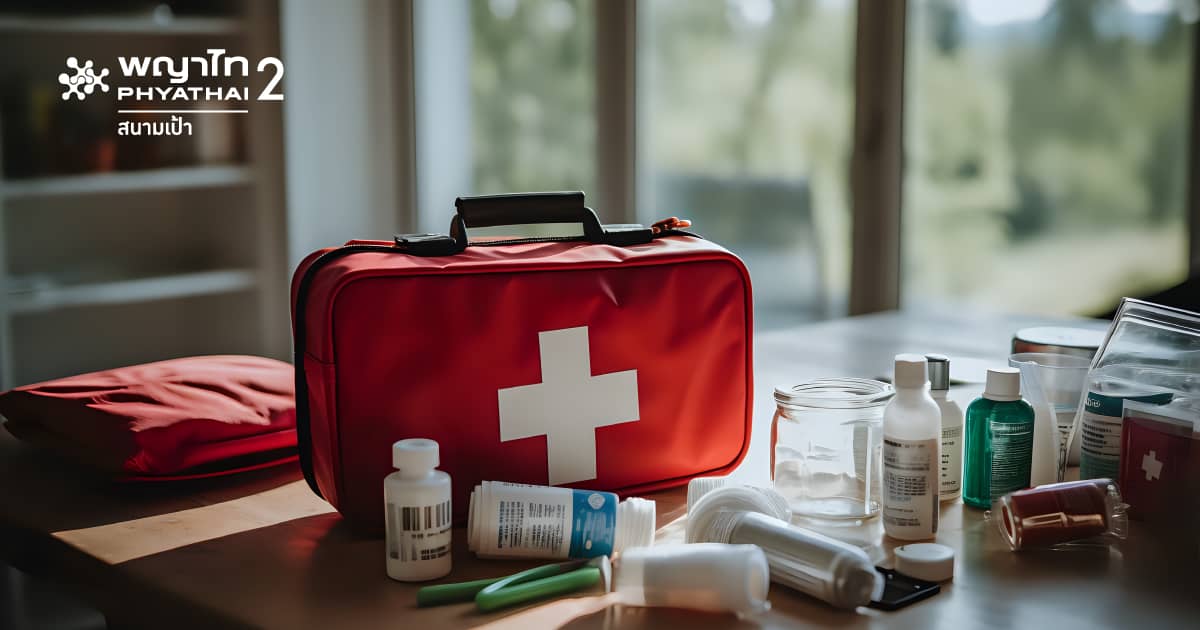
Essential Items to Have in a Car First Aid Kit
- Gauze pads / adhesive bandages
- Triangular bandage / elastic bandage
- Saline solution for wound cleaning (Normal Saline)
- Disposable rubber gloves
- Scissors / medical adhesive tape
- Pain relievers and fever reducers (Paracetamol)
- Emergency phone numbers (1669, nearby hospitals)
- Power bank for mobile phones
Immediately Take to Hospital If You Observe These Symptoms
- Unconscious, not breathing, weak pulse
- Heavy bleeding that cannot be stopped by pressure
- Chest pain, difficulty breathing
- Deformed bones or deep open wounds
- Severe headache, persistent vomiting, suspected brain bleeding
- Snake or venomous insect bites
- Burns or scalds over a large area
Safety First… Do Not Be Careless While Traveling
Although we cannot control all accident events, we can “reduce the severity of the outcomes” by being prepared. Don’t forget to check your vehicle’s condition before traveling, get enough rest, and if an emergency occurs, call 1669 or take the injured to the nearest hospital immediately.
If injured in an accident or suspect a fracture, sprain, or bruise, you can get examined and treated at Phyathai Hospital 2 by a specialized orthopedic and emergency medicine team, with ambulance service available 24 hours a day.
