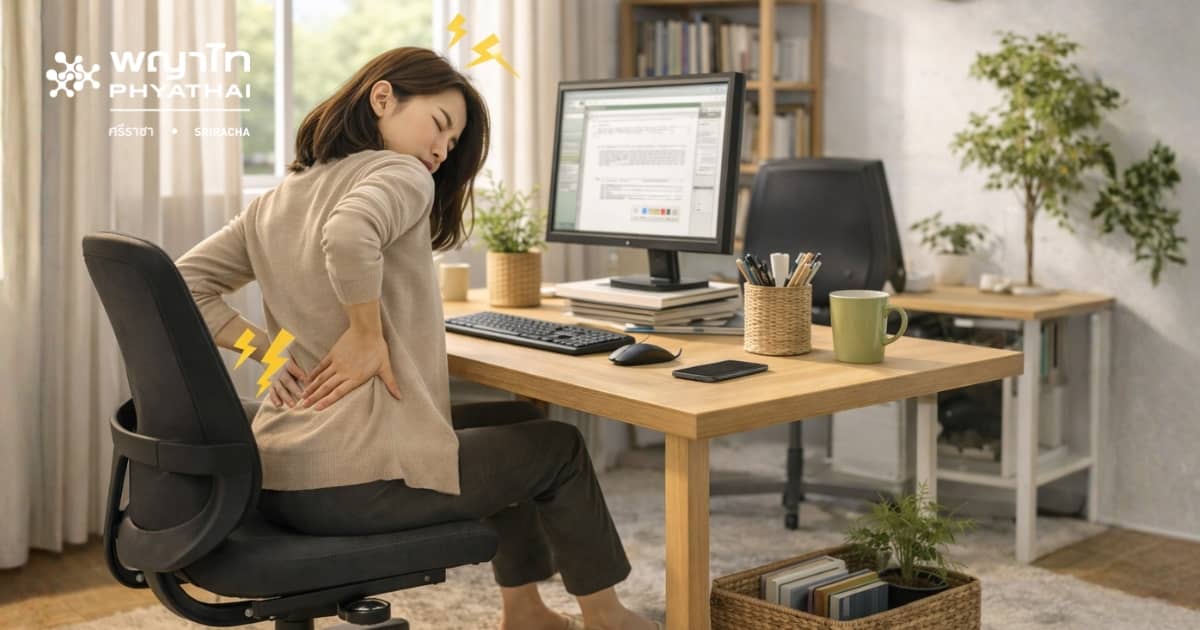
Many working-age people think that back pain is normal because of sitting for long periods, heavy work, or little rest. However, in reality, back pain may gradually accumulate from small repeated behaviors every day without realizing it, such as sitting in the same position for too long, slouching, lifting objects incorrectly, or using a desk that is not suitable for the body.
Health agencies state that back pain can result from structural or mechanical problems of the spine, intervertebral discs, muscles, ligaments, and surrounding tissues. Behaviors that cause the body to stay in repetitive or overly stressful postures are also factors that can cause or worsen chronic back pain.
This article will help you check which behaviors are “harming your back” and how to adjust your sitting posture correctly to prevent office syndrome and back pain.
Why do working-age people often experience back pain?
Working in front of a computer for many hours a day causes the body to stay in the same position for too long, especially improper sitting postures, which may increase pressure on the lower back, back muscles, and various joints. Ergonomic studies also indicate that sitting still for long periods and limited posture changes may be associated with lower back discomfort and increase the risk of back pain in workers.
Additionally, if the desk, chair, computer screen, or keyboard is not arranged to fit the body, the body may compensate with unnatural postures such as raised shoulders, forward head, slouched back, or repeatedly twisting the waist to one side, all of which increase the workload on muscles and spinal alignment.
7 “Back-Harming” Behaviors That Working-Age People Often Do Unknowingly
- 1) Sitting for too long without changing posture
- 2) Slouching, forward head, rounded shoulders
- 3) Sitting without full buttocks contact or leaning too far forward
- 4) Using chairs and desks that do not fit the body
- 5) Sitting cross-legged or twisting repeatedly for long periods
- 6) Lifting heavy objects with a bent back
What type of back pain should not be ignored?
Some types of back pain require urgent medical attention, especially when accompanied by the following symptoms:
- Increasingly severe back pain
- Pain radiating down the leg, numbness, or weakness
- Fever, weight loss, or other illness symptoms
- Back pain after an accident
- Pain lasting several weeks without improvement
- Problems controlling urination or bowel movements
Health agencies recommend that if back pain does not improve, behavior adjustments do not help, or if there is chronic pain, radiating pain, numbness, or interference with daily life, you should consult a doctor for proper evaluation. Accurate diagnosis helps ensure correct treatment and reduces the chance of chronic symptoms in the future.
FAQ Frequently Asked Questions
Q: Is back pain from sitting and working for long periods dangerous?
A: If it is only mild stiffness or soreness, it may be related to prolonged sitting and improper posture. However, if the pain is frequent, lasts long, radiates down the leg, or is accompanied by numbness and weakness, you should see a doctor for further examination.
Q: What is the correct sitting posture for work?
A: You should sit with your back supported by a backrest, feet flat on the floor, knees level with hips, elbows bent about 90 degrees, shoulders relaxed, and the screen at eye level or slightly lower.
Q: Can I still have back pain even if I sit on a good chair?
A: Yes, because even with a good chair, sitting in the same position for too long without moving or having a screen and desk that do not fit the body can still cause back pain.
Q: How often should I get up from the desk to prevent back pain?
A: There is no single number suitable for everyone, but the key is not to sit still for too long continuously. You should get up to change posture, walk, or stretch periodically throughout the day to help reduce muscle stiffness and lower back discomfort.
Q: What type of back pain requires urgent medical attention?
A: If the pain worsens progressively, radiates down the leg, causes numbness, weakness, fever, weight loss, occurs after an accident, or causes problems controlling urination and bowel movements, you should see a doctor immediately.
