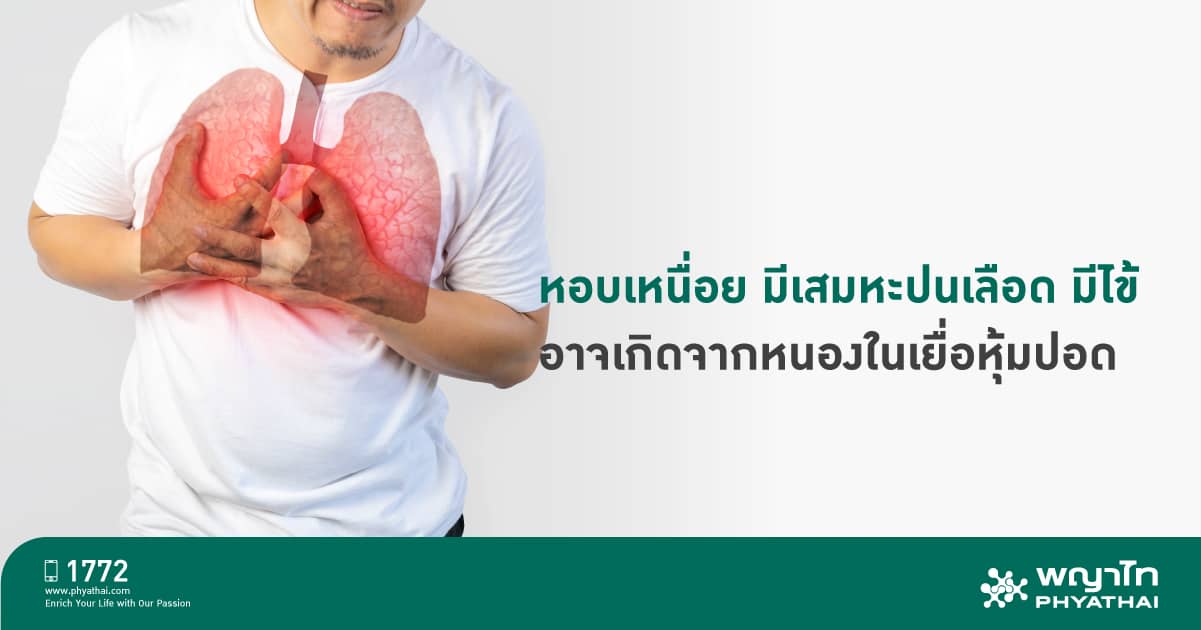
Symptoms of shortness of breath, fatigue, sputum mixed with blood, pus, and fever—did you know that these may be symptoms of “Empyema”?
What causes empyema?
“Empyema” is a condition where the body sends warning signals that we are ill. The pleural cavity is the space between the two layers of the pleura surrounding the lungs, containing a small amount of lubricating fluid.
In some people, abnormalities such as pus or blood may cause irritation or inflammation of the pleura, resulting in symptoms like shortness of breath, fatigue, or high fever. The cause of empyema usually follows pneumonia infection. It can occur in healthy individuals without underlying diseases as well as in patients with other chronic conditions such as diabetes, hypertension, or immunodeficiency.
Assoc. Prof. Dr. Sira Laothai, a thoracic surgery specialist in lung diseases at Phyathai 1 Hospital, said
“The most important symptoms of empyema are that patients often start with high fever and chest tightness, progressing to shortness of breath. Some may have severe coughing or cough up pus or sputum mixed with blood.”
Diagnosis of empyema
Diagnosis requires thoracentesis to examine the fluid characteristics and differentiate whether the patient has cancer with pleural effusion or tuberculosis. These two conditions can be detected by testing for tuberculosis bacteria (PCR for TB) and cancer cells (Cytology).
Treatment
Treatment of empyema depends on the disease stage. In the early stage, doctors will insert a tube to drain the pus. If the pus is fully drained and the patient’s condition improves, surgery is not necessary. Antibiotics must be administered for at least 2-4 weeks. If symptoms do not improve after completing antibiotics, or chest X-rays still show pus in the pleural cavity, or if multiple pus locations are found, it indicates the disease is in stage 2 or 3, requiring surgery (Decortication). In the past, this was done through open surgery, which involved a large incision and sometimes rib removal to fully drain the pus and remove infected pleura.
Nowadays, with improved technology, this condition can be treated with video-assisted thoracoscopic surgery (VATS). This minimally invasive surgery involves only small incisions about 3 centimeters long. The surgeon must be highly skilled in using the instruments and performing the procedure. The results are comparable to open surgery but with fewer complications and shorter hospital stays.
Assoc. Prof. Dr. Sira Laothai
Thoracic surgery specialist in lung diseases
For more information, please contact
Center for Vascular Radiology and Interventional Radiology
Phyathai 1 Hospital
Building 1, 2nd Floor
Tel. 02-201-4600 or 1772
