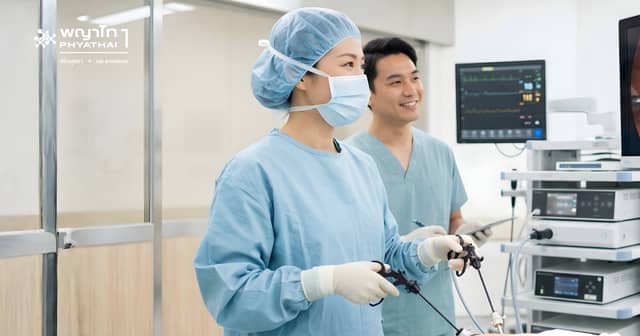
Illnesses caused by abnormalities of internal organs in the chest or abdomen in many diseases require surgical treatment. In the past, surgery for diseases in the chest or abdominal cavity was performed by open surgery, which affected adjacent organs. Patients lost a lot of blood, had a high risk of disease or complications, and left large scars that were painful and unsightly. Recovery in the hospital also took several days or weeks.
Small Incisions, Less Pain, Enhanced Treatment Efficiency
Currently, there is innovative surgery that results in small incisions, less pain, shorter recovery time, reduced risk of infection and complications, minimal impact on adjacent organs, and better treatment outcomes than open abdominal surgery. This is called minimally invasive surgery (Minimally Invasive Surgery – MIS).
In this type of surgery, the doctor makes three small holes about 0.5 cm in size and one hole about 1 cm at the abdomen near the navel or depending on the organ to be operated on, to insert a camera and instruments through the abdominal wall. The surgeon views the organ to be treated or operated on through a monitor, which magnifies and clearly shows the area, allowing for high precision. This surgery can be performed for many diseases, including gallstones, appendicitis, hernias, diseases related to the large intestine, stomach, or specific diseases in women such as chocolate cysts, tumors in the ovaries and uterus, with good results.
Laparoscopic Surgery for Gallstones (Laparoscopic Cholecystectomy)
After making the incisions and inserting the instruments into the abdominal cavity, the doctor will dissect the gallbladder from the liver, place it in a specially designed bag, and remove it through the incision near the navel. The doctor uses clips to stop bleeding instead of sutures. After confirming that all steps of the surgery are completed successfully, the doctor removes all instruments and closes the skin incisions neatly. The wounds are therefore small and cause less pain.
Laparoscopic Surgery for Appendicitis (Laparoscopic Appendectomy)
The doctor inserts surgical instruments through the incisions and removes the appendix using the camera for guidance. However, if the doctor finds that the appendix has ruptured or there is inflammation of the peritoneum caused by infection, it may be necessary to switch to open abdominal surgery.
The decision to use laparoscopic surgery depends on the severity and risk, assessed based on the individual patient’s health condition.
Laparoscopic Hernia Repair (Laparoscopic Herniorrhaphy)
Laparoscopic hernia repair can be done in two ways: through the pre-peritoneal layer or entering the abdominal cavity. The patient will have small incisions approximately 1.5 cm for one incision and 0.5 cm for two incisions. The doctor pulls the hernia sac back into the abdominal cavity and places a synthetic mesh to cover the area, secured with metal tacks. This surgery causes less tissue disturbance, reduces the chance of abdominal adhesions, less postoperative pain, fewer complications, lowers recurrence rates, and can repair all types of inguinal hernias on the same side in a single surgery. Hospital recovery takes only 1-2 days, and some patients can go home immediately after recovery. Within one week, patients can resume normal activities, and if there is no wound pain within 2-4 weeks, they can engage in heavy exercise or sports.
Laparoscopic Surgery for Colon Tumors (Laparoscopic Colectomy)
The doctor performs surgery through small incisions in the abdomen, inserting a small video camera through one incision and other surgical instruments through other incisions. The colon with the tumor is then removed while viewing the monitor. After removing the colon and tumor completely, the doctor will sew the remaining parts of the colon together, or connect the remaining colon to an opening in the abdomen, or connect the small intestine to the anus, depending on how much healthy colon remains, to ensure the best quality of life for the patient.
Laparoscopic Surgery for Abdominal Adhesions (Laparoscopic Lysis Adhesion)
Abdominal adhesions often result from injury to the peritoneum, which may be caused by surgery such as uterine surgery, anal surgery, or trauma. When there is an abdominal wound, the body undergoes changes that cause adhesions in strands or sheets, causing the intestines or internal organs to stick together, such as intestines sticking to the abdominal wall, fallopian tubes sticking to the intestines, or liver sticking to the diaphragm. This can cause pain. When pain is severe or there is inflammation of the organs affected by adhesions, or bowel obstruction or fallopian tube obstruction in women occurs, surgery to remove the adhesions is necessary. Laparoscopic surgery is an option that allows for small incisions, less pain, reduced risk of infection, and faster recovery.
Laparoscopic Surgery for Stomach (Laparoscopic Gastrectomy)
Surgery for stomach cancer, stomach ulcers, or perforated stomach depends on the severity of the disease and the patient’s condition. The surgery may involve partial or total removal of the stomach. If total removal is necessary, the doctor will connect the esophagus directly to the small intestine so the patient can eat normally. Laparoscopic surgery helps reduce the risk of complications, causes less impact on adjacent organs, allows faster recovery, and avoids large scars like open abdominal surgery.
Advantages of Laparoscopic Surgery
- Small incisions of only 1-2 cm, whereas open surgery has incisions 12-20 cm wide, reducing the size of scars from open abdominal surgery.
- Reduces injury to tissues and internal organs, resulting in less pain, less swelling, and less blood loss.
- Reduces the occurrence of complications and other associated diseases, safer than open abdominal surgery.
- Hospital recovery time is only 1-2 days; in some cases, patients can go home immediately after surgery, which is faster than open surgery that requires weeks of recovery.
- Doctors can see detailed views of the surgical site clearly with the camera’s magnification, allowing precise surgery and reducing impact on other organs.
- Reduces the formation of abdominal adhesions compared to open surgery.
Limitations of Laparoscopic Surgery
- Relatively high cost due to the need for special equipment.
- Not suitable for some patients, such as those with severe lung and heart diseases or those who have had previous surgeries with extensive abdominal adhesions.
